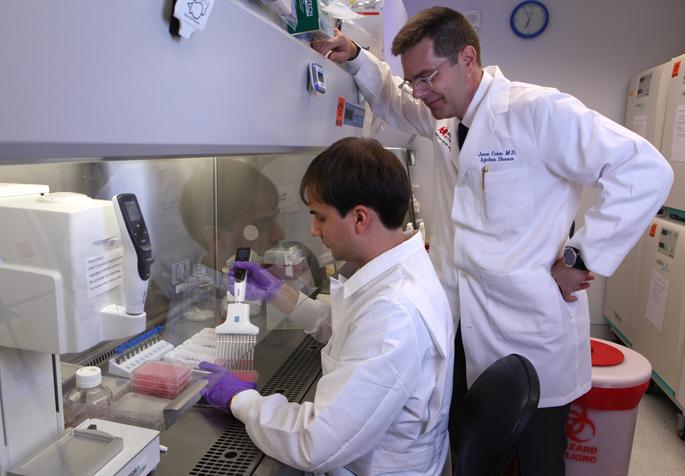
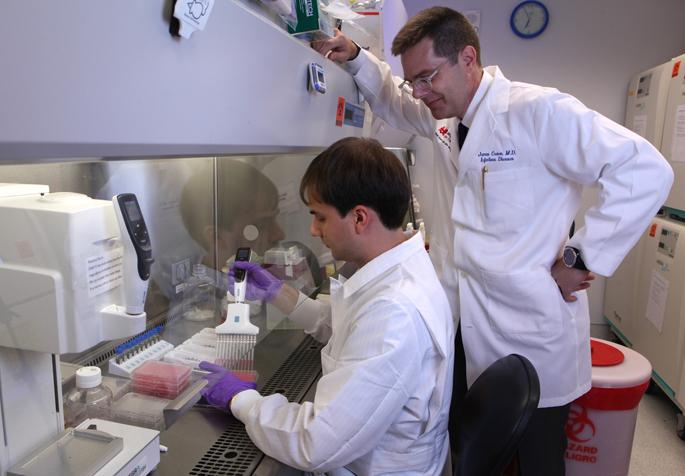
IMAGE: James Crowe, M.D., director of the Vanderbilt Vaccine Center, watches graduate student Andrew Flyak plate antibody-producing B cells from people in Africa who have survived infection by the Ebola virus….
Credit: Photo courtesy of Vanderbilt University Medical Center
There may be a "silver bullet" for Ebola, a family of hemorrhagic viruses, one of which has killed more than 11,000 people in West Africa in the past two years.
Researchers at Vanderbilt University Medical Center and the University of Texas Medical Branch in Galveston (UTMB) reported today in the journal Cell that they have isolated human monoclonal antibodies from Ebola survivors which can neutralize multiple species of the virus.
"We thought we would need five different sets of vaccines or five different (drugs)," said James Crowe Jr., M.D., the Ann Scott Carrell Professor and director of the Vanderbilt Vaccine Center, who led Vanderbilt's end of the research.
"This work suggests there are common elements across different groups of Ebola viruses," Crowe said. "Maybe we can come up with one therapeutic or one vaccine that would solve all of them."
"In this study, a remarkably diverse array of virus-specific antibodies was isolated, which appeared to bind to various parts of the envelope protein of the virus," said UTMB professor Alexander Bukreyev, Ph.D., corresponding author of the paper with Crowe who led the UTMB team.
"Some of the antibodies neutralized not only Ebola Bundibugyo virus, but also Ebola Sudan virus and Ebola Zaire virus, similar to that which caused the recent outbreak in West Africa," Bukreyev said.
Ebola virus disease is spread by contact with contaminated body fluids, including blood and semen. It can cause massive bleeding. The death rate is about 50 percent.
The World Health Organization has reported 24 Ebola outbreaks since 1976, the largest of which is thought to have begun in Guinea in December 2013. Of the 28,600 people who had been infected as of this month, 40 percent have died.
Several experimental Ebola vaccines and monoclonal antibody therapies currently are in development.
Monoclonal antibodies are generated by clones of a type of white blood cell that have been fused to myeloma (cancer) cells to form fast-growing "hybridomas." Like heat-seeking missiles, they seek out and destroy their targets, in this case, the Ebola virus.
Unlike vaccines, antibody treatments are meant to provide short-term protection to health care workers and others at risk of exposure. They also could be used as antiviral drugs to treat patients who are already infected with Ebola virus.
Last week, researchers at Albert Einstein College of Medicine in New York reported that "bispecific" monoclonal antibodies they engineered to recognize two species of Ebola virus provided a high degree of protection in mice exposed to two Ebola viral species.
In the current study, Vanderbilt researchers led by graduate student Andrew Flyak, the paper's first author, used a high-efficiency method they developed to quickly isolate and generate large quantities of monoclonal human antibodies from the blood of survivors of a 2007 outbreak in Uganda who were infected by the Bundibugyo ebolavirus.
Components of the study, which require work with live viruses, were performed by Bukreyev's team at the Galveston National Laboratory at UTMB, which has biosafety facilities capable of handling Ebolaviruses safely.
In addition to neutralizing multiple Ebolavirus species, one of the antibodies also protected guinea pigs from a lethal challenge of virus.
Previous therapeutics used re-engineered mouse antibodies. "This work points the way to using fully human antibodies as the next generation of antibody therapeutics," Crowe said.
"From the human antibody work … and the vaccine work that's being done, it's clear we can find a protective strategy for Ebola," he said. "That's a big step forward."
###
The research was supported in part by three grants from the National Institute of Allergy and Infectious Diseases of the National Institutes of Health – grants AI109711, AI109762 and AI067927 – and by a Defense Threat Reduction Agency award, HDTRA1-13-1-0034.
Media Contact
Craig Boerner
[email protected]
615-322-4747
http://www.mc.vanderbilt.edu/npa