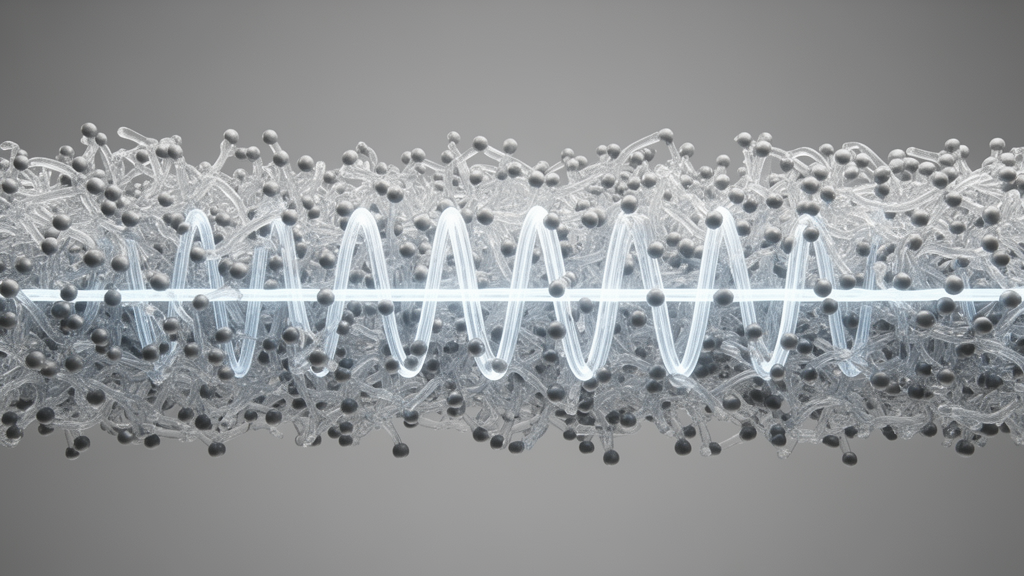
A post-fabrication shock wave treatment significantly enhances the room-temperature ionic conductivity of a polymer blend electrolyte membrane, according to an experimental investigation published in Ionics. Researchers synthesized nanocomposite polymer electrolyte films based on a blend of poly(vinyl acetate) and poly(ethyl methacrylate) complexed with lithium perchlorate salt. The membranes incorporated titanium dioxide nanoparticles across weight fractions ranging from 0 to 10 weight percent to explore solid alternatives to volatile liquid electrolytes in energy storage devices.
Solid polymer electrolytes present a leakage-free design for lithium battery applications, yet their widespread implementation has frequently faced ambient ionic transport limitations. To address these operational constraints, the investigators utilized a standard solution casting technique to prepare dry polymer electrolyte matrices. Combining complementary host polymers aimed to tailor the resulting thermal, mechanical, and electrochemical characteristics of the composite frameworks.
The synthesized nanocomposite films were evaluated using Fourier Transform Infrared spectroscopy, X-ray diffraction, Scanning Electron Microscopy, and Differential Scanning Calorimetry. Spectroscopic analysis confirmed successful intermolecular interactions and complexation between the lithium perchlorate salt and the host polymer framework. Furthermore, diffraction patterns verified that the titanium dioxide nanofillers achieved homogeneous dispersion throughout a predominantly amorphous matrix structure.
Scanning electron micrographs showed that the un-shocked baseline film featured a dense, smooth surface morphology characterized by minimal superficial micro-porosity. Under these pristine conditions, the sample containing 10 weight percent titanium dioxide exhibited a baseline room-temperature ionic conductivity of 6.74 × 10⁻⁸ Siemens per centimeter.
To overcome transport barriers in the solid matrix, the authors subjected the optimized 10 weight percent titanium dioxide membrane to high-energy post-fabrication shock wave treatment. Post-shock scanning electron microscopy demonstrated substantial architectural reorganization across the material. The processed membrane developed an extensive micro-porous architecture displaying a well-defined, interconnected porous network throughout the composite film.
Electrochemical Impedance Spectroscopy conducted at 303 Kelvin demonstrated marked improvements in ionic transport following shock wave processing. The room-temperature ionic conductivity increased by approximately 3.27 orders of magnitude, representing an estimated 1,860-fold enhancement over the pristine baseline. This post-treatment measurement reached a value of 1.26 × 10⁻⁴ Siemens per centimeter in the optimized membrane.
Thermal characterization via Differential Scanning Calorimetry established strong operational resilience in the dry blended system. The electrolyte framework maintained operational integrity across elevated temperatures, demonstrating a thermal decomposition onset threshold of 240 degrees Celsius.
The study outlines a viable design pathway pairing thermal resilience with post-synthesis physical processing to develop solid-state electrolytes. By combining polymer blending, inorganic filler dispersion, and targeted high-energy shock waves, the protocol effectively altered membrane porosity and enhanced ion transport without relying on liquid components.
Subject of Research: Post-fabrication shock wave enhancement of nanocomposite polymer electrolytes
Article Title: Enhancing the room-temperature ionic conductivity of PVAc–PEMA–TiO2 nanocomposite polymer electrolytes via post-fabrication shock wave treatment
Article References: Arumugam, J. (2026). Enhancing the room-temperature ionic conductivity of PVAc–PEMA–TiO2 nanocomposite polymer electrolytes via post-fabrication shock wave treatment. Ionics. https://doi.org/10.1007/s11581-026-07648-z
Image Credits: AI Generated
DOI: 10.1007/s11581-026-07648-z
Keywords: solid polymer electrolytes, ionic conductivity, shock wave treatment, PVAc, PEMA, titanium dioxide nanoparticles, lithium perchlorate, solution casting, electrochemical impedance spectroscopy, scanning electron microscopy, differential scanning calorimetry, Fourier transform infrared spectroscopy, X-ray diffraction, nanocomposite electrolytes, solid-state batteries, micro-porous architecture
News Source: Neil Sanderson. (November 23, 2026). Shock Wave Processing Boosts Room-Temperature Conductivity in Nanocomposite Solid Polymer Electrolytes. Scienmag.