• HOME
  • NEWS
  • EXPLORE
    • CAREER
      • Companies
      • Jobs
    • EVENTS
    • iGEM
      • News
      • Team
    • PHOTOS
    • VIDEO
    • WIKI
  • BLOG
  • COMMUNITY
    • FACEBOOK
    • INSTAGRAM
    • TWITTER
Monday, November 23, 2026
BIOENGINEER.ORG
No Result
View All Result
  • Login
  • HOME
  • NEWS
  • EXPLORE
    • CAREER
      • Companies
      • Jobs
        • Lecturer
        • PhD Studentship
        • Postdoc
        • Research Assistant
    • EVENTS
    • iGEM
      • News
      • Team
    • PHOTOS
    • VIDEO
    • WIKI
  • BLOG
  • COMMUNITY
    • FACEBOOK
    • INSTAGRAM
    • TWITTER
No Result
View All Result
Bioengineer.org
No Result
View All Result
Home NEWS Science News Biology

Deep Burial Changes Carcass Microbial Succession and Limits Forensic Interval Models

by
November 23, 2026
in Biology
Reading Time: 2 mins read
0
Deep Burial Changes Carcass Microbial Succession and Limits Forensic Interval Models

Deep Burial Changes Carcass Microbial Succession and Limits Forensic Interval Models

Share on FacebookShare on TwitterShare on LinkedinShare on RedditShare on Telegram

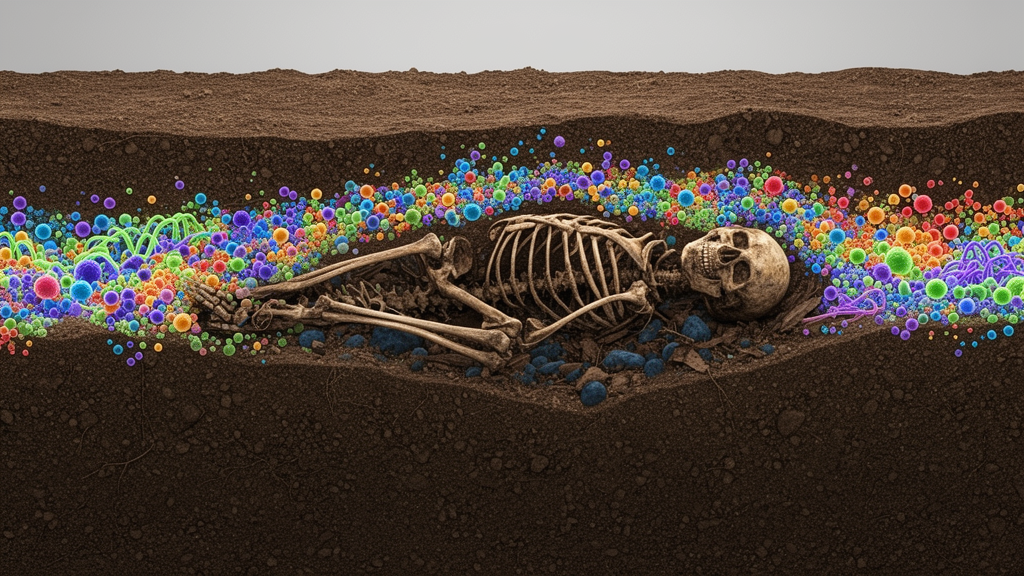
Postmortem microbial community succession in decaying carcasses differs substantially between deep burial and indoor conditions, severely limiting the cross-environment transferability of forensic models designed to estimate postmortem interval. While shallow burial succession broadly resembles surface decomposition in open air, deep burial exerts distinct and influential effects on postmortem microbial dynamics. To evaluate whether a unified postmortem interval model could function reliably across diverse terrestrial environments, researchers compared decomposition trajectories between deeply buried rat carcasses and carcasses kept under constant indoor temperature and humidity.

The researchers utilized 16S rRNA sequencing to track bacterial community succession across multiple internal anatomical sites as well as surrounding grave soil. Specifically, the team examined successional dynamics within initially sterile internal tissues, including the heart and skeletal muscle, alongside bacteria-rich environments represented by the cecum and adjacent soil. By tracking microbial changes across these distinct anatomical and environmental niches over time, the authors evaluated how separate bacterial communities evolve under contrasting decomposition settings.

Experimental observations revealed clear contrasts in diversity trajectories between sterile and bacteria-rich tissues during decomposition. Initially sterile organs, including the heart and skeletal muscle, exhibited similar diversity profiles that remained largely homogeneous across most decomposition time points.

Co-occurrence network analysis uncovered distinct structural patterns among microbial communities across the different sampled tissues. In initially sterile organs, microbial assemblages formed highly modular networks during early postmortem stages, which later reorganized as decomposition progressed. In contrast, cecal microbial communities maintained stable network architectures throughout decomposition, centered predominantly on taxa from Firmicutes and Bacteroidetes. Meanwhile, grave soil networks transitioned from assemblages dominated by the ambient surrounding environment to networks directly associated with active carcass decomposition.

Cross-environment prediction tests revealed that postmortem interval models failed to transfer accurately between environments, as buried carcass succession diverged significantly from exposed conditions. Models calibrated on heart and skeletal muscle performed poorly in cross-environment estimations, while cecal samples generalized best, although their predictive accuracy remained limited.

Subject of Research: Forensic postmortem interval estimation using carcass microbial community succession

Article Title: A comparative study on microbial community succession of carcasses in two environments

Article References: Zhao, G., Li, X., Dong, C., Dou, S., Liang, Y., Zhang, Y., Liu, R., Zhou, Z., Yu, H., Li, S., Fu, L., & Cong, B. (2026). A comparative study on microbial community succession of carcasses in two environments. BMC Microbiology. https://doi.org/10.1186/s12866-026-05936-2

Image Credits: AI Generated

DOI: 10.1186/s12866-026-05936-2

Keywords: postmortem interval, microbial succession, deep burial, forensic microbiology, 16S rRNA sequencing, carcass decomposition, cecum microbiome, grave soil, Firmicutes, Bacteroidetes, alpha diversity, co-occurrence network, rat carcasses, heart microbiome, muscle microbiome, cross-environment prediction, indoor decomposition, decomposition ecology

News Source: Morgan Morrow. (November 23, 2026). Deep Burial Changes Carcass Microbial Succession and Limits Forensic Interval Models. Scienmag.

Tags: 16S rRNA sequencingalpha diversityBacteroidetescarcass decompositioncecum microbiomeco-occurrence networkcross-environment predictiondecomposition ecologydeep burialFirmicutesforensic microbiologygrave soilheart microbiomeindoor decompositionmicrobial successionmuscle microbiomePostmortem intervalrat carcasses
Share12Tweet7Share2ShareShareShare1

Related Posts

Mantidfly Larvae Found Inside Vectius niger Spider Egg Sacs in Brazil

Mantidfly Larvae Found Inside Vectius niger Spider Egg Sacs in Brazil

November 23, 2026
Larger Lakes Face Slower Yet Far More Severe Dreissena Mussel Impacts

Larger Lakes Face Slower Yet Far More Severe Dreissena Mussel Impacts

November 23, 2026

Larval Gene Silencing Disrupts Appendage Patterning in Developing Tortoise Beetles

November 23, 2026

Optimized mRNA Structure Boosts Recombinant Bacterial Asparaginase Yield for Cancer Therapy

November 23, 2026

POPULAR NEWS

  • Thoracoscopic Enucleation Removes Giant Esophageal Tumor While Preserving Critical Anatomy

    Thoracoscopic Enucleation Removes Giant Esophageal Tumor While Preserving Critical Anatomy

    29 shares
    Share 12 Tweet 7
  • Optimized mRNA Structure Boosts Recombinant Bacterial Asparaginase Yield for Cancer Therapy

    29 shares
    Share 12 Tweet 7
  • Threaded Wire Fixation Demonstrates High Tuberosity Healing in Humeral Head Fractures

    29 shares
    Share 12 Tweet 7
  • Molybdenum and Copper Alter Austenite Decomposition in Recycled Medium Manganese Steels

    29 shares
    Share 12 Tweet 7

About

We bring you the latest biotechnology news from best research centers and universities around the world. Check our website.

Follow us

Recent News

Mantidfly Larvae Found Inside Vectius niger Spider Egg Sacs in Brazil

Unsupervised Grouping Enhances Three-Dimensional Reconstruction of Submerged Fukushima Daiichi Reactor Structures

Larger Lakes Face Slower Yet Far More Severe Dreissena Mussel Impacts

Subscribe to Blog via Email

Enter your email address to subscribe to this blog and receive notifications of new posts by email.

Join 88 other subscribers
  • Contact Us

Bioengineer.org © Copyright 2023 All Rights Reserved.

Welcome Back!

Login to your account below

Forgotten Password?

Retrieve your password

Please enter your username or email address to reset your password.

Log In
No Result
View All Result
  • Homepages
    • Home Page 1
    • Home Page 2
  • News
  • National
  • Business
  • Health
  • Lifestyle
  • Science

Bioengineer.org © Copyright 2023 All Rights Reserved.