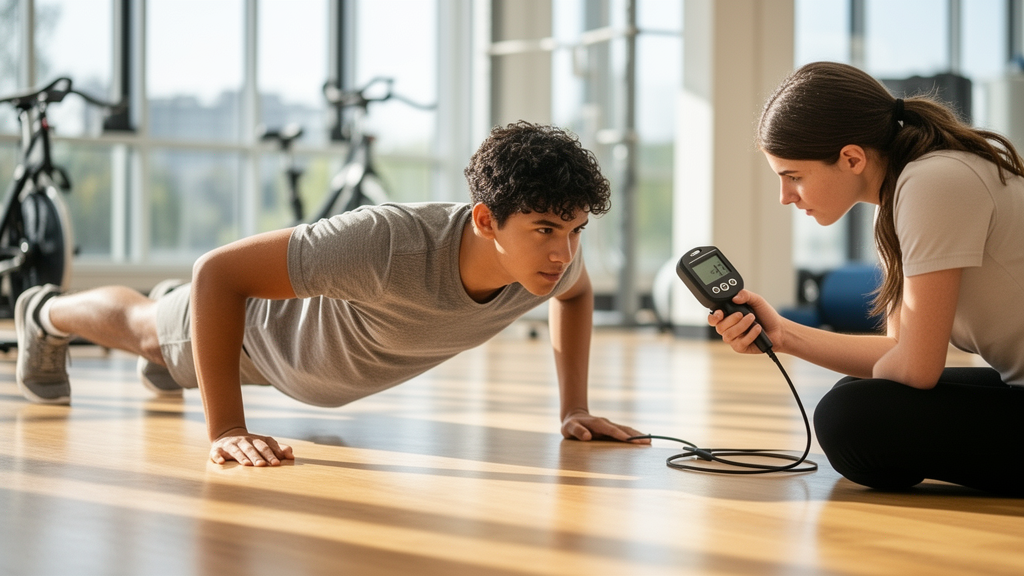
A cross-sectional investigation evaluating five hundred university students found that the daily frequency of brief, self-initiated physical activity sessions was positively associated with maximum handgrip strength under a fully adjusted statistical model, whereas total dietary protein intake demonstrated a substantially weaker and fragile relationship that was largely confined to protein consumed from dietary supplements. The investigation, conducted at Capital University of Physical Education and Sports in Beijing, China, sought to evaluate whether dispersed short bursts of exertion and habitual protein consumption exhibit independent conditional associations with hand isometric force under free-living conditions. Handgrip strength is widely applied across health research as an accessible proxy for general muscular strength, yet previous experimental research on short physical activity bouts has focused almost exclusively on cardiorespiratory fitness and metabolic markers rather than skeletal muscle force generation in the upper extremities. By evaluating both behavioral indicators simultaneously within a single observational design, the researchers established that while an omnibus statistical test detected a non-zero association for the combined parameters, the incremental explanatory power of both lifestyle factors remained remarkably small relative to standard demographic and anthropometric characteristics.
The concept of exercise snacks involves dispersing short, relatively intense, intentional bouts of physical activity across the day to reduce temporal barriers to structured exercise regimens. Prior investigations involving stair climbing and low-volume high-intensity interval training protocols observed improvements in peak oxygen consumption and glycemic regulation, but an isolated sprint-interval study in physically active young adults failed to show improvements in maximal force production, and broader literature reviews report inconsistent results regarding strength adaptations. Furthermore, nutritional interventions demonstrate that protein ingestion supports myofibrillar remodeling following resistance exercise, but meta-analyses confirm that gains in muscular strength are primarily observed when elevated protein intake coincides with structured resistance training rather than occurring in sedentary or untrained contexts. To clarify whether these lifestyle factors correlate with strength among young adults, the investigators prespecified three distinct hypotheses: a primary omnibus hypothesis positing that the parameters for exercise-snack frequency and total protein intake were not simultaneously zero; a secondary hypothesis that each exposure was positively conditionally associated with maximum handgrip force; and an exploratory evaluation examining whether protein intake modified the relationship between activity bouts and strength performance.
To examine these relationships, the researchers executed a single-center observational protocol that was reviewed and approved by the Ethics Committee of Capital University of Physical Education and Sports under approval number 2026A173, adhering strictly to the ethical principles of the Declaration of Helsinki. The design, administrative execution, and analytical documentation conformed to the Strengthening the Reporting of Observational Studies in Epidemiology guidelines alongside the STROBE-nut nutritional reporting extension. All exposure definitions, sample size calculations, inclusion criteria, and regression equations were formally established prior to data inspection, with post-hoc modifications explicitly designated to preserve scientific transparency. Sample size planning was specifically targeted to power the two-degree-of-freedom joint main-effect Wald test in a fully adjusted multivariable linear regression, assuming an incremental effect size of Cohen’s f-squared equal to 0.02 at eighty percent statistical power and an alpha level of 0.05. Although a conventional non-central F-distribution calculation indicated that 485 complete observations were required, the authors targeted 500 complete cases and expanded recruitment to 590 students to account for anticipated data attrition during intensive multi-day physical activity recording and multi-pass dietary interviews.
Participant recruitment utilized convenience sampling among full-time students aged eighteen to twenty-five years who were residing on campus and capable of completing physical performance testing. Exclusion criteria removed professional athletes, members of competitive collegiate sports squads, individuals enrolled in concurrent nutritional or training trials, and anyone presenting with recent upper-limb musculoskeletal injuries or surgeries within the preceding three months. From the initial cohort of 590 screened students, 18 failed baseline eligibility criteria and 72 eligible participants were subsequently omitted from primary regressions due to incomplete data domains, specifically including 26 with incomplete dietary recalls, 25 with inadequate physical activity records, 14 who failed to obtain valid bilateral handgrip readings, and 7 missing covariate values. The remaining complete-case analytical sample comprised 500 participants, consisting of 267 women and 233 men with an overall mean age of 21.6 years. Included individuals were statistically comparable across all observed baseline characteristics to eligible non-included peers, exhibiting standardized mean differences below 0.17 across demographic, dietary, and physical traits, with a logistic model predicting study inclusion demonstrating no significant bias.
Exercise snacks were captured across seven consecutive days using a structured self-report diary that underwent preliminary comprehensibility testing during an initial pilot phase. Investigators personally trained each participant on logging criteria, movement classification, and the Borg CR-10 subjective exertion scale. The primary exposure operationalized an exercise snack as a discrete, self-initiated bout lasting between 30 and 300 seconds, containing at least 30 seconds of accumulated active movement, performed outside of formal classes or gym workouts, and concluding with a perceived exertion rating of at least 5, corresponding to the anchor strong or hard. To avoid artificially inflating frequency counts through consecutive sets of calisthenics, adjacent bouts separated by fewer than 30 minutes were combined into single events, and merged bouts exceeding 5 minutes were reassigned to general moderate-to-vigorous physical activity. Across the cohort, 53.2 percent of participants recorded zero exercise snacks, yielding a sample median of 0.0 events per day, while the 234 active reporters logged a median daily frequency of 1.29 events with an average duration of 107 seconds per bout. Categorization revealed that 44.2 percent of logged events were resistance movements, but only 13.7 percent involved upper-limb musculature, while 55.8 percent represented non-resistance activities like stair sprints.
Dietary intake was documented using three non-consecutive multiple-pass 24-hour recalls conducted by trained interviewers across two weekdays and one weekend day within the activity tracking week. Nutrient compositions were derived using the sixth edition of the China Food Composition Tables, with weekday and weekend intakes combined via a five-to-two weighting formula. Total daily protein intake averaged 78.6 grams per day, corresponding to 1.3 grams per kilogram of body mass, with food sources providing 75.8 grams per day. Commercial protein-containing supplements, including powders and ready-to-drink beverages, were consumed by 112 participants, representing 22.4 percent of the sample. Although supplement-derived protein contributed only 3.5 percent of total protein intake across the full cohort, supplement consumers recorded substantially higher total protein intake than non-consumers, averaging 90.3 grams daily compared to 75.2 grams, whereas their food-derived protein consumption remained nearly identical at 77.8 and 75.2 grams. Total dietary energy intake averaged 2,011.9 kilocalories per day, and unadjusted correlation analyses indicated virtually no linear dependence between daily exercise-snack frequency and total protein consumption.
Handgrip strength testing was performed one to two days following completion of the behavioral tracking period using a Jamar Plus digital hand dynamometer that was calibrated daily in accordance with manufacturer specifications. Participants rested seated for five minutes before completing bilateral assessments in a standardized posture with shoulders adducted neutrally, elbows bent at ninety degrees, and wrists positioned neutrally. Testing alternated between limbs across three valid maximal efforts per hand sustained for three to five seconds, separated by two-minute rest intervals. The primary outcome was prespecified as maximum handgrip strength, defined as the highest single value obtained among the six valid bilateral attempts, an approach chosen to minimize underestimation caused by isolated submaximal trials. Handgrip strength averaged 37.8 kilogram-force across the full cohort, with men averaging 45.2 kilogram-force and women averaging 31.4 kilogram-force. Within-session test-retest reliability across the three contractions was high, showing intraclass correlation coefficients of 0.967 for the left hand and 0.969 for the right hand, with 82.6 percent of participants achieving their personal maximum reading with the right hand.
Statistical evaluation applied ordinary least squares regression accompanied by heteroscedasticity-consistent HC3 robust standard errors across three nested linear models. The baseline model unadjusted for lifestyle covariates was expanded in model one to adjust for age, sex, standing height, body mass, and total energy intake, while the fully adjusted primary model two further incorporated weekly routine resistance training, log-transformed resistance training experience, other moderate-to-vigorous physical activity, daily sedentary duration, and nocturnal sleep. The sole primary statistical hypothesis test yielded a significant HC3 joint Wald statistic of 25.43 with two degrees of freedom, generating a p-value of 3.01 times ten to the negative sixth power and rejecting the composite null hypothesis. However, the incremental coefficient of determination added by both exposures beyond demographic and behavioral covariates was merely 0.015, indicating that exercise snacks and protein intake explained only 1.5 percent of variance in grip strength. The overall model coefficient of determination reached 0.726, but this explanatory power was overwhelmingly driven by established biological determinants such as biological sex, stature, and body weight rather than the target lifestyle variables.
In the fully adjusted primary model, each additional exercise snack per day was associated with a 0.807 kilogram-force increment in maximum handgrip strength, with a ninety-five percent confidence interval spanning 0.444 to 1.170 kilogram-force. Total protein intake demonstrated an adjusted coefficient of 0.369 kilogram-force per 10 grams per day, with a ninety-five percent confidence interval ranging from 0.056 to 0.681 kilogram-force. Standardized regression coefficients were 0.113 for exercise snacks and 0.073 for protein intake. When scaled across observed interquartile ranges, increasing exercise snacks from zero to 1.2 events daily corresponded to a 0.97 kilogram-force higher grip strength, while shifting protein intake from 67.23 to 88.95 grams daily corresponded to a 0.80 kilogram-force difference. Because no clinically validated minimal important difference for handgrip strength exists in healthy collegiate cohorts, these modest statistical differences cannot be construed as evidence of functional or clinical significance.
Prespecified sensitivity analyses revealed pronounced asymmetry in the empirical stability of the two lifestyle exposures. The positive conditional association for exercise snacks remained robust across all prespecified model variations, yielding a coefficient of 3.017 kilogram-force per event under a strict duration and exertion definition of 30 to 60 seconds with perceived exertion of at least 7, a coefficient of 0.798 when examining food-derived protein, and 0.801 when modeling the mean of bilateral hand maxima. Conversely, the statistical association for protein intake proved fragile: replacing total protein with food-derived protein yielded an attenuated coefficient of 0.179 kilogram-force per 10 grams whose ninety-five percent confidence interval bridged zero from negative 0.168 to positive 0.526. Excluding protein supplement users reduced the protein coefficient to 0.046 kilogram-force with a confidence interval spanning negative 0.339 to positive 0.430, and restricting the cohort to participants without routine resistance training produced an imprecise estimate of 0.255 kilogram-force spanning negative 0.080 to positive 0.590.
Exploratory analyses further demonstrated that the protein association was predominantly driven by commercial supplementation rather than regular food sources. Simultaneous decomposition of protein sources indicated that supplement-derived protein yielded an adjusted coefficient of 0.891 kilogram-force per 10 grams daily, whereas food-derived protein yielded only 0.180 kilogram-force, with a statistically significant difference between parameters. Directly entering supplement consumption into the regression attenuated the total protein coefficient to 0.226 kilogram-force with an interval including zero, while supplement users independently exhibited 1.116 kilogram-force greater strength. Adding an interaction product term between centered exercise-snack frequency and centered protein intake yielded a coefficient of negative 0.129 kilogram-force whose ninety-five percent confidence interval ranged from negative 0.391 to positive 0.134. Because post-hoc power calculations indicated that the study possessed only sixty-one percent power to detect a minor interaction effect, the statistical test for effect modification was statistically inconclusive, confirming neither synergistic enhancement nor an absence of interaction.
The standard primary regression modeled total protein alongside total energy intake, representing an isocaloric substitution framework wherein the protein parameter reflects replacing forty kilocalories of non-protein energy with ten grams of protein while holding total caloric consumption constant. Alternative post-hoc energy parameterizations, including an energy-partition model contrasting added protein without caloric constraint, a nutrient-density percentage model, and the residual adjustment method, yielded comparable coefficients between 0.369 and 0.448 kilogram-force per unit, though each answers a distinct nutritional question. Diagnostic evaluations confirmed moderate heteroscedasticity via Breusch-Pagan and White tests, justifying HC3 covariance modeling, while variance inflation factors remained below 3.0, ruling out severe multicollinearity. Truncating twenty-five high-influence cases with Cook’s distance values surpassing four divided by sample size did not alter substantive conclusions, yielding coefficients of 0.685 kilogram-force for exercise snacks and 0.446 kilogram-force for protein intake.
Crucially, the authors emphasized extensive methodological and conceptual constraints that prohibit interpreting these conditional associations as causal outcomes. The cross-sectional design cannot establish temporal precedence or distinguish behavioral effects from reverse causation, as physically stronger or fitness-minded individuals may simply be more inclined to undertake spontaneous physical tasks and purchase protein powders. Unmeasured confounding represents an additional limitation, as investigators did not assess training motivation, general health consciousness, socioeconomic standing, overall dietary quality, or previous upper-limb loading histories from climbing or racket athletics. Moreover, exercise snacks were measured through an unvalidated self-report diary subject to recall bias, and handgrip dynamometry reflects isolated isometric forearm function rather than lower-body strength or whole-body muscular fitness. Consequently, the researchers concluded that significant regression coefficients in this single-campus cohort cannot justify clinical dietary guidelines or exercise prescriptions, highlighting the necessity for prospective trials incorporating objective motion sensors and broader strength assessments.
Subject of Research: Cross-sectional analysis of exercise-snack frequency, dietary protein intake, and maximum handgrip strength in university students
Article Title: Associations of exercise-snack frequency and protein intake with handgrip strength in university students: a cross-sectional study
Article References: Wang, S., Chen, Z., Xing, X., & Hao, N. (2026). Associations of exercise-snack frequency and protein intake with handgrip strength in university students: a cross-sectional study. Frontiers in Nutrition, 13, Article 2008744. https://doi.org/10.3389/fnut.2026.2008744
Image Credits: AI Generated
DOI: 10.3389/fnut.2026.2008744
Keywords: exercise snacks, handgrip strength, protein intake, dietary supplements, cross-sectional study, university students, muscular strength, isometric force, 24-hour dietary recall, physical activity diary, Borg CR-10 scale, Wald test, HC3 robust standard errors, resistance training, isocaloric substitution, nutritional epidemiology, energy adjustment
News Source: Daisy Hatcher. (November 23, 2026). Exercise Snack Frequency Shows Modest Association With Handgrip Strength in Students. Scienmag.