Credit: Cedars-Sinai
LOS ANGELES (Aug. 17, 2017) — Cedars-Sinai neuroscience investigators have found that Alzheimer's disease affects the retina — the back of the eye — similarly to the way it affects the brain. The study also revealed that an investigational, noninvasive eye scan could detect the key signs of Alzheimer's disease years before patients experience symptoms.
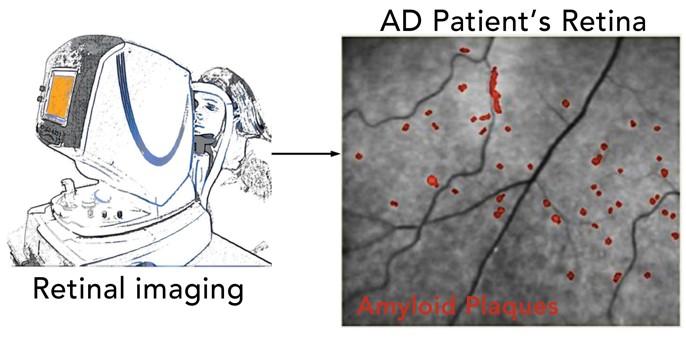
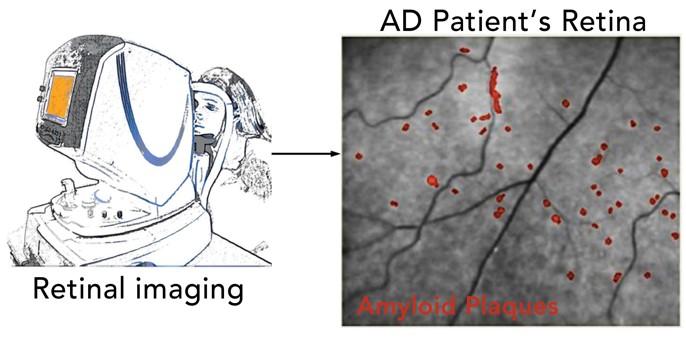
Using a high-definition eye scan developed especially for the study, researchers detected the crucial warning signs of Alzheimer's disease: amyloid-beta deposits, a buildup of toxic proteins. The findings represent a major advancement toward identifying people at high risk for the debilitating condition years sooner.
The study, published today in JCI Insight, comes amid a sharp rise in the number of people affected by the disease. Today, more than 5 million Americans have Alzheimer's disease. That number is expected to triple by 2050, according to the Alzheimer's Association.
"The findings suggest that the retina may serve as a reliable source for Alzheimer's disease diagnosis," said the study's senior lead author, Maya Koronyo-Hamaoui, PhD, a principal investigator and associate professor in the departments of Neurosurgery and Biomedical Sciences at Cedars-Sinai. "One of the major advantages of analyzing the retina is the repeatability, which allows us to monitor patients and potentially the progression of their disease."
Yosef Koronyo, MSc, a research associate in the Department of Neurosurgery and first author on the study, said another key finding from the new study was the discovery of amyloid plaques in previously overlooked peripheral regions of the retina. He noted that the plaque amount in the retina correlated with plaque amount in specific areas of the brain.
"Now we know exactly where to look to find the signs of Alzheimer's disease as early as possible," said Koronyo.
Keith L. Black, MD, chair of Cedars-Sinai's Department of Neurosurgery and director of the Maxine Dunitz Neurosurgical Institute, who co-led the study, said the findings offer hope for early detection when intervention could be most effective.
"Our hope is that eventually the investigational eye scan will be used as a screening device to detect the disease early enough to intervene and change the course of the disorder with medications and lifestyle changes," said Black.
For decades, the only way to officially diagnose the debilitating condition was to survey and analyze a patient's brain after the patient died. In recent years, physicians have relied on positron emission tomography (PET) scans of the brains of living people to provide evidence of the disease but the technology is expensive and invasive, requiring the patient to be injected with radioactive tracers.
In an effort to find a more cost-effective and less invasive technique, the Cedars-Sinai research team collaborated with investigators at NeuroVision Imaging, Commonwealth Scientific and Industrial Research Organisation, University of Southern California, and UCLA to translate their noninvasive eye screening approach to humans.
The published results are based on a clinical trial conducted on 16 Alzheimer's disease patients who drank a solution that includes curcumin, a natural component of the spice turmeric. The curcumin causes amyloid plaque in the retina to "light up" and be detected by the scan. The patients were then compared to a group of younger, cognitively normal individuals.
###
Koronyo-Hamaoui and Koronyo also were key authors of the original results, published in the journal Neuroimage in 2011 and first presented at the Alzheimer's Association's International Conference in 2010.
Investigators who contributed to the study include David Biggs, Ernesto Barron, David S. Boyer, Joel A. Pearlman, William J. Au, Shawn J. Kile, Austin Blanco, Dieu-Trang Fuchs, Adeel Ashfaq, Sally Frautschy, Gregory M. Cole, Carol A. Miller, David R. Hinton and Steven R. Verdooner.
The study was funded by the National Institutes of Health/National Institute on Aging, The Marciano Family Foundation and The Saban Family Foundation.
Disclosure: The optical imaging technology in humans was developed by Keith L. Black, MD, Steven Verdooner, Yosef Koronyo, and Maya Koronyo-Hamaoui, PhD. Cedars-Sinai licensed the technology to NeuroVision Imaging LLC, a company in which Black is chairman, founder and equity holder. Maya Koronyo-Hamaoui and Yosef Koronyo are founding members of NeuroVision Imaging. Cedars-Sinai has an equity interest in the company.
To learn more about the retinal imaging device and Black's motivation for conceiving it, click here.
The JCI Insight article is available at http://insight.jci.org/articles/view/93621?key=8ffdb3ae9fa891.
Media Contact
Anasia Obioha
[email protected]
310-423-7798
@cedarssinai
http://www.csmc.edu