Dual discoveries at USC propose a promising method to regrow nonliving hard tissue, lessening or even eliminating pain associated with tooth decay, which the National Institutes of Health calls the most prevalent chronic disease.
Janet Moradian-Oldak, a professor at the Herman Ostrow School of Dentistry of USC, has investigated methods to regrow tooth enamel for the past two decades. The process is especially tricky because unlike bone, mature enamel cannot rejuvenate. Tooth enamel is a nonliving tissue.
The a-ha moment came Oct. 22 when, in collaboration with lead author Sauma Prajapati of USC and other colleagues, she published a study in the Biomaterials journal saying matrix metalloproteinase-20, an enzyme found only in teeth, chops up amelogenin proteins, which facilitate organized enamel crystal formation. MMP-20 clears the way for hard material to usurp vacated space.
Her team is the first to define the function of an enzyme for preventing protein occlusion inside a crystal, she said.
"MMP-20 is released at a very early stage of enamel formation," said Moradian-Oldak, the study's senior author. "MMP-20 chops up proteins during the crystallization of enamel. Together with other enzymes, it gets rid of 'sludge' so the enamel making cells in the body can add more mineral and make enamel, the hardest bioceramic in the human body."
Dental restoration
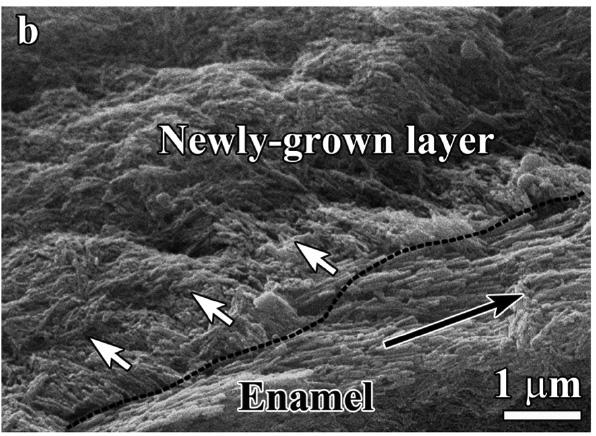
Moradian-Oldak will couple the MMP-20 discovery with another study published Nov. 2 in the Journal of Biomedical Engineering and Informatics, which concluded an amelogenin-chitosan hydrogel could repair early tooth decay by growing an enamel-like layer that reduces lesions by up to 70 percent.
"Recognizing MMP-20's function in biomineralization is one of the first steps to learning how dental enamel forms in nature," said Qichao Ruan, lead author of the hydrogel study and a postdoctoral research associate in the Center for Craniofacial Molecular Biology at USC. "The findings regarding MMP-20 not only help us to further understand the mechanisms of enamel formation but [they] also can be applied in the design of novel biomaterials for future clinical applications in dental restoration or repair."
The Food and Drug Administration has not yet approved any type of enamel regrowing gel. USC is in pre-clinical trials. Moradian-Oldak said one day people may be able to use an overnight mouth guard or teeth strips saturated with hydrogel to regrow enamel-like substances and reduce teeth sensitivity.
Finding the right fix
Products such as toothpaste and mouthwash containing fluoride and casein phosphopeptide-amorphous calcium phosphate promote remineralization of initial enamel lesions; however, they need to be used regularly and are more of a tire patch than a real solution, Moradian-Oldak said. It plugs up the problem so people don't feel pain. The gel, however, fills the cracks and holes with an enamel-like substance.
In the United States, 92 percent of adults aged 20 to 64 have had dental decay in their permanent teeth, Moradian-Oldak said. Grinding teeth at night, gum recession and the disappearance of enamel over a lifetime due to demineralizing acidic food and drink are all common problems people everywhere face.
When tested in an environment that mimics an oral cavity's biochemical processes, the gel created a robust attachment, eliminating the threat of secondary cavities in the same spot, Ruan said. The gel could be more effective than traditional crowns, whose adhesion weakens over time, he added.
"Besides biocompatibility and biodegradability, the gel has unique antimicrobial and adhesion properties that are important for dental applications," Ruan said.
###