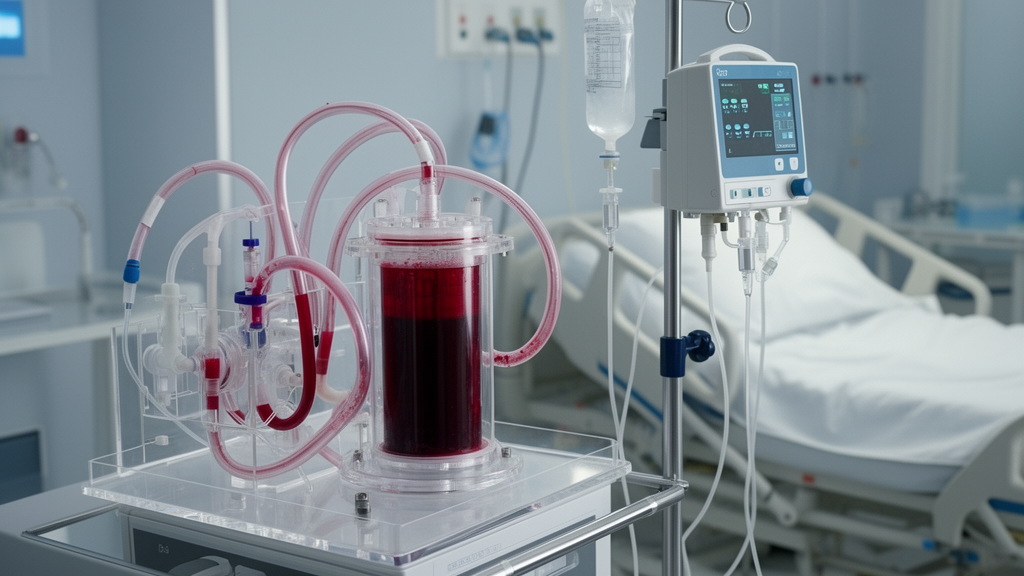
Measurable sequestration of antimicrobial agents within extracorporeal membrane oxygenation circuit components does not preclude clinically meaningful drug underexposure in critically ill patients, according to a scholarly evaluation published in Critical Care. Analyzing findings from a recent prospective observational study led by Escolà-Rodríguez and colleagues, researchers Patrick M. Honoré, Ala Eddine Ben Ismail, Yasser Benkaddour, and Catherine Y. Muscato highlighted that limited overall circuit-related losses do not guarantee sufficient systemic exposure. While the original investigation identified drug-specific retention across hardware elements and concluded that circuit-related losses exert minimal clinical relevance, the commentary authors argue that this interpretation requires substantial re-evaluation when applied to bedside patient management and pharmacodynamic efficacy.
The foundational observational investigation examined antimicrobial sequestration alongside systemic exposure during extracorporeal membrane oxygenation support, but its scope was constrained by a small clinical cohort. The study evaluated eight patients who received fifteen antimicrobial treatments, an inherently limited sample size that restricts both statistical precision and the wider generalizability of the findings. Crucially, the absence of statistically significant differences in systemic antimicrobial concentrations across circuit sites does not establish that clinically meaningful pharmacokinetic alterations are absent. Furthermore, twenty percent of the evaluated treatment courses failed to reach predefined pharmacokinetic and pharmacodynamic efficacy targets, raising practical concerns regarding whether standard regimens reliably provide adequate systemic drug availability.
This shortfall in target attainment is particularly consequential for time-dependent antibiotics such as meropenem, whose bactericidal activity depends strictly on sustaining free, unbound drug concentrations above target thresholds throughout the entire dosing interval. Although prior laboratory and experimental investigations demonstrated that antimicrobials can undergo measurable sequestration within extracorporeal membrane oxygenation circuits, directly extrapolating benchtop findings to systemic exposure in real-world clinical care remains exceedingly difficult. The observed twenty percent target failure rate underscores that circuit-specific measurements alone cannot confirm therapeutic adequacy, particularly when critically ill patients present with highly unstable physiology, altered drug distribution volumes, and variable systemic clearance rates.
Evidence gathered from therapeutic drug monitoring investigations reinforces existing concerns regarding antibiotic underexposure during extracorporeal life support. In a prospective study encompassing 105 critically ill patients, which included 30 individuals receiving extracorporeal membrane oxygenation, Kühn and colleagues observed significantly lower serum concentrations of piperacillin and standard-dose meropenem among extracorporeal support recipients compared to non-supported peers. Despite utilizing continuous infusions designed to maximize drug exposure, predefined therapeutic targets were not achieved in 48 percent of extracorporeal patients administered piperacillin. Similarly, 35 percent of extracorporeal patients receiving linezolid failed to attain targeted levels, even when treated with an intensified daily dosage of 1800 milligrams.
These therapeutic monitoring observations demonstrate that adequate systemic drug exposure cannot simply be assumed, even when clinicians implement intensified dosing strategies. Nonetheless, the researchers noted that failing to reach a predefined concentration threshold does not necessarily equate to clinical treatment failure. Dosing and administration strategies introduce additional pharmacological complexities that clinicians must weigh. While prolonged or continuous infusions can substantially improve pharmacokinetic target attainment for time-dependent antibiotics, drug stability remains a critical constraint, specifically regarding the chemical stability of meropenem across prolonged administration modalities. In parallel, pharmacokinetic simulation analyses by Taubert and colleagues emphasize the intricate trade-offs inherent in optimizing linezolid dosing, where efforts to enhance efficacy must be carefully balanced against the risks of excessive toxicity.
Important methodological distinctions also separate the investigations conducted by Escolà-Rodríguez et al. and Kühn et al., as each research group addressed related but fundamentally distinct questions. Escolà-Rodríguez and colleagues evaluated concentration differences between specific sampling sites within the extracorporeal membrane oxygenation circuit and measured pharmacokinetic target attainment, estimating circuit-related sequestration indirectly from concentration gradients rather than quantifying drug loss through direct recovery or formal mass-balance calculations. In contrast, Kühn and colleagues utilized therapeutic drug monitoring to compare systemic antimicrobial concentrations between patients with and without extracorporeal support. Beyond circuit interactions, systemic drug levels in intensive care patients are governed by fluid shifts, altered distribution volumes, hepatic metabolism, fluctuating renal clearance, and overall pharmacokinetic variability, making direct comparisons between different patient cohorts and administration protocols challenging.
Ultimately, while the data from Escolà-Rodríguez et al. confirm that circuit-related concentration differences remained limited under the specific conditions studied, they do not demonstrate that therapeutic drug monitoring and individualized dose adjustments are unnecessary. Although the original investigators recommended considering monitoring during extracorporeal membrane oxygenation, their protocol did not prospectively examine whether monitoring-guided dose interventions improve target attainment or patient survival. The pivotal clinical issue is whether each patient consistently reaches and maintains appropriate pharmacokinetic and pharmacodynamic targets. Consequently, repeated therapeutic drug monitoring paired with individualized dose titrations remains an indispensable clinical strategy, and larger prospective multicenter trials incorporating serial measurements, unbound concentration assessments, validated mass-balance loss quantification, and prospective outcome evaluations are urgently needed.
Subject of Research: Antimicrobial pharmacokinetics and therapeutic drug monitoring during extracorporeal membrane oxygenation
Article Title: Limited antimicrobial sequestration during ECMO does not exclude clinically relevant underexposure: the role of therapeutic drug monitoring
Article References: Honoré, P. M., Ismail, A. E. B., Benkaddour, Y., & Muscato, C. Y. (2026). Limited antimicrobial sequestration during ECMO does not exclude clinically relevant underexposure: the role of therapeutic drug monitoring. Critical Care, 30(1), Article 607. https://doi.org/10.1186/s13054-026-06464-1
Image Credits: AI Generated
DOI: 10.1186/s13054-026-06464-1
Keywords: extracorporeal membrane oxygenation, antimicrobial sequestration, therapeutic drug monitoring, pharmacokinetics, pharmacodynamics, meropenem, piperacillin, linezolid, critically ill patients, systemic drug exposure, continuous infusion, circuit-related drug loss, time-dependent antibiotics, dose optimization, target attainment, critical care pharmacotherapy
News Source: Ophelia Keating. (November 23, 2026). Limited Antimicrobial Circuit Sequestration During ECMO Does Not Exclude Patient Underexposure. Scienmag.