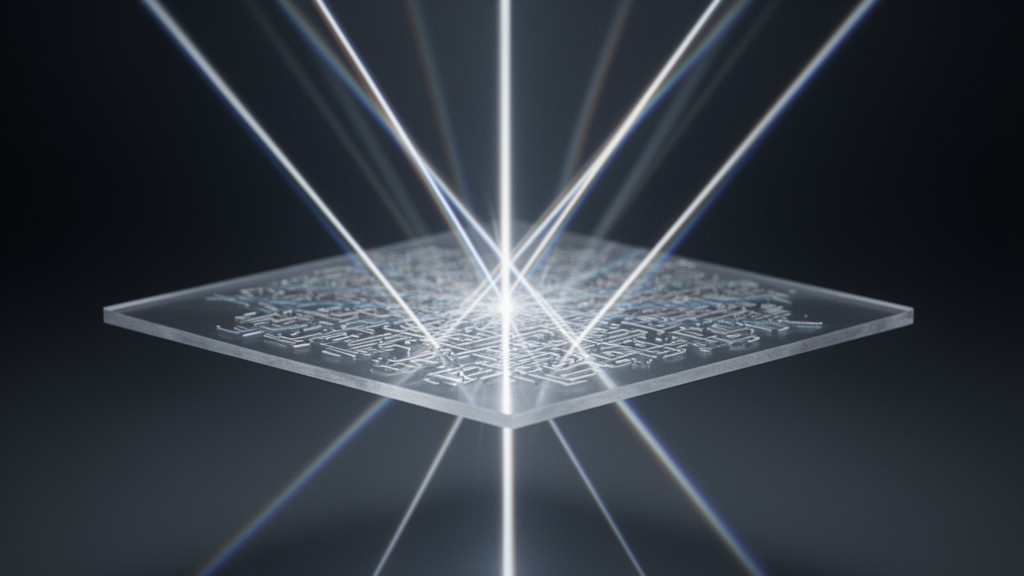
Researchers have demonstrated that nonlinear analog computing can be performed using a single linear diffractive surface under coherent illumination, bypassing the conventional necessity for cascaded multi-layer architectures or specialized nonlinear optical materials. In a study published in Light: Science and Applications, a research team led by Yuntian Wang, Alexander Chen, Md Sadman Sakib Rahman, and Aydogan Ozcan introduced an encoder-decoder co-localization architecture, designated as the E + D processor. The experimental and theoretical investigation establishes that an input-dependent dynamic phase encoder and a static optimized phase decoder can be integrated side by side on a solitary phase-only modulation plane. When illuminated by a coherent plane wave, the optical fields diffracted from both regions propagate through free space and interfere at an output plane, where a square-law intensity detector translates their coherent superposition into programmable nonlinear input-output mappings.
Digital electronic processors have long served as the foundation of modern computational infrastructure, yet the physical constraints of conventional hardware scaling coupled with expanding machine learning workloads have motivated the exploration of analog optical alternatives. Light-based computing offers notable operational advantages, including high-dimensional signal manipulation, passive wave propagation, massive parallelism, and low transit latency. Nevertheless, synthesizing nonlinear functional mappings directly in optical hardware has remained an enduring physical bottleneck. Natural optical materials generally exhibit very weak nonlinearities that demand prohibitive optical power levels to activate, whereas photorefractive or photochromic mechanisms often introduce severe absorption losses and slow temporal responses. While prior diffractive optical computing platforms managed to approximate nonlinear functions using linear optical components, they systematically relied on cascaded sequences of physically separated diffractive surfaces to shape spatially varying point spread functions, inherently increasing axial system footprint, alignment sensitivity, and manufacturing complexity.
The co-localized E + D framework directly circumvents this physical footprint penalty by collapsing the entire modulation mechanism into a single diffractive layer located at an input plane. Within this shared aperture, the active area is partitioned into two functionally distinct zones: an argument-dependent encoder region that maps incoming scalar or vector data into continuous phase profiles, and a static decoder region whose phase profile is optimized during training and subsequently held fixed during inference. As the coherent optical fields emitted by the dynamic encoder and static decoder travel across a uniform axial distance in free space, diffraction laterally disperses their spatial wavefronts. At the designated output plane, the two propagating wavefields overlap and interfere. Because optical intensity detection records the squared magnitude of the total incident complex field, the resulting measurement naturally contains a multiplicative interference mixing term alongside individual intensity contributions. The authors derived the mathematical conditions governing this interference, proving that through proper optimization of the decoder degrees of freedom, the cross-term can synthesize arbitrary real-valued band-limited nonlinear functions once an invariant background intensity is subtracted.
These analyses identified key physical parameters governing the approximation fidelity, primarily the detector aperture width, the axial propagation distance, and the count of trainable decoder phase pixels. At a moderate detector width of two wavelengths, expanding the decoder degrees of freedom decreased the mean squared error across Fourier harmonic test targets by several orders of magnitude, descending from approximately 10 to the power of negative 2 to 10 to the power of negative 8. When the detector width was widened to four wavelengths or the axial distance was extended, diffractive spreading allowed more complete coherent mixing across the sensor aperture, causing the approximation accuracy to saturate at numerical precision limits. Conversely, contracting the detector aperture to half a wavelength severely degraded performance, as the sensor sampled only localized complex field values rather than the distributed interference structure required for nonlinear synthesis.
The research team further enhanced the functional capability of the architecture by incorporating an optimizable, frozen phase bias directly into the dynamic encoder region without altering the single-layer physical layout. Instead of relying purely on an unweighted phase ramp, the encoder received an additive, spatially varying phase offset that was trained jointly alongside the static decoder and frozen at inference time. Statistical testing across forty randomly sampled target functions revealed that this frozen bias systematically depressed the error distribution, yielding mean squared errors ranging between 10 to the power of negative 12 and 10 to the power of negative 10. In ablation tests where models were trained with the bias but evaluated with it removed, approximation errors deteriorated dramatically to between 10 to the power of negative 2 and 10 to the power of negative 1, confirming that the bias functions as an integral component of a co-adapted phase landscape rather than a superficial post-hoc adjustment. This cooperative design proved particularly effective under limited phase bit-depth constraints, where learned per-pixel phase offsets acted analogously to deterministic dithering to mitigate quantization errors on spatial light modulators.
Beyond abstract mathematical harmonics, the bias-augmented E + D processor was challenged to reconstruct standard nonlinear activation functions widely utilized in artificial neural networks, including the Rectified Linear Unit, Sigmoid, Exponential Linear Unit, and Gaussian Error Linear Unit. Evaluated symmetrically over an input range from negative 0.5 to positive 0.5 on a 70 by 70 pixel grid, the single-surface diffractive models successfully approximated each functional profile, closely tracking steep transition zones and high-curvature inflection points. Because these activation functions are not strictly band-limited—possessing sharp derivative shifts whose spectral content extends beyond finite harmonic truncations—the residual approximation error concentrated locally around the central transition origins in patterns resembling the Gibbs phenomenon, while smooth continuous segments exhibited near-ideal reconstruction. Sweeps of the encoder-to-decoder spatial budget indicated that allocating roughly one-third of the total surface area to the encoder provided sufficient interference strength without starving the decoder of necessary phase-shaping degrees of freedom.
The study also defined the structural boundaries of the single-layer architecture through rigorous theoretical and numerical counter-demonstrations. The authors proved that an E + D processor cannot directly synthesize all-optically cascadable complex-valued nonlinear functions within the output complex field itself. If optical intensity detection is omitted in favor of measuring complex field amplitudes, the multiplicative mixing cross-term disappears, leaving only a linear superposition that lacks nonlinear computational capacity. Similarly, under spatially incoherent illumination, the intensity distributions from the encoder and decoder add together linearly without phase interference, preventing nonlinear function approximation. To overcome the complex-field limitation within the optoelectronic domain, the authors introduced multi-detector schemes where separate intensity sensors approximate distinct real-valued components. Using two detectors assigned to orthogonal bases, or three non-negative detectors spaced across the camera plane, the system reconstructed arbitrary complex-valued function trajectories with mean squared errors reaching 10 to the power of negative 8 and 10 to the power of negative 3, respectively, maintaining compact single-layer hardware while handling complex mathematics.
The single-surface formulation was further broadened to multi-variable nonlinear mappings by structuring the encoder with multi-dimensional Fourier basis matrices. By enumerating harmonic index combinations across multiple dimensions, input vectors were mapped into two-dimensional phase patterns and replicated across the shared plane. In numerical simulations, the single-layer E + D processor approximated a two-variable nonlinear target across its full unit domain with an impressive mean squared error of 3.5 times 10 to the power of negative 14. Scaling the system to a three-variable target yielded an error of 1.0 times 10 to the power of negative 4. The relative shift in accuracy between two and three input variables illustrated the physical constraints of the modulation aperture: because multi-variable Fourier encoding requirements scale exponentially, the three-variable encoder consumed approximately 64 percent of the modulation surface, substantially curtailing the remaining decoder pixels and underscoring that processing higher input dimensions requires scaling the total physical pixel budget of the diffractive plane.
To confirm that this synthesized physical nonlinearity could perform practical machine learning inference, the researchers deployed an E + D model to classify hand-drawn sketches of apples and bananas from the QuickDraw dataset. The input images were encoded directly as phase objects on the modulation surface, eliminating the need for digital phase retrieval or electronic pre-processing. The incident optical wavefront propagated freely to two designated detector regions whose differential intensity dictated the assigned classification category. Operating entirely through passive diffraction and physical interference, the single-layer optical classifier attained a blind-testing accuracy of 98.33 percent across 28,945 previously unseen sketches, outperforming an equivalent digital linear classifier that achieved 96.60 percent on the identical benchmark. This demonstration highlighted the specific utility of diffractive computing when processing natural phase-encoded optical signals, such as biological specimens or live wavefields, where computation occurs directly in the physical domain during optical transit.
Hardware validation was carried out on an experimental visible-light optical bench operating at a wavelength of 635 nanometers. A reflective 8-bit phase-only spatial light modulator with an 8-micrometer pixel pitch was illuminated by a collimated laser beam delivering an average intensity of 138 nanowatts per square centimeter, and the modulated wavefield was relayed via a four-f optical lens system onto a complementary metal-oxide-semiconductor camera sensor. To test parallel processing capacity, the spatial light modulator was partitioned into a mosaic of multiple independent E + D tiles. Initial models were pre-trained in silico using a differentiable physics-informed digital twin and subsequently fine-tuned on the physical hardware via model-free reinforcement learning using Proximal Policy Optimization. By treating individual pixel phase values as stochastic Gaussian policies updated through empirical loss rewards, the in situ optimization successfully absorbed system misalignments, optical aberrations, and phase non-idealities without propagating gradients through the physical setup.
The experimental setup demonstrated the simultaneous parallel approximation of 100 distinct nonlinear functions within a single optical forward pass on a 10 by 10 spatial mosaic. The experimental outputs converged toward their respective targets, achieving a mean evaluation error of 2.8 times 10 to the power of negative 3 across all 100 channels. Crucially, the long-term operational robustness of the trained optical processor was evaluated by re-measuring all 100 function channels every 10 minutes over 12 continuous hours without any optical realignment, mechanical recalibration, or software retraining. The system maintained stable output fidelity throughout the entire 12-hour period, demonstrating that co-localized single-layer diffractive architectures can provide resilient, highly parallel analog processing in physical operating environments.
While digital microelectronics calculate isolated arithmetic activations at lower per-operation energy thresholds than off-the-shelf spatial light modulators, the single-layer diffractive processor provides distinct architectural advantages for high-throughput, latency-critical optical workflows. In the experimental geometry, the core optical calculation was completed entirely within the free-space transit time of approximately 173 picoseconds over a 5.2-centimeter path. The researchers emphasized that the E + D architecture can be permanently fabricated as passive diffractive phase plates via photolithography, two-photon polymerization, or three-dimensional printing, which would eliminate dynamic modulation power entirely for fixed computing applications. By reducing the physical requirements of nonlinear optical computing to a single diffractive surface and standard intensity detection, this work establishes a rigorous foundation for compact, easily aligned, and massively parallel analog processors capable of integrating directly into high-speed optical systems.
Subject of Research: Single-layer diffractive optical computing for nonlinear function approximation
Article Title: Breaking the cascade: compact nonlinear optical computing with single-layer encoder–decoder co-localization
Article References: Wang, Y., Chen, A., Rahman, M. S. S., & Ozcan, A. (2026). Breaking the cascade: compact nonlinear optical computing with single-layer encoder–decoder co-localization. Light: Science & Applications, 15(1), Article 411. https://doi.org/10.1038/s41377-026-02560-7
Image Credits: AI Generated
DOI: 10.1038/s41377-026-02560-7
Keywords: optical computing, diffractive processors, nonlinear function approximation, analog information processing, phase-only spatial light modulators, coherent illumination, encoder-decoder co-localization, in situ learning, optical machine learning, universal function approximation, visible-light optics, wavefront modulation, diffractive optical elements, intensity detection, parallel optical processing, free-space propagation
News Source: Denise Maddox. (November 23, 2026). Single Linear Diffractive Surface Executes Nonlinear Optical Computing Without Cascaded Layers. Scienmag.