A systematic review evaluating remote sensing and high-throughput phenotyping technologies applied to faba bean cultivation has found that machine learning approaches and multi-sensor aerial platforms are increasingly outperforming single-sensor methods in estimating crop performance, despite persistent constraints in dataset size and seasonal diversity. Researchers Pius Jjagwe, Abhilash K. Chandel, and Maria Balota synthesized ten years of research published between 2015 and 2025 across scholarly databases, demonstrating that high-throughput phenotyping has experienced a notable acceleration in peer-reviewed investigations after 2021. Their synthesis, published in Agricultural Research, highlights that while advanced digital platforms offer rapid and non-destructive trait assessments, the broader adoption of these technologies for the cool-season pulse remains concentrated within a comparatively small collection of twenty-four specialized studies.
Faba bean, scientifically classified as Vicia faba L. and alternatively known as broad bean, fava bean, horse bean, or tick bean, ranks sixth globally among pulse crops in production volume, trailing lentil, field pea, cowpea, chickpea, and common bean. Global agricultural records from 2022 indicate that agricultural systems yielded approximately 1,810,000 tons of green faba beans across 640,000 harvested acres alongside 6,770,000 tons of dry faba beans across 6,630,000 harvested acres. The legume serves critical agronomic functions in human nutrition and livestock feeding because its seeds contain high protein concentrations ranging between 25 percent and 40 percent, alongside an abundance of levodopa, an established biochemical precursor to dopamine used pharmacologically to treat Parkinson’s disease. Within broader cropping frameworks, faba bean breaks pest cycles and enriches soil nitrogen reserves, yet optimizing its yield potential requires rigorous trait evaluation across diverse growth stages.
Traditional crop phenotyping techniques have historically presented severe operational bottlenecks for breeding programs and field management due to their labor-intensive, destructive, and subjective nature. Conventional measurements typically require field personnel to measure plant height manually with a ruler from the ground surface to the stem tip, or to determine above-ground biomass by destructive harvesting and oven-drying vegetative samples at 80 degrees Celsius for nine hours until reaching constant weight. Assessing harvest yield has similarly demanded manual harvest and mechanical weighing before extrapolating calculations to tons per hectare, while chemical evaluations such as high-performance liquid chromatography for anti-nutritional compounds require destructive extraction. Furthermore, standard crop simulation systems like CropSyst and CERES frequently treat plant canopies as uniform entities, failing to reflect multi-level canopy architecture in the manner of functional-structural models.
To overcome the operational limitations of conventional scouting, researchers have deployed high-throughput phenotyping platforms equipped with both active and passive sensing instruments across ground, aerial, and satellite systems. Passive optical instruments capture natural electromagnetic reflectance across distinct wavelengths, ranging from affordable visual red-green-blue cameras to specialized multispectral, hyperspectral, and thermal infrared sensors. Active systems such as light detection and ranging, commonly designated as LiDAR, emit pulsed laser energy to record reflected signals and construct accurate three-dimensional point clouds of plant canopies without relying on ambient solar illumination. These combined sensor modalities allow agronomists to evaluate morphological, structural, and physiological crop properties non-invasively, from individual cellular scales to expansive field canopies, while minimizing physical crop disturbance.
The systematic review followed established PRISMA guidelines, beginning with an initial pool of 381 scientific publications identified across Scopus, Web of Science, and ScienceDirect using targeted Boolean search strings. Following duplicate removal and title-and-abstract screening that narrowed the field to 171 investigations, the authors applied rigorous inclusion criteria evaluating topic relevance, methodological rigor, field-testing evidence, and scientific novelty. Ultimately, exactly twenty-four peer-reviewed journal articles satisfied all criteria for full-text synthesis. The assessment revealed that 37.5 percent of the evaluated literature utilized machine learning algorithms, reflecting an increasing analytical reliance on predictive modeling rather than purely descriptive observations, particularly as investigators transitioned from controlled experimental enclosures to active field plots.
In field-scale investigations utilizing unoccupied ground vehicles, autonomous robotic rovers have demonstrated remarkable spatial fidelity and analytical throughput when navigating pulse crop rows. Notably, trial deployments of the Ladybird ground vehicle in South Australia incorporated hyperspectral, thermal, and LiDAR instruments, achieving plant height estimation accuracies corresponding to a coefficient of determination of R² = 0.95, canopy closure estimations of R² = 0.91, and normalized difference vegetation index estimations of R² = 0.83. The robotic platform recorded phenotypic data within ten seconds per experimental plot compared to approximately one full minute required for manual scouting, maintaining high measurement repeatability despite the dense, sprawling faba bean canopy partially obscuring vehicle wheel tracks during late vegetative development.
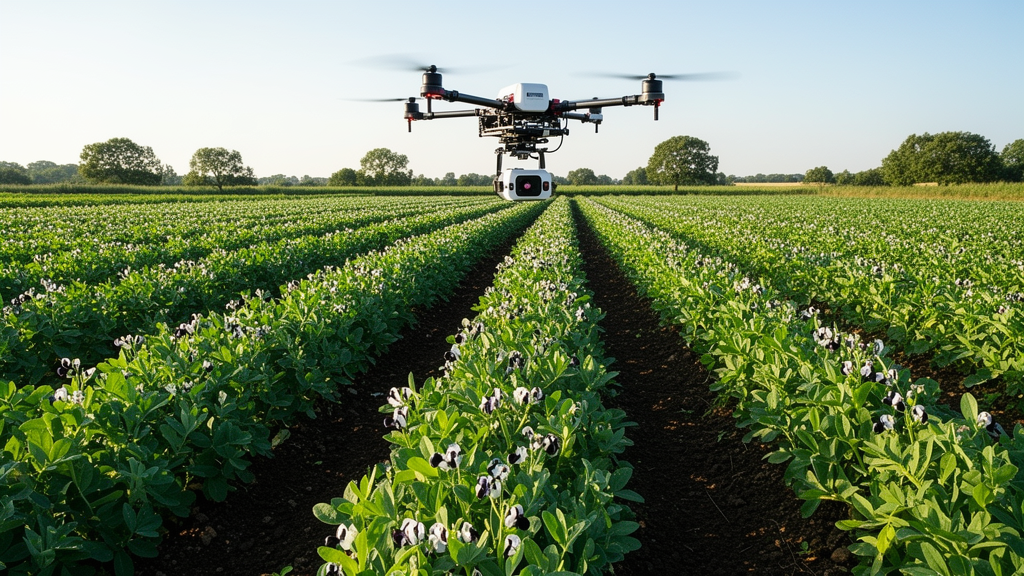
Unoccupied aerial vehicles, encompassing multirotor, fixed-wing, and vertical takeoff and landing configurations, have formed the primary aerial platform for multi-sensor phenotyping studies. Multirotor systems have seen the widest adoption due to their maneuverability, hovering capability, and low-altitude sensor stability. Evaluated aerial studies confirmed that while standalone consumer-grade visual cameras reliably capture plant height—where two-dimensional orthomosaics reached correlation coefficients of R² = 0.99 against ground-truth height measurements and R² = 0.78 to 0.84 for biomass and yield—fusing multiple sensor streams consistently delivered superior predictive power. Integrating visual, multispectral, and thermal imagery achieved fused yield predictions reaching R² = 0.75 compared to R² = 0.66 for visual imagery alone, although thermal sensors contributed minimal predictive power toward estimating dry biomass weight.
Analytical pipelines have increasingly shifted from basic linear modeling toward advanced machine learning and ensemble frameworks capable of handling complex non-linear interactions across large multi-sensor datasets. Across the evaluated literature, ensemble architectures, random forests, Ridge Regression, and extreme gradient boosting, known as XGBoost, routinely outperformed isolated base learners. Specific implementations demonstrated that XGBoost models supplied with fused multi-sensor inputs achieved yield predictions of R² = 0.79, while ensemble Bayesian model averaging delivered the strongest harvest index estimations with R² = 0.74. Furthermore, analytical performance varied significantly across the crop life cycle, with remote sensing data gathered during later reproductive and pod-filling stages generally exhibiting higher correlation coefficients and lower normalized root mean square error values compared to early vegetative measurements.
At the post-harvest and seed-quality level, near-infrared spectroscopy has emerged as a rapid, non-destructive analytical method for quantifying internal biochemical traits in intact and ground faba bean samples. By measuring infrared light absorption associated with specific molecular chemical bonds, spectroscopic instruments paired with partial least squares regression, Elastic Net, or Bayes B algorithms successfully predicted seed protein content with an accuracy of R² = 0.98, seed oil concentrations at R² = 0.86, and oleic acid levels at R² = 0.68. Related investigations documented that spectral preprocessing techniques such as Savitzky-Golay smoothing, vector normalization, and multiplicative scatter correction enhanced the estimation of bioactive phenolic compounds and anti-nutritional factors like vicine and convicine in milled flour samples.
Computer vision applications utilizing deep learning architectures represent the latest analytical frontier in faba bean phenotyping, though their scientific deployment remains in an early stage. Convolutional neural networks trained on multi-thousand image datasets achieved classification accuracies up to 90 percent when identifying common fungal pathologies, including chocolate spot caused by Botrytis fabae, rust caused by Uromyces viciae-fabae, and faba bean gall. Concurrently, object detection models such as YOLOv8 achieved a 95.10 percent accuracy in categorizing rust severity into healthy, moderate, and critical tiers within a processing latency of 10.1 milliseconds. More recently, airborne plant counting using YOLO12n achieved a mean average precision of mAP50 = 0.892 across ninety-six faba bean breeding lines, demonstrating viable automation for early-season stand establishment counts.
Despite these technological strides, the systematic review emphasizes critical limitations that currently hinder commercial scalability and broad operational deployment across agricultural landscapes. Most evaluated studies relied on single-season trials, modest sample sizes, and homogeneous field environments, leaving predictive algorithms vulnerable to overfitting and unverified across broader geographic regions. Real-world field conditions—such as variable sun angles, passing cloud shadows, wind-induced canopy motion, and background weed infestations—frequently distort imagery quality. The review concludes that future research must emphasize multi-year and multi-location field trials, automated ground robotics for real-time crop assessment, and hybrid machine learning architectures capable of detecting diseases beyond foliar tissues to encompass stem and root structures.
Subject of Research: High-throughput phenotyping and remote sensing technologies for faba bean crop assessment
Article Title: High-Throughput Phenotyping of Faba Bean Crop Using Remote Sensing Technologies and Data Analytics: A Systematic Assessment of Status and Trends Over Past Decade
Article References: Jjagwe, P., Chandel, A. K., & Balota, M. (2026). High-Throughput Phenotyping of Faba Bean Crop Using Remote Sensing Technologies and Data Analytics: A Systematic Assessment of Status and Trends Over Past Decade. Agricultural Research, 15(3), 1482-1496. https://doi.org/10.1007/s40003-026-01009-y
Image Credits: AI Generated
DOI: 10.1007/s40003-026-01009-y
Keywords: faba bean, Vicia faba, high-throughput phenotyping, remote sensing, unoccupied aerial vehicles, unoccupied ground vehicles, multispectral imaging, hyperspectral imaging, machine learning, deep learning, XGBoost, near-infrared spectroscopy, plant height estimation, yield prediction, crop disease detection, systematic review, PRISMA guidelines
News Source: Alan Morgan. (November 23, 2026). Decade Review Tracks High-Throughput Remote Sensing Advances for Faba Bean Phenotyping. Scienmag.