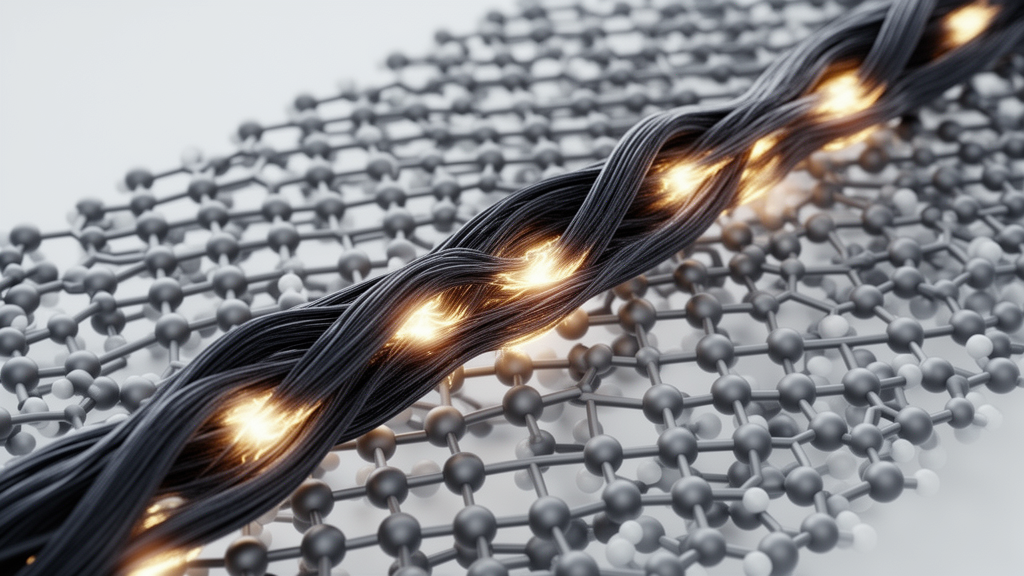
A narrative review published in Frontiers in Batteries and Electrochemistry indicates that the electrochemical performance of hybrid supercapacitor electrodes depends predominantly on the molecular architecture of the interface established between conductive polymers and two-dimensional nanomaterials, rather than simply on the individual intrinsic properties of each component. Supercapacitors have attracted significant research interest because they charge and discharge faster than traditional chemical batteries while maintaining superior durability over repeated cycling routines, yet creating electrodes that combine elevated energy density, rapid power delivery, and prolonged operational lifespan remains a fundamental challenge in modern energy storage. Conductive polymers such as polyaniline, polypyrrole, poly(3,4-ethylenedioxythiophene), and polythiophene deliver substantial pseudocapacitance through fast, reversible surface redox reactions and offer tunable synthetic chemistry, low cost, and high electronic conductivity. Nevertheless, these polymeric systems suffer from severe volumetric expansion and contraction during repeated doping and de-doping cycles, leading to internal mechanical stress, micro-cracking, film delamination, and eventual loss of electrical percolation. Two-dimensional nanomaterials, including graphene, graphene oxide, reduced graphene oxide, transition metal carbide or nitride MXenes, and transition metal dichalcogenides such as molybdenum disulfide and tungsten disulfide, provide very large surface areas, highly conductive pathways, and rapid ion-transport channels, but their theoretical charge-storage capabilities are routinely hindered by sheet restacking and limited electrolyte access to electrochemically active sites.
The evaluation conducted by Melih Beşir Arvas at Istanbul University demonstrates that hybridizing conductive polymers with two-dimensional nanomaterials mitigates the shortcomings of the isolated components only when interfacial coupling is intentionally engineered to optimize transport phenomena and mechanical durability. In these hybrid systems, the two-dimensional sheets act as mechanically compliant, highly conductive frameworks that support electroactive polymer layers, prevent excessive macroscopic deformation, and reduce charge-transfer resistance across the electrode matrix. However, simply mixing or co-depositing conductive polymers and two-dimensional nanosheets does not automatically yield synergistic performance. The review emphasizes that the physical and chemical interactions governing the heterojunction interface dictate the nucleation and growth behavior of the polymer chains, govern the uniformity of deposited coatings, regulate the accessible interlayer spacing between stacked sheets, and provide stress-buffering mechanisms during prolonged electrochemical operation. The author identified and analyzed relevant peer-reviewed studies published up to November 2026 across databases including Web of Science, Scopus, and Google Scholar, focusing primarily on investigations that coupled structural, spectroscopic, and morphological characterizations with quantitative electrochemical impedance spectroscopy and cycling durability data.
Among the primary interface engineering strategies surveyed, electrostatic assembly serves as a direct approach for creating hybrid electrodes by exploiting opposing surface charges between polymers and functionalized nanomaterials. Oxygen-containing functional groups on graphene oxide and hydrophilic terminal groups such as oxygen, hydroxyl, and fluorine on MXene nanosheets impart substantial negative surface charges in solution, which strongly attract positively charged monomers or protonated polymer backbones before and during chemical or electrochemical polymerization. In polyaniline and graphene oxide systems, electrostatic attraction promotes homogeneous monomer adsorption across the basal planes of the nanosheets, suppressing uncontrolled polymer agglomeration and preventing the severe restacking of graphene layers. Similarly, in polypyrrole and MXene composites, the electrostatic attraction between protonated pyrrole oligomers and terminal surface groups creates uninterrupted electrical pathways between the metallic-like MXene layers and the electroactive polymer chains. These electrostatically guided interfaces reduce equivalent series resistance, lower charge-transfer resistance, and enhance electrolyte-ion accessibility, thereby elevating measured specific capacitance and rate capability while retaining a well-distributed morphology across the active electrode surface.
To overcome the finite binding energy of physical electrostatic interactions, covalently engineered interfaces utilize specific chemical anchor groups to create durable linkages capable of enduring rigorous charging and discharging schedules. The review outlines how functional moieties, including carboxylic acid, amine, hydroxyl, and sulfonic acid groups, can covalently bridge conductive polymer chains with functionalized two-dimensional scaffolds. For instance, carboxyl-functionalized graphene derivatives react with amine-terminated monomers or polymers to form robust covalent bonds that physically anchor the electroactive phase to the underlying two-dimensional support. Introducing sulfonic acid groups to the interface not only provides strong covalent binding but also enhances the chemical compatibility between phases and facilitates the migration of electrolyte ions toward interior redox sites. Because covalent bonds possess significantly higher binding energies than purely physical contacts, they distribute mechanical stresses generated by redox-induced polymer volume changes uniformly throughout the electrode framework. This structural anchoring prevents polymer film detachment and micro-cracking during extended cycling, though researchers must balance the extent of covalent functionalization against potential disruptions to the continuous conjugated electronic structures of the materials.
Non-covalent interfacial mechanisms, particularly pi-pi stacking and extensive hydrogen bonding networks, offer alternative strategies to stabilize hybrid architectures without altering conjugated polymer backbones or introducing multi-step chemical reactions. Delocalized pi-electron systems in sp2-hybridized carbon frameworks, such as graphene and reduced graphene oxide, interact strongly with the conjugated aromatic rings of polypyrrole, polythiophene, polyaniline, and poly(3,4-ethylenedioxythiophene) through interfacial pi-pi stacking. These non-destructive interactions maintain intimate electronic contact, facilitate rapid charge transfer between adjacent nanosheets, and allow intercalated polymer chains to function as molecular spacers that inhibit sheet restacking and preserve electrolyte-accessible surface area. In complementary fashion, hydrogen bonding networks formed between hydroxyl surface terminations on MXenes or oxygen groups on graphene oxide and the amine or imine functional groups of polyaniline provide compliant interfacial adhesion. Although individual hydrogen bonds are inherently weaker than covalent linkages, dense interfacial networks of hydrogen bonds provide collective mechanical stability while offering sufficient flexural compliance to accommodate the reversible swelling and shrinkage of the polymer during continuous redox cycling.
The review details how these molecular-level interfacial interactions directly govern macroscopic electrochemical metrics, notably electronic conductivity, ion diffusion kinetics, and structural durability under high-current operating conditions. Incorporating highly conductive two-dimensional materials such as graphene or titanium carbide MXenes reduces polarization by establishing continuous electronic conduction networks that link otherwise isolated polymer domains. In electrochemical impedance spectroscopy, successful interface engineering manifests as marked reductions in both the uncompensated equivalent series resistance and the model-dependent charge-transfer resistance, accompanied by faster voltammetric responses at elevated scan rates. Simultaneously, regulating the interlayer spacing of nanosheets and introducing hierarchical porous architectures containing macropores, mesopores, and accessible micropores ensures rapid electrolyte penetration. Macropores act as entry reservoirs, interconnected mesopores serve as low-resistance ionic conduits, and subnanometer pores or interlayer galleries provide short diffusion pathways to deeply buried pseudocapacitive redox sites, thereby maintaining high electroactive material utilization even when cycling rates increase substantially.
Quantitative comparisons across representative hybrid systems compiled in the review demonstrate that interfacial design decisively dictates electrochemical performance and cyclic retention across diverse electrode configurations. For example, a three-dimensional titanium carbide MXene and polyaniline composite electrode delivered a gravimetric capacitance of 503 Farads per gram, retaining 98.3 percent of its initial capacitance after 10,000 cycles, while a thick-film variant with an active-material loading of 23.82 milligrams per square centimeter exhibited 336 Farads per gram. In a freestanding titanium carbide MXene, cellulose nanofiber, and polyaniline hybrid film, an areal capacitance of 2,935 millifarads per square centimeter was achieved alongside 94 percent retention after 2,000 cycles at 10 milliamperes per square centimeter, with the cellulose nanofibers acting as structural regulators that prevented nanosheet restacking without displacing the fundamental polymer-MXene interface. Other evaluated architectures include an all-solid-state flexible device based on an MXene-crosslinked poly(acrylic acid) hydrogel with polyaniline, which exhibited a device capacitance of 222 Farads per gram and retained 98.5 percent of its capacitance over 10,000 cycles, and a reduced graphene oxide, MXene, and polypyrrole film electrode demonstrating a rate retention of 67.3 percent when current density increased up to 10 Amperes per gram, alongside 91.2 percent cycling retention over 10,000 cycles at the device level.
A critical analytical contribution of the review is its rigorous examination of the methodological limitations and reporting inconsistencies that frequently obscure true mechanistic insights in the supercapacitor literature. The author underscores that spectral shifts observed in X-ray photoelectron spectroscopy, Fourier-transform infrared spectroscopy, or Raman spectroscopy provide evidence of changes in local chemical environments or conjugation states, but they do not uniquely prove the formation of specific covalent linkages or charge-transfer complexes without complementary controls. Similarly, scanning and transmission electron microscopy confirm morphology and nanosheet dispersion but cannot independently establish chemical bonding mechanisms. Furthermore, electrochemical impedance parameters such as the series resistance and fitted charge-transfer resistance reflect composite properties influenced by active-material mass loading, electrode thickness, current collector resistance, electrolyte composition, and equivalent circuit modeling choices. The review highlights that gravimetric, areal, and volumetric capacitances, as well as data derived from three-electrode half-cells versus complete two-electrode devices, cannot be directly converted or equated, cautioning that extraordinarily high specific capacitance measured in idealized laboratory settings often fails to translate to stable device-level performance.
In evaluating the fundamental technological barriers that currently impede commercial adoption, the author identifies ongoing challenges associated with dynamic interface stability, polymer degradation, and manufacturing scalability. Despite the mechanical reinforcement provided by two-dimensional matrices, repeated ion insertion and solvent expulsion during redox cycling inevitably induce localized mechanical strains that can weaken interfacial adhesion, leading to polymer delamination and irreversible capacity loss, especially in highly pseudocapacitive polyaniline and polypyrrole electrodes. Moreover, the natural tendency of two-dimensional nanosheets to restack through van der Waals forces requires precise tuning of interlayer spacing, as excessive separation compromises inter-sheet electrical conductivity while insufficient spacing restricts ion transport. Laboratory-scale fabrication methods involving hydrothermal synthesis, multi-step chemical functionalization, freeze-drying, and hazardous acid etching—particularly prominent in MXene preparation—entail significant energy consumption and processing costs. Bridging this gap demands scalable manufacturing approaches, such as printable conductive inks, spray coating, and roll-to-roll processing that minimize inactive binder content while maintaining reliable interfacial contact.
Looking toward future developments, the review argues that advancing next-generation hybrid supercapacitors requires shifting from empirical trial-and-error optimization toward mechanism-guided, predictive interface design. A major identified knowledge gap is the reliance on static ex situ characterization, which provides only pre- and post-cycling snapshots of dynamic electrode structures. The integration of operando characterization techniques, including operando Raman spectroscopy, in situ X-ray diffraction, electrochemical atomic force microscopy, and operando electrochemical impedance spectroscopy, will allow researchers to track real-time changes in polymer doping states, interlayer expansion, and interfacial degradation during charge storage. The author also emphasizes the potential of data-driven machine learning models and digital-twin frameworks to simulate localized ion concentration gradients, mechanical stresses, and degradation rates, thereby enabling the inverse design of hybrid interfaces. Coupled with self-healing polymer architectures that reversibly restore mechanical and electrical contacts via dynamic bonding, these rational engineering strategies aim to transition conductive polymer and two-dimensional material hybrid electrodes from promising laboratory demonstrations into technologically viable, high-durability energy storage devices.
Subject of Research: Interface engineering in conductive polymer and two-dimensional nanomaterial hybrid supercapacitor electrodes
Article Title: Interface engineering in hybrid supercapacitors using conductive polymers and two-dimensional nanomaterials: recent progress and future perspectives
Article References: Arvas, M. B. (2026). Interface engineering in hybrid supercapacitors using conductive polymers and two-dimensional nanomaterials: recent progress and future perspectives. Frontiers in Batteries and Electrochemistry, 5, 1972399. https://doi.org/10.3389/fbael.2026.1972399
Image Credits: AI Generated
DOI: 10.3389/fbael.2026.1972399
Keywords: supercapacitors, conductive polymers, two-dimensional nanomaterials, interface engineering, MXenes, graphene, polyaniline, polypyrrole, pseudocapacitance, charge transfer resistance, cyclic durability, rate capability, electrostatic assembly, covalent bonding, operando characterization, energy storage
News Source: Charles Cole. (November 23, 2026). Interface Engineering Boosts Performance in Hybrid Supercapacitors Combining Conductive Polymers and Nanomaterials. Scienmag.