Researchers have developed an adaptive federated learning architecture that integrates grey relational analysis to monitor student exercise load across intelligent physical education classrooms without transmitting private physiological data to central servers. In comparative evaluations across authoritative wearable computing benchmarks, the resulting framework, designated as FedGRA, demonstrated superior classification capability over conventional distributed training schemes, achieving an accuracy of 87.21 percent and a weighted F1-score of 84.86 percent on the multimodal PAMAP2 dataset, alongside an accuracy of 90.58 percent and an F1-score of 89.34 percent on the WISDM dataset. By combining edge-based spatiotemporal feature extraction with a cloud-level geometric similarity mechanism, the system addresses the persistent challenge of client drift triggered by severe biological diversity among student populations. The experimental findings establish that dynamically evaluating parameter trajectory alignment rather than relying solely on local data volume allows collaborative models to sustain high predictive precision while preserving edge device autonomy.
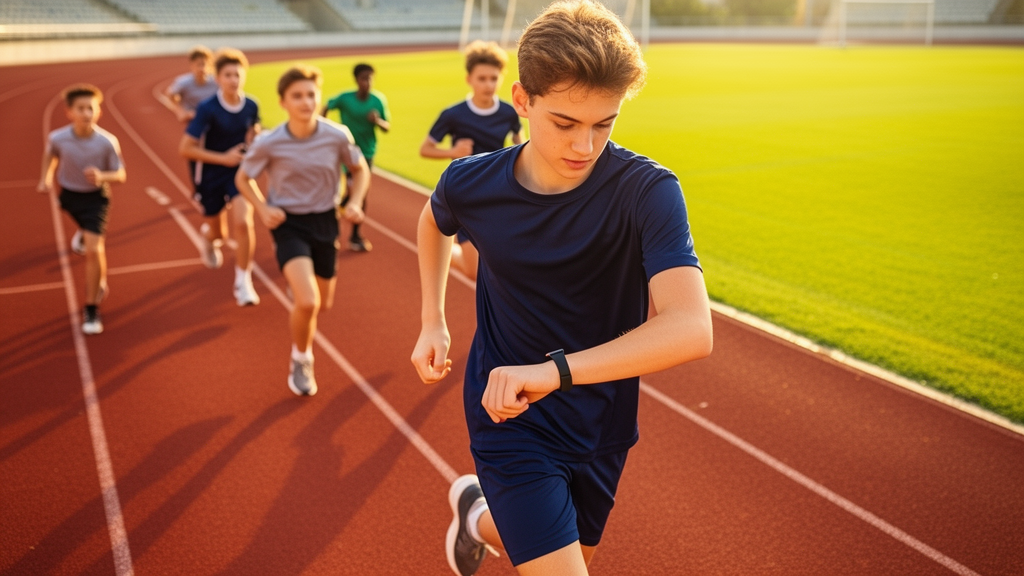
Contemporary physical education within Chinese primary schools, secondary institutions, and universities has increasingly shifted from traditional experiential coaching paradigms toward data-guided, smart instructional models. Precise real-time tracking of physiological strain enables instructors to evaluate pedagogical outcomes scientifically, adjust exercise intensity dynamically, and prevent physical injuries or excessive cardiovascular fatigue among exercising pupils. Conventional physical education assessment strategies, which historically relied on retrospective post-class pulse measurements or subjective exertion rating scales, lack sufficient continuous monitoring fidelity and objective diagnostic rigor. While the proliferation of wearable Internet of Things sensors has created opportunities to capture rich multidimensional physiological streams for deep learning analysis, centralizing these records poses profound operational and legal dilemmas. Students’ biometric trajectories and personal fitness habits constitute sensitive biometric measurements, and transferring raw physiological telemetry over campus network infrastructures introduces substantial bandwidth congestion alongside severe vulnerabilities to data exposure and privacy non-compliance.
Federated learning provides a decentralized paradigm wherein client devices train models locally on private data and transmit only parameter tensors to a central server for collaborative aggregation. However, implementing standard federated learning within physical education environments encounters acute obstacles stemming from non-independent and identically distributed data distributions. Pronounced physical differences in body mass, gender, cardiovascular endurance, and prior training experience create stark statistical divergence across student device nodes. Furthermore, inconsistent hardware placement, movement-induced shifts, and uncontrollable background sensor noise induce severe heterogeneity within both feature representations and class label distributions across participating clients. When conventional algorithms such as Federated Averaging aggregate global parameters, they apply static linear weights strictly proportional to the sample size of each local dataset under the unverified assumption of uniform data quality. Consequently, when anomalous nodes provide degraded updates due to sensor faults or erratic physical behaviors, static aggregation inadvertently assigns them substantial weight, causing severe client drift and slowing global convergence.
To overcome these architectural bottlenecks, the FedGRA architecture establishes a tripartite collaborative pipeline comprising privacy-preserving edge processing, localized neural optimization, and quality-aware cloud aggregation. Edge-level computation takes place on wearable hardware equipped with multimodal sensors that collect continuous time-series streams of triaxial acceleration, angular velocity, and instantaneous heart rate. Rather than transmitting raw signals to external infrastructure, each terminal processes its local data through a lightweight hybrid neural network that chains convolutional neural networks with long short-term memory layers. The initial convolutional layers extract spatial structural associations and cross-axis correlations from sensor signals, while the subsequent recurrent units capture progressive temporal dependencies across movement cycles. This compact design maintains localized computational efficiency while deriving expressive spatiotemporal feature representations for final exercise intensity classification, ensuring that highly sensitive biological signals remain confined strictly to each student’s personal hardware terminal throughout the collaborative training lifecycle.
Localized model optimization at each client node proceeds through iterative gradient adjustments directed by a supervised cross-entropy objective function. Given a designated local dataset containing multidimensional physiological sequences paired with discrete exercise load categories, the edge device calculates the logarithmic loss over evaluated class probabilities produced by the neural network’s final softmax layer. Client devices minimize this local loss across multiple localized epochs using mini-batch stochastic gradient descent, adjusting internal network weight tensors according to a configured learning rate. Upon concluding the localized training iterations, each client uploads its updated parameter tensor to the central aggregation server. In standard aggregation, client weight contributions are strictly tied to relative data volume, leaving the shared network unprotected against structurally distorted local updates. The FedGRA framework replaces this volume dependency by introducing a server-side reference sequence that mathematically synthesizes historical momentum from the preceding global round with the arithmetic mean of all uploaded client parameters.
At the center of the cloud aggregation stage lies a quality assessment module rooted in grey relational analysis, a mathematical methodology adept at evaluating geometric profile similarity within complex systems characterized by limited samples and incomplete structural knowledge. Traditional geometric metrics such as Euclidean distance or cosine angle frequently lose discriminatory sharpness when evaluating high-dimensional, non-convex parameter spaces. The FedGRA mechanism instead treats client parameter sets as multidimensional discrete curves and assesses their alignment with the synthesized global reference baseline. To ensure scale invariance across distinct neural network layers, the server normalizes the reference sequence and all uploaded client weight tensors along each individual parameter dimension via extreme-value Min-Max scaling. The server then computes dimension-wise grey relational coefficients using a resolution coefficient set to 0.5, measuring dimensional deviations between local updates and the reference trajectory before averaging these coefficients across all network dimensions to formulate a scalar relational grade for each client.
Transforming these calculated grey relational grades into operational aggregation weights requires an aggregation mechanism capable of suppressing harmful outliers without discarding valid local adaptations. Rather than employing a direct linear allocation, FedGRA maps client relational scores into global aggregation weights using a temperature-scaled Softmax function. This nonlinear exponential mapping functions as a rigorous quality filter: clients exhibiting low relational grades—indicative of gradient trajectories distorted by sensor noise or extreme statistical skew—receive weights that approach zero exponentially, effectively neutralizing their potential to degrade the global parameter state. Conversely, clients whose updates track the ideal reference trajectory closely receive amplified weighting factors. The temperature scaling hyperparameter governs the sharpness of this selection pressure, ensuring that the cloud server dynamically isolates aberrant updates while fusing legitimate, high-quality distributed feature knowledge into the revised global network.
Empirical evaluation of the FedGRA framework utilized two established public wearable sensing benchmarks, PAMAP2 and WISDM, to reproduce realistic classroom conditions. The PAMAP2 corpus comprises 25,480 samples gathered across triaxial acceleration, gyroscope, and heart rate modalities, distributed among 20 mock clients partitioned across four discrete exercise load intensities comprising 18 percent, 36 percent, 28 percent, and 18 percent of total records. The WISDM dataset contains 18,250 smartphone triaxial acceleration measurements assigned across 36 mock clients, categorized into four load tiers representing 22 percent, 41 percent, 24 percent, and 13 percent of the sample volume. To simulate variable data non-uniformity arising from student physiological diversity, researchers partitioned client data according to a Dirichlet distribution with concentration parameters spanning from an extreme heterogeneity level of 0.1, through moderate and mild tiers at 0.5 and 1.0, to a near-uniform distribution at 5.0. Classification performance was tracked using overall accuracy alongside a weighted F1-score to accommodate class imbalances across load tiers.
Across baseline comparisons against Local-Only, FedAvg, FedProx, Scaffold, and MOON algorithms, the FedGRA framework consistently attained superior classification and convergence performance. Under baseline experimental conditions, FedGRA reached an accuracy of 87.21 percent and an F1-score of 84.86 percent on the multimodal PAMAP2 benchmark, surpassing standard FedAvg by 4.22 percentage points in F1-score and outperforming the advanced contrastive learning algorithm MOON by 1.61 percentage points. On the WISDM dataset, FedGRA attained 90.58 percent accuracy and an 89.34 percent F1-score, exceeding FedAvg’s 84.18 percent F1-score. An ablation analysis on the PAMAP2 dataset further confirmed the structural necessity of each architecture layer: an isolated convolutional baseline aggregated via FedAvg attained an F1-score of 77.12 percent, incorporating the LSTM sequence module raised performance to 80.64 percent, and deploying the complete grey relational adaptive aggregation module elevated the steady-state F1-score to 84.86 percent, establishing the collective value of spatiotemporal feature modeling and dynamic quality filtering.
System robustness evaluations subjected competing distributed algorithms to simulated real-world classroom anomalies, including sensor signal corruption via Gaussian noise injection and coordinated data poisoning via label-flipping attacks across 20 percent and 40 percent of participating clients. When malicious clients constituted 40 percent of the network under label-flipping conditions, standard FedAvg suffered a catastrophic accuracy collapse exceeding 30 percent, and regularized frameworks such as FedProx and MOON experienced marked performance loss due to unconditional server-side gradient fusion. In contrast, FedGRA maintained stable classification with a minor performance fluctuation under 4 percent, as correlation tracking confirmed that corrupted nodes consistently received grey relational scores 40 percent to 50 percent lower than benign clients across consecutive rounds. Furthermore, communication analysis demonstrated that FedGRA accelerated convergence speed without altering per-round transmission size, requiring only 45 communication epochs to achieve an 80 percent target accuracy on PAMAP2, compared to approximately 120 epochs required by conventional FedAvg, even when the client participation ratio was constrained to 0.1.
Translating the FedGRA architecture into physical school environments involves addressing several practical engineering and network considerations identified by the investigators. Rapid body motions during competitive physical activities can cause wearable displacement and mechanical signal artifacts, necessitating standardized hardware configurations such as firmly secured smart wristbands worn on non-dominant wrists to preserve signal fidelity. Edge computing constraints on student wearables and personal mobile devices also demand ongoing thermal and battery management, which the authors addressed through compact network design and proposed quantization techniques to maintain real-time inference delays below a few hundred milliseconds. Additionally, simultaneous parameter uploads from dozens of student devices present risk of campus wireless network saturation, suggesting the future utility of asynchronous aggregation or hierarchical edge-cloud servers. Finally, because parameter exchanges remain vulnerable to gradient inversion or membership inference risks, prospective research will explore integrating differential privacy and cryptographic secure aggregation to reinforce mathematical privacy protections across educational deployments.
Subject of Research: Federated learning and grey relational analysis for student exercise load monitoring in smart physical education
Article Title: Study on students' exercise load monitoring in PE classroom based on the fusion of FedAvg and Grey relationship analysis
Article References: Ding, J., Huang, H., Sun, Q., Nie, X., & Zhou, Q. (2026). Study on students' exercise load monitoring in PE classroom based on the fusion of FedAvg and Grey relationship analysis. Systems and Soft Computing, 9, Article 200657. https://doi.org/10.1016/j.sasc.2026.200657
Image Credits: AI Generated
DOI: 10.1016/j.sasc.2026.200657
Keywords: federated learning, grey relational analysis, exercise load monitoring, physical education, wearable sensors, spatiotemporal features, CNN-LSTM, data privacy, non-IID data, client drift, multimodal sensing, PAMAP2 dataset, WISDM dataset, adaptive aggregation, edge computing, temperature scaling, label flipping attack, Dirichlet distribution
News Source: Denise Maddox. (November 23, 2026). Federated Grey Relational Framework Accurately Monitors Student Exercise Load. Scienmag.