Transportation activity stands as one of the most prominent contributors to worldwide greenhouse-gas output, responsible according to Intergovernmental Panel on Climate Change accounting for approximately fifteen percent of total global greenhouse-gas emissions and twenty-three percent of global energy-related carbon dioxide emissions in 2019. Within this sectoral boundary, road vehicles historically produced seventy percent of direct transport emissions, while international aviation and maritime shipping accounted for roughly twelve percent and eleven percent, respectively. By 2025, total global energy-related carbon dioxide output reached nearly 38.4 gigatonnes, underscoring an enduring reliance on petroleum-derived liquid fuels across international supply chains and passenger networks. In response to these persistent climate impacts, electrification has emerged as the primary technological pathway to achieve deep decarbonization. Yet an extensive engineering review authored by Kaushik Rajashekara from the University of Houston emphasizes that substantial commercial momentum within passenger road transport does not imply equal technical readiness across heavier, more demanding mobility sectors.
Commercial adoption of electric propulsion has accelerated rapidly in road travel, with global sales of electric passenger cars exceeding twenty million units in 2025 to capture a twenty-five percent market share of all new passenger vehicles sold worldwide. This swift expansion has been underpinned by an estimated ninety percent decline in light-duty battery pack costs between 2008 and 2023, achieved through cell-manufacturing scale, optimized chemical formulations, and advanced physical pack architecture. Rail traction has likewise functioned as an established, largely electrified baseline where remaining challenges center on institutional and economic factors rather than fundamental technical hurdles. However, the operational success achieved in light-duty electric automobiles cannot be directly transferred to commercial aviation, deep-sea maritime shipping, level-four autonomous platforms, or electric vertical-takeoff-and-landing aircraft. Each of these emerging transport domains encounters distinct duty cycles, physical payload limitations, and safety requirements that rule out standardized, one-size-fits-all battery installations.
The engineering analysis identifies a foundational architecture comprising six strongly coupled functional domains that govern all electrified transport systems regardless of operational medium: the primary energy source or fuel storage, electrical power conversion equipment, electric machines and mechanical propulsors, thermal management systems, electrical distribution and circuit protection, and the external refueling or charging infrastructure. Technological optimization cannot focus on component-level efficiencies in isolation, because design modifications in one domain trigger immediate trade-offs across the remaining subsystems. For example, elevating nominal system bus voltage diminishes operating current at a specified power, thereby reducing conductor mass and resistive losses, but simultaneously introduces severe insulation stresses, partial-discharge risks, and elevated fault-interruption complexity. Similarly, increasing semiconductor switching frequencies lightens passive magnetic elements while amplifying electromagnetic interference and thermal dissipation challenges, proving that vehicle architecture must be optimized around real-world mission profiles.
Two universal systems-engineering principles govern the selection of vehicle propulsion architectures across diverse transportation duty cycles. First, direct electrification using electrochemical batteries provides the highest end-to-end efficiency and the simplest infrastructure profile whenever operating ranges and payload schedules permit, primarily because it bypasses the thermodynamic penalties of synthesizing, handling, and converting intermediate energy carriers. Second, when gravimetric or volumetric storage constraints become prohibitive, alternative chemical energy carriers such as hydrogen, ammonia, methanol, and sustainable hydrocarbon fuels must serve as necessary complements. The genuine environmental performance of these chemical fuels depends heavily on upstream production pathways, leakage prevention, distribution logistics, and onboard conversion efficiency. Consequently, technological comparisons require rigorous life-cycle accounting across component, vehicle, energy-system, and mobility boundaries rather than simple tank-to-wheel metrics.
In road transportation, battery energy storage continues to dictate overall vehicle mass, economic cost, and manufacturing complexity despite major advances in commercial lithium-ion cells. Pack engineering requires a delicate balance among driving range, fast-charge acceptance, calendar life, structural crashworthiness, and cell-to-cell thermal runaway mitigation. Upstream dry-electrode processing, solvent recovery protocols, and nondestructive battery diagnostic methods are equally critical to lower initial production footprints and support circular materials recycling.
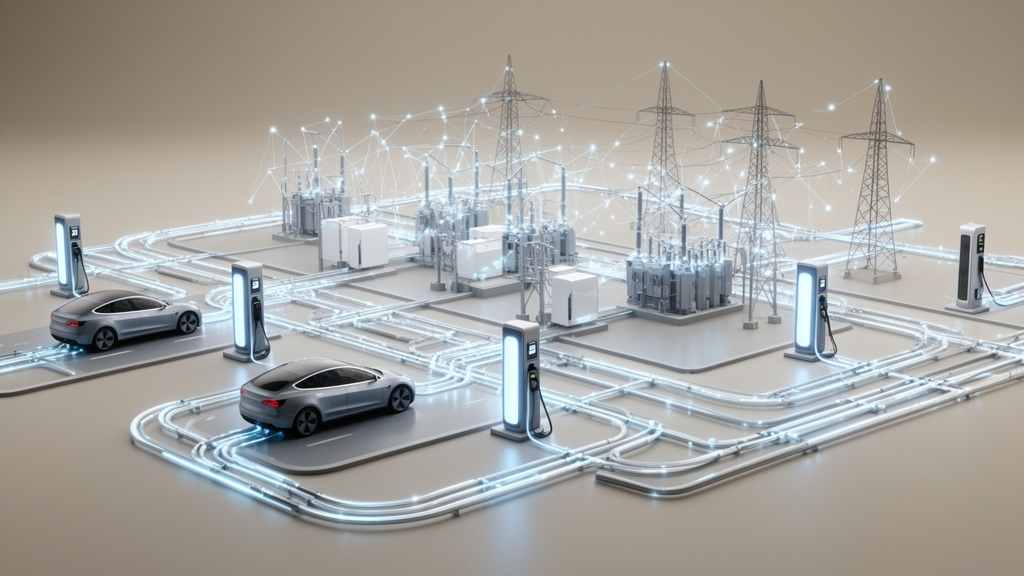
The operational performance of electric road vehicles is tightly coupled to charging infrastructure, where extreme fast charging functions as a coordinated power-electronics, thermal, and electrical distribution challenge. Charging speed is governed not by charger nameplate power alone, but by dynamic interactions among battery temperature, cell state of charge, connector limits, active cable cooling, and local utility capacity. Transitioning from traditional 400-volt architectures to 800-volt systems reduces current requirements and cable heating, yet demands upgraded contactors, continuous isolation monitoring, and wide-bandgap silicon carbide traction inverters capable of withstanding high voltage slew rates. For commercial heavy-duty trucks, depot charging can require simultaneous multi-megawatt connections, producing severe localized power spikes that necessitate on-site energy storage, coordinated charging schedules, local renewable generation, and medium-voltage direct-current microgrids to protect regional utility distribution feeders from unmanageable peak loads.
Aviation introduces the most rigorous mass constraints in transportation engineering, because commercial aircraft must carry their total energy-storage and cooling mass throughout flight, unlike jet-fuel engines that become lighter as fuel burns. NASA estimates indicate that future single-aisle transport aircraft may require propulsive power ranging from 3 to 20 megawatts, a scale at which traditional industrial machines are unacceptably heavy. Megawatt-scale aeronautical motors, such as NASA’s 1.4-megawatt High-Efficiency Megawatt Motor, must deliver efficiencies exceeding 98 percent alongside power densities well beyond conventional hardware. High-altitude operations aggravate thermal management because low-density air severely reduces convective heat transfer, turning even tiny percentage losses into heavy cooling burdens. Furthermore, operating high-voltage direct-current networks at low atmospheric pressures dramatically elevates the risk of destructive partial discharge and electrical arcing, requiring advanced high-speed solid-state circuit breakers, segmented fault-tolerant bus architectures, and arc-resistant cabling.
Aviation electrification consequently encompasses a continuum of architectures spanning all-electric, turboelectric, and hybrid configurations. However, achieving net-zero emissions in larger commercial aircraft demands hybrid systems, sustainable aviation fuels, or cryogenic liquid hydrogen. Demonstrating the potential of hydrogen, a modified electric vertical-takeoff-and-landing prototype completed an 842-kilometer test flight in 2024 using a liquid-hydrogen fuel cell powering six electric motors, touching down with approximately ten percent of its fuel remaining. Despite this milestone, production implementations must overcome immense engineering challenges related to cryogenic tank design, boil-off management, system water handling, and formal certification frameworks under civil airworthiness regulations.
Maritime transportation displays a similar operational divide governed by voyage length and duty cycle, driven by International Maritime Organization targets mandating at least a twenty percent reduction in annual shipping greenhouse gases by 2030 and striving for eighty percent reduction by 2040 relative to 2008 baselines. Short-route operations are technically viable for pure battery power, as demonstrated by the 130-meter ferry China Zorrilla built in Tasmania for Rio de la Plata service between Argentina and Uruguay, which incorporates more than 5,000 lithium-ion cells totaling approximately 40 megawatt-hours for repeated one-hour crossings on a single charge. Conversely, transoceanic commercial vessels operate for weeks without shore contact and require vast energy reserves, necessitating alternative low-carbon fuels including green methanol and ammonia. A modern electric vessel functions as an isolated microgrid where port and starboard bus segmentation, selective fault isolation, waste-heat recovery, and standardized shore-side cold ironing are essential to prevent catastrophic blackout events at sea.
The integration of autonomous driving capabilities introduces substantial, continuous parasitic auxiliary loads that directly degrade vehicle propulsion efficiency and usable range. A contemporary sensor and perception suite generates between 10 and 50 gigabits per second of raw data from multicamera arrays, radar, lidar, and inertial sensors, demanding high-performance onboard computing platforms that approach the kilowatt scale. Experimental measurements by Brown and colleagues demonstrated that an auxiliary computing and sensing stack drawing 446.7 watts reduced overall electric vehicle range by 12.2 percent over a combined urban and highway drive cycle. To mitigate this penalty, engineering efforts are focusing on energy-proportional computing architectures, including event-driven sensor activation, dynamic voltage and frequency scaling, model compression, and domain-specific hardware accelerators that dynamically throttle electrical power consumption during low-demand operating phases without compromising passenger safety.
Electric vertical-takeoff-and-landing aircraft represent one of the most mechanically and aerodynamically demanding electrification frontiers, pairing high hover power requirements with stringent acoustic limits and aviation-grade fault tolerance. While distributed multirotor and tilt-propeller arrangements offer mechanical simplicity and control authority, vehicle configurations must manage critical single-point failures across high-voltage distribution buses, power converters, and battery packs. Regulatory progress was marked in 2024 when the Federal Aviation Administration issued a final rule establishing operational and pilot qualification standards for powered-lift aircraft. Nonetheless, broad commercial entry depends on model-based safety assurance, validated digital engineering twins, low-noise propulsor designs, and the development of urban vertiport facilities capable of providing megawatt-scale battery charging alongside safe passenger and emergency handling.
Ultimately, advancing transportation electrification from passenger cars into heavy-duty freight, maritime vessels, and commercial aviation requires shifting from isolated component improvements to cross-sector systems engineering. Key technological building blocks—including rare-earth-lean permanent-magnet and reluctance motors, wide-bandgap silicon carbide and gallium nitride converters, fast solid-state circuit interruption, and grid-interactive managed charging—deliver transferable benefits across ground, air, and marine applications. Because electrification substitutes mechanical assemblies with complex software and power electronics, long-term success hinges on multidisciplinary co-design, standardized digital certification frameworks, and robust low-carbon infrastructure that collectively expand global mobility while achieving verifiable life-cycle emissions reductions.
Subject of Research: Systems engineering constraints and cross-sector technological innovations in transportation electrification
Article Title: CHALLENGES AND INNOVATIONS FOR TRANSPORTATION ELECTRIFICATION
Article References: Rajashekara, K. (2026). CHALLENGES AND INNOVATIONS FOR TRANSPORTATION ELECTRIFICATION. Technology and Innovation, 1-13. https://doi.org/10.1080/19498241.2026.2755261
Image Credits: AI Generated
DOI: 10.1080/19498241.2026.2755261
Keywords: transportation electrification, electric vehicles, electrified aircraft propulsion, marine electrification, autonomous electric vehicles, eVTOL aircraft, wide-bandgap semiconductors, silicon carbide, high-voltage direct-current protection, solid-state circuit breakers, megawatt charging, battery energy density, liquid hydrogen fuel cells, energy-proportional computing, model-based assurance, rare-earth-lean machines
News Source: Denise Maddox. (November 23, 2026). Cross-Sector Analysis Reveals Systems Engineering Hurdles Across Transportation Electrification Pathways. Scienmag.