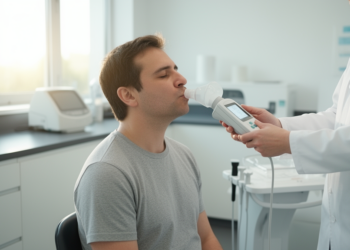
A prospective multicenter physiological investigation has established that resting lung diffusing capacity for carbon monoxide serves as the sole independent predictor of exertional breathlessness, ventilatory inefficiency, dynamic mechanical constraints, and reduced peak oxygen consumption in long-term smokers presenting with chronic respiratory symptoms despite normal or near-normal spirometry. Conducted across three Canadian specialized exercise physiology laboratories at Queen’s University, the University of Alberta, and the University of British Columbia, the cross-sectional clinical study addressed a frequent and complex diagnostic dilemma encountered in pulmonary medicine: individuals with extensive cumulative cigarette smoke exposure who suffer from debilitating activity-related dyspnea and functional exercise limitations yet demonstrate unremarkable or only minimally obstructed expiratory airflow on standard post-bronchodilator spirometric testing. While contemporary international consensus reports and global respiratory commissions have advocated investigating advanced resting pulmonary function modalities to uncover subclinical abnormalities, the relative diagnostic and clinical value of detailed airway mechanics assessments compared to alveolar-capillary gas transfer tests has remained largely uncharacterized until now.
To evaluate these underlying pathophysiological mechanisms, the clinical investigators enrolled a carefully selected cohort of ninety volunteer participants aged forty years and older who had a body mass index between 18.5 and 40 kilograms per square meter and no confounding cardiovascular, neuromuscular, or musculoskeletal comorbidities capable of independently limiting exercise tolerance or generating dyspnea. The study population comprised thirty-three healthy non-smoker control volunteers with smoking histories of less than three pack-years alongside fifty-seven current or former smokers possessing a substantial tobacco inhalation history of at least ten pack-years. The smoking participants were stratified physiologically according to prospective spirometric criteria: twenty-one individuals demonstrated preserved ratio spirometry, defined as a post-bronchodilator forced expiratory volume in one second to forced vital capacity ratio of at least 0.70 with a forced expiratory volume in one second of at least 80 percent of predicted values, whereas thirty-six individuals met the criteria for mild chronic obstructive pulmonary disease classified as Global Initiative for Chronic Obstructive Lung Disease Grade 1, defined by a fixed ratio below 0.70 accompanied by a preserved expiratory volume of at least 80 percent predicted.
Symptomatic eligibility requirements ensured that all enrolled smokers without spirometric airflow obstruction exhibited meaningful functional disability, verified by a modified Medical Research Council dyspnea scale score of two or higher, a Chronic Obstructive Pulmonary Disease Assessment Test score of ten or greater, or documented baseline functional abnormalities including lung hyperinflation, pulmonary gas trapping, or impaired diffusion capacity. Over seventy percent of participants were actively recruited from broad community settings through direct digit dialing, public advertisements, and word-of-mouth outreach, while less than thirty percent were referred from tertiary outpatient chest clinics, thereby capturing a representative sample of community-dwelling adults exhibiting early or mild respiratory impairment rather than advanced hospital-based disease. The clinical evaluation protocol comprised two comprehensive laboratory sessions scheduled at identical times of day separated by an average interval of thirty-two days to facilitate rigorous test-retest reproducibility evaluations across the three academic testing centers.
The baseline testing protocol during the initial clinical visit encompassed standardized questionnaires detailing respiratory symptom burden, medical history, physical activity profiles, and detailed pulmonary function testing administered via automated SensorMedics instrumentation adhering strictly to consensus quality standards. Respiratory physiological assessments included pre-bronchodilator and post-bronchodilator spirometry, whole-body plethysmography, single-breath carbon monoxide diffusing capacity, respiratory system impedance measured via Jaeger impulse oscillometry in concordance with international recommendations, and both single-breath and multiple-breath nitrogen washout procedures. All pulmonary function indices were derived as absolute values, percent predicted, and standard deviation z-scores using Global Lung Function Initiative multi-ethnic reference equations, establishing the lower limit of normal at the fifth percentile of reference distributions corresponding to a z-score below negative 1.645. Between-visit test-retest reliability across the academic sites demonstrated good to excellent intraclass correlation coefficients exceeding 0.75 for all resting modalities except nitrogen washout functional residual capacity, although derived impulse oscillometry parameters exhibited substantially greater coefficients of variation.
During the second physiological evaluation visit, participants completed an incremental cardiopulmonary exercise test performed on an electronically braked cycle ergometer to symptom limitation, generating detailed metabolic, gas-exchange, dynamic ventilatory, and perceptual measurements. Symptom intensity ratings for perceived respiratory distress and leg discomfort were monitored continuously using the validated Borg zero-to-ten category-ratio scale, synchronized with continuous breath-by-breath recordings of minute ventilation, oxygen uptake, carbon dioxide output, and end-tidal gas tensions. Dynamic operating lung volumes were tracked throughout exercise via serial inspiratory capacity maneuvers performed at rest and regular submaximal exercise intervals, allowing investigators to quantify progressive dynamic hyperinflation and define the exact inflection points where tidal volume expansion encroached upon inspiratory reserves, expressed as the critical ratio of tidal volume to inspiratory capacity relative to total ventilatory demand.
The initial resting physiological data demonstrated marked differences across cohorts despite comparable group demographics in age and anthropomorphic characteristics. While all participants maintained post-bronchodilator forced expiratory volumes within statistically normal boundaries exceeding the lower limit of normal, smokers exhibited modest reductions in expiratory volume compared to non-smokers alongside significant increases in residual volume to total lung capacity ratios, with elevations most pronounced in Grade 1 disease. Furthermore, resting single-breath diffusing capacity and the carbon monoxide transfer coefficient were significantly depressed across all smoking cohorts relative to non-smoking controls, demonstrating graduated declines from preserved ratio smokers to individuals with mild obstruction. In contrast, resting impulse oscillometry measures of total respiratory resistance and reactance demonstrated substantial overlap between smokers and non-smokers, although the frequency-dependent resistance between five and twenty Hertz was significantly elevated among obstructed smokers.
During incremental cardiopulmonary exercise stress, symptomatic smokers displayed significant functional impairment across nearly every physiological domain compared to healthy controls, culminating in markedly reduced peak work rates and diminished peak oxygen consumption. Exertional breathlessness ratings and perceived peripheral leg fatigue increased sharply at equivalent mechanical workloads in all smoking groups, accompanied by inefficient ventilation reflected in substantially elevated minute ventilation to carbon dioxide production nadir values and depressed end-tidal carbon dioxide tensions. Although overall tidal volume and breathing frequency trajectories were statistically similar between aggregate groups, smokers with mild airflow obstruction developed dynamic lung hyperinflation characterized by an average ten percent decline in inspiratory capacity from rest to peak exercise, precipitating critical mechanical inspiratory constraints at significantly lower workloads and lower minute ventilations than participants with preserved spirometric ratios.
To establish which resting pulmonary function parameters best accounted for this observed variance in clinical exercise intolerance, the investigators conducted comprehensive univariate and stepwise multilinear regression modeling adjusting for participant age, sex, standing height, and cumulative pack-year smoking history. Stepwise regression models confirmed that resting carbon monoxide diffusing capacity was the only independent pulmonary function variable that systematically predicted peak exertional dyspnea relative to oxygen uptake, reduced peak exercise capacity, elevated ventilatory inefficiency nadir values, and dynamic mechanical inspiratory constraints quantified by tidal volume to inspiratory capacity ratios normalized for minute ventilation. In contrast, resting impulse oscillometry variables, including peripheral resistance and resonant frequency, exhibited only weak univariate associations with peak oxygen consumption and mechanical constraint and failed to maintain independent predictive significance in multivariate models, while low-frequency reactance showed no statistical association with exercise responses.
These statistical associations were further reinforced when participants were stratified directly by their resting diffusion status, comparing individuals exhibiting a diffusing capacity below the fifth percentile lower limit of normal against those with preserved diffusion above the threshold. Smokers with diffusing capacity values below normal demonstrated heightened dyspnea scores during incremental exercise, paired with severe ventilatory inefficiency, reduced end-tidal carbon dioxide levels, and accelerated mechanical constraint at standardized submaximal workloads of sixty and eighty watts. The researchers emphasized that when ventilatory requirements are pathologically elevated due to microvascular or alveolar gas exchange impairment, exercising individuals must generate excessive minute ventilation, rapidly driving tidal volume toward total inspiratory capacity and placing an intense elastic load upon the inspiratory musculature that magnifies central motor drive and heightens subjective breathlessness.
The study authors identified several methodological limitations, noting that the cohort represented a relatively homogeneous and modest sample of ninety individuals with minor baseline mechanical abnormalities whose characteristics might not generalize to patients with severe airway obstruction or differing phenotypic presentations such as isolated peripheral flow limitation with preserved diffusion. Furthermore, resting hemoglobin concentrations were obtained through medical record review rather than prospective sampling on testing days, and concurrent high-resolution computed tomography was unavailable to quantify exact extents of anatomical emphysema or pulmonary vascular pruning. In addition, smokers exhibited elevated exertional leg fatigue that might reflect peripheral skeletal muscle deconditioning or tobacco-induced myopathy uncaptured by respiratory testing. Nevertheless, the investigators concluded that when evaluating symptomatic smokers whose standard spirometry appears unremarkable, quantifying resting carbon monoxide diffusing capacity provides superior clinical and physiological insight into exercise limitation, highlighting the necessity of advanced diffusion assessment and continued longitudinal monitoring.
Subject of Research: Clinical utility of carbon monoxide diffusing capacity versus airway mechanics for assessing persistent exertional dyspnea in symptomatic smokers with normal or mildly obstructed spirometry
Article Title: Clinical Assessment of Smokers with Persistent Dyspnoea but Unremarkable Spirometry: The Added Value of Diffusing Capacity for Carbon Monoxide
Article References: James, M. D., Vincent, S. G., Elbehairy, A. F., Phillips, D. B., Neder, J. A., Dhillon, S. S., Ryerson, C. J., Tan, W., Guenette, J. A., Stickland, M. K., & O’Donnell, D. E. (2026). Clinical Assessment of Smokers with Persistent Dyspnoea but Unremarkable Spirometry: The Added Value of Diffusing Capacity for Carbon Monoxide. COPD: Journal of Chronic Obstructive Pulmonary Disease, 23(1), Article 2705831. https://doi.org/10.1080/15412555.2026.2705831
Image Credits: AI Generated
DOI: 10.1080/15412555.2026.2705831
Keywords: diffusing capacity for carbon monoxide, exertional dyspnea, spirometry, impulse oscillometry, cardiopulmonary exercise testing, chronic obstructive pulmonary disease, small airways dysfunction, ventilatory efficiency, dynamic hyperinflation, GOLD grade 1 COPD, pulmonary gas exchange, body plethysmography, nitrogen washout, transfer coefficient, respiratory mechanics, inspiratory capacity, peak oxygen uptake
News Source: Ophelia Keating. (November 23, 2026). Lung Diffusing Capacity Predicts Breathlessness in Smokers With Preserved Spirometry. Scienmag.