Credit: Kobe University
A Japanese research team has become the first in the world to discover that 2-aminobutyric acid (2-AB) is closely involved in the metabolic regulation of the antioxidant glutathione, and that it can effectively raise levels of glutathione in the body when ingested. The findings were published in the online version of Scientific Reports on November 9.
Glutathione, an antioxidant with antidotal properties, plays an important role in keeping us healthy. This finding could contribute to the development of new ways to prevent, diagnose and treat various oxidative stress-related conditions including Alzheimer's, aging, cancer, lifestyle-related diseases, hardened arteries, and organ damage caused by medicines and toxins.
The team was led by Kobe University Graduate School of Medicine, Division of Evidence-Based Laboratory Medicine Assistant Professor IRINO Yasuhiro and Associate Professor TOH Ryuji, in collaboration with Professor HIRATA Ken-ichi (Kobe University, Division of Cardiovascular Medicine) and Professor MIYATA Okiko (Kobe Pharmaceutical University, Medicinal Chemistry Laboratory)
Glutathione is a major antioxidant component within cells, and keeps our bodies healthy by contributing to the detoxification of foreign substances. Monitoring glutathione metabolism in the body can help with early diagnosis of illness, as glutathione is consumed when bodies experience oxidative stress. However, glutathione concentration in the blood is 100- to 1000-fold lower than levels within cells, making it hard to accurately measure. Our bodies also compensate for the depletion of glutathione under stress, so circulating levels will not necessarily decrease during illness. This makes it difficult to accurately monitor the metabolism of glutathione just by measuring its levels in the blood.
Increasing levels of glutathione in the body could help to prevent and treat a variety of conditions which involve oxidative stress and organ damage caused by toxins. However, simply ingesting glutathione does not efficiently increase glutathione levels in the body.
2-aminobutyric acid (2-AB) has been reported as a basic component of ophthalmic acid, which is produced when glutathione is synthesized. Until now, the metabolism and physiological effects of 2-AB itself were unknown. The group investigated whether 2-AB could be a marker for glutathione dynamics, and whether it could be used to modulate glutathione homeostasis.
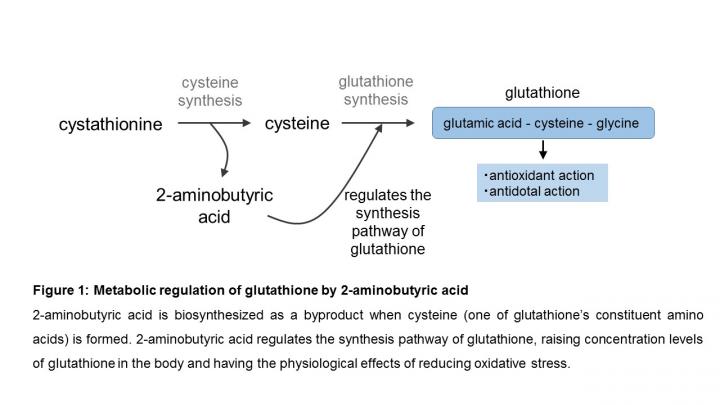
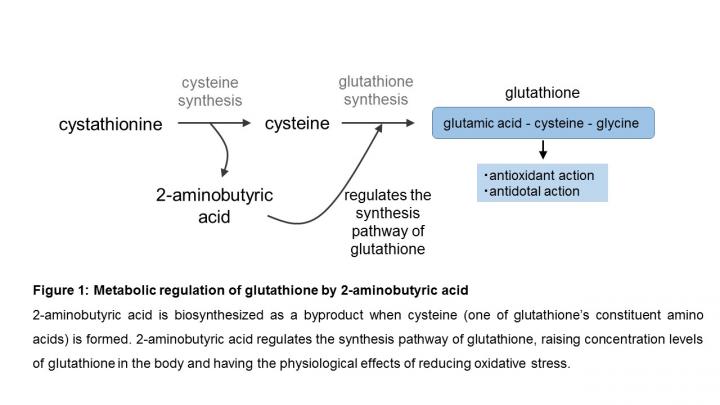
Searching for leads to develop new diagnoses and treatment to combat heart failure, the group started by comprehensively analyzing metabolites in the bloodstreams of atrial septal defect patients using a gas chromatography mass spectrometer. Results showed that levels of 2-AB were higher in these patients than in healthy subjects, and 2-AB levels decreased after the closure of atrial septal defect. Then, the group clarified for the first time that 2-AB is a byproduct of cysteine, one of the constituent amino acids of glutathione (figure 1), and revealed that activation of glutathione synthetic pathway under oxidative damage led to 2-AB accumulation. Because blood concentration of 2-AB reflects the metabolism of glutathione within the body, 2-AB could potentially be used as a new biomarker for early detection of oxidative stress.
Intriguingly, the group also found that 2-AB promotes glutathione synthesis. The anticancer drug doxorubicin causes heart damage via oxidative stress as an adverse effect. They discovered that when taken orally, 2-AB increases the concentration of glutathione in the bloodstream and the heart, lessening the heart damage caused by doxorubicin (figure 2).
This research found that as well as being a biomarker, 2-AB itself is an antioxidant that can be used to effectively increase glutathione in the body (patent pending). 2-AB is a naturally-occurring amino acid that can be found in everyday food products. Future research will examine which foods contain high levels of 2-AB, the recommended level to ingest, whether it can be used as an antioxidant for other organs, and the development of medicines and functional food for clinical use.
###
Media Contact
Eleanor Wyllie
[email protected]
@KobeU_Global
http://www.kobe-u.ac.jp/en/