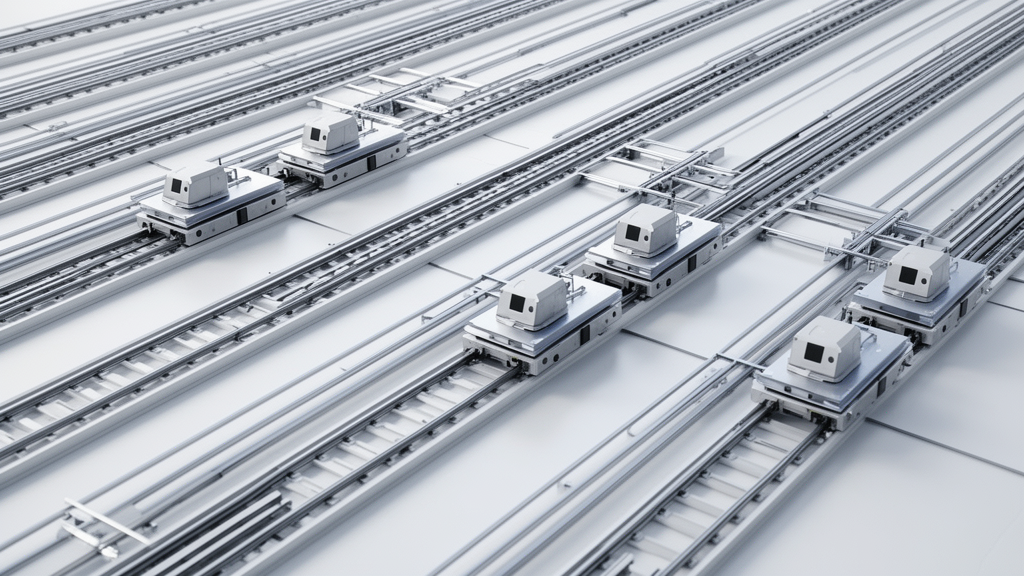
Railway freight operations frequently require sorting disordered groups of railcars into precise configurations before departing outbound trains, a microscopic logistics problem that researchers have now resolved using an exact mixed-integer linear programming model and a customized branch-and-bound algorithm. In classification yards, primary drop-off procedures and gravitational humping systems efficiently divide incoming trains across storage tracks, yet these processes cannot always form the exact sequence required for delivery along a route. When residual sequences remain disordered, repeating full humping maneuvers consumes considerable terminal capacity. Addressing this operational challenge, a research team led by Gongyuan Lu, Zili Shen, Xuesong Zhou, Bojian Zhang, and Xiaobo Liu developed an optimization framework designed specifically for multi-stage flat shunting operations, focusing on the microscopic movement costs of individual railcars alongside mesoscopic locomotive actions.
Flat shunting operations take place within rail terminals where trains are rearranged without the assistance of a gravitational hump, meaning a shunting locomotive must repeatedly couple, pull, push, and decouple railcars using a leading track and a set of shunting tracks. The physical layout of these yards imposes a strict first-in-last-out condition, meaning that railcars can only be coupled or decoupled from one open end of a given track. Because freight cars spend roughly sixty percent of their overall transit time inside rail terminals, enhancing the efficiency of train marshaling represents a substantial operational concern. Classical train marshaling formulations, known historically as the train marshaling problem or rolling stock sorting problem, have generally focused on minimizing engine pull-back maneuvers. However, the researchers observed that two distinct operational schedules requiring the exact same number of engine pull-back actions can produce radically different numbers of intermediate car roll-ins and microscopic railcar movements.
To capture these overlooked operational dynamics, the investigators constructed a mathematical model that tracks the discrete state transitions of every railcar across both the shunting tracks and the engine-connected slots on the leading track. In their mixed-integer linear programming formulation, multi-index binary variables represent the distribution of railcars across designated spatial slots before and after each engine operation. The mathematical model accounts for the strict first-in-last-out physical constraint by treating both the shunting tracks and the locomotive assembly as discrete stacks where couplings and decouplings occur exclusively at the open outer boundary. Moreover, the formulation explicitly incorporates capacity thresholds, defining the finite storage limits of individual shunting tracks as well as the maximum number of cars the shunting engine can pull or push simultaneously along the leading track.
A primary mathematical contribution of the study is the exact formulation of railcar movement counts without relying on approximation errors. Each engine maneuver inherently requires two trips: moving toward a track and subsequently moving backward. Consequently, counting the actual movement of railcars involves quadratic interactions between binary action selection variables and the sum of active railcars present across adjacent execution steps. The authors reformulated these quadratic relationships into linear inequalities by introducing big-M parameters bounded strictly by the physical capacity of the leading track. Through this exact linearization, the model computes the cumulative volume of pull-back car movements and assignment movements alongside total pull-back and push-in engine actions, integrating them into a composite objective function governed by configurable weighting coefficients.
Because tracking the microscopic transition of every single railcar dramatically increases computational complexity, the resulting mixed-integer linear programming model generates an immense number of variables and constraints. For example, sorting an instance involving ten railcars, seven destination stations, and five shunting tracks generates 163,552 decision variables and 202,951 mathematical constraints. Standard commercial solvers such as CPLEX and Gurobi struggle to find optimal solutions for instances of this scale within reasonable timeframes, frequently failing to achieve termination or even establish feasible integer solutions on larger benchmarks. To overcome these computational barriers, the authors designed a specialized branch-and-bound algorithm structured around recurrent operational cycles of collecting and assigning railcars.
In the customized branch-and-bound algorithm, the search tree mirrors the physical cycle of yard operations, alternating systematically between a collecting phase and an assignment phase. A collecting node branches on two sequential decisions: selecting which specific shunting track the engine must visit, and enumerating how many cars to decouple and pull onto the leading track. Conversely, an assignment node evaluates three distinct operational choices: selecting the recipient tracks, isolating which railcars to detach from the locomotive, and determining the exact distribution of those cars across the designated tracks. To prune unpromising branches across this expansive search space, the authors integrated lower-bound cost estimations derived from the minimum theoretical pull-back, assignment, and car movement costs required to transfer all displaced cars onto the target departure track.
To further accelerate search convergence, the investigators introduced a branching reduction heuristic based on a quantitative metric termed the sequencing state measure. This metric calculates the non-negative differences between the destination indices of adjacent railcars, summing these differences across a train to quantify its deviation from an ideal, monotonically ordered sequence. Evaluating yard states by determining the minimum representative sequencing state measure obtainable through train coupling, the authors formulated a monotonic decrease proposition: along an optimal flat shunting schedule, the sequencing state measure decreases monotonically across successive operations until reaching zero. By pruning branches that violate this monotonic progression, the heuristic dramatically tightens the exploration tree while preserving access to high-quality schedules.
The computational performance of the algorithm was evaluated across multiple benchmark instances using an Intel Core i5 personal computer with eight gigabytes of memory, comparing standard CPLEX 12.8, the baseline branch-and-bound algorithm, a feasibility-rule variant, and the sequencing state measure heuristic under a standardized thousand-second execution limit. In controlled tests, CPLEX failed to find optimal solutions for small instances within the allotted timeframe and could not identify feasible solutions for medium and large problem instances. In contrast, the branch-and-bound algorithm resolved small cases in approximately one percent of the time required by the commercial solver. When augmented with feasibility rules, the algorithm pruned roughly ninety-six percent of explored nodes, slashing computation time by more than ninety-nine percent on benchmark instance 1c. Incorporating the sequencing state measure heuristic yielded additional improvements, saving an extra 80.6 percent of execution time in instance 1e and discovering a superior objective value of 2686 in instance 1f, where prior configurations stalled.
Numerical experiments applying varied weighting schemes demonstrated that optimizing microscopic car movements directly enhances overall shunting quality beyond classical engine-count minimization. In an illustrative four-car sorting problem across three tracks, incorporating car movement penalties into the objective function eliminated two pull-back car movements and six assignment car movements compared to schemes focusing solely on engine actions. When benchmarked against the classical manual drop-off method on a ten-car, four-track scenario, the branch-and-bound algorithm matched the baseline’s optimal five pull-back steps while reducing roll-in operations from ten to nine. Crucially, the optimization reduced pull-back car movements from 46 to 38 and roll-in movements from 90 to 70, achieving an overall 20.6 percent reduction in cumulative car movements.
Sensitivity analyses further revealed that engine action counts and car movement volumes do not vary in direct proportion. Under balanced weighting scenarios where pull-back and assignment actions were penalized equally, total car movements fell by 75.3 percent while maintaining a constant total of fourteen engine actions.
Subject of Research: Mathematical optimization of railway flat shunting operations and railcar movement costs
Article Title: An exact approach to the flat shunting problem with a focus on car movement cost optimization
Article References: Lu, G., Shen, Z., Zhou, X., Zhang, B., & Liu, X. (2026). An exact approach to the flat shunting problem with a focus on car movement cost optimization. Railway Engineering Science. https://doi.org/10.1007/s40534-026-00454-3
Image Credits: AI Generated
DOI: 10.1007/s40534-026-00454-3
Keywords: railway engineering, flat shunting, train marshaling problem, mixed-integer linear programming, branch-and-bound algorithm, railcar movement cost, first-in-last-out, sequencing state measure, freight yard operations, combinatorial optimization, classification yard, locomotive scheduling, linearization, rolling stock sorting, operational research, terminal logistics
News Source: Denise Maddox. (November 23, 2026). Exact Algorithm Optimizes Microscopic Railcar Movements in Multi-Stage Flat Yard Shunting. Scienmag.