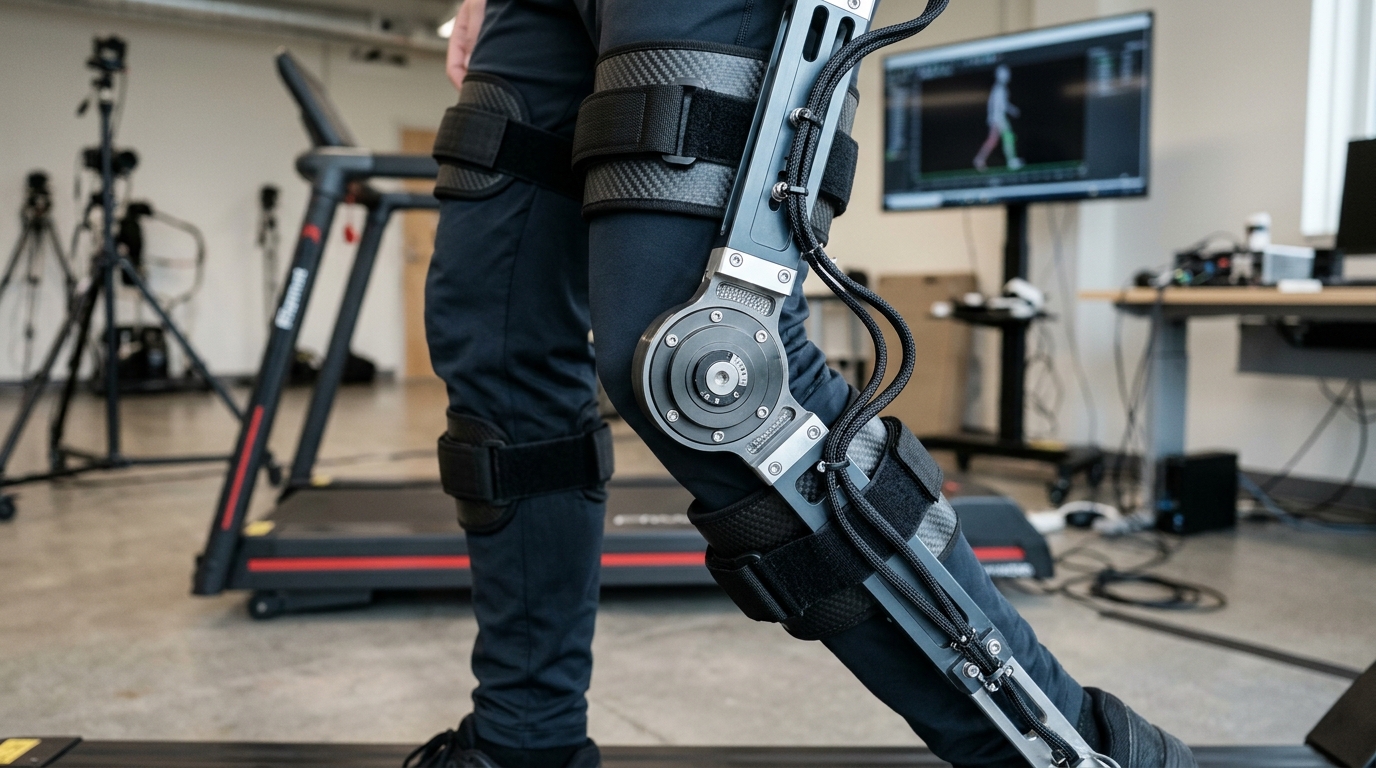
Wearable upper-limb robotic exoskeletons have shown substantial clinical value in physical rehabilitation therapies, yet ensuring that mechanical joints strictly adhere to therapeutic trajectories under close human-robot interaction remains a foundational challenge in control engineering. Standard clinical regimens demand that assistive devices move patients along predetermined motion profiles within rigorous timing schedules to promote neuromuscular recovery. However, existing control methodologies frequently struggle to simultaneously achieve rapid convergence, maintain robust resistance against lumped uncertainties, and guarantee patient safety. Conventional trajectory-tracking approaches for wearable exoskeletons predominantly employ sliding mode control, model-predictive control, robust adaptive control, or intelligent algorithms that exploit neural networks and fuzzy logic. While these strategies have advanced rehabilitation technology, robotic devices must still contend with complex time-varying uncertainties, including unmodeled dynamics, external disturbance torques, and interaction torques induced by the deviation between the target trajectory and the patient’s actual joint motion.
To overcome convergence delays, control theorists have increasingly implemented finite-time and fixed-time stabilization frameworks in exoskeleton prototypes. Finite-time control laws guarantee that tracking errors settle to zero within a finite period; however, the upper bound of this convergence time is tightly coupled to the system’s initial state. If an initial displacement or angular error is large, the settling time increases substantially, preventing clinicians from enforcing predictable therapeutic timings. Fixed-time control formulations were subsequently introduced to eliminate this dependence on initial states by establishing a uniform settling bound governed entirely by internal controller parameters. Nevertheless, because these mathematical bounds are fixed functions of specific algorithmic gains, operators cannot freely preset an arbitrary settling time to match tailored clinical protocols. In rehabilitation robotics, where specific joint exercises must conform to explicit, pre-planned movement schedules, neither finite-time nor fixed-time methods offer the required operational flexibility.
Addressing these fundamental constraints, researchers Gaowei Zhang, Jiawei Gao, Jie Wang, and Xi Vincent Wang have formulated an observer-based prescribed-time control scheme applied to a two-degrees-of-freedom upper-limb exoskeleton subject to external and interaction disturbances. Documented in the journal Digital Engineering, their investigation establishes a mathematical framework wherein the system’s tracking errors and disturbance estimation errors converge to zero within a designer-selected time bound. Unlike existing prescribed-performance or adaptive structures that often rely on complex fractional-order or parameter-heavy calculations, this control architecture explicitly decouples the closed-loop convergence duration from initial state conditions and system physical parameters. By incorporating a time-varying scaling function into both a state observer and a backstepping sliding mode controller, the engineers provide a deterministic guarantee that wrist joint movements track targeted trajectories while strictly remaining inside preset safety boundaries.
The physical system analyzed in the investigation focuses on an upper-limb exoskeleton configured to actuate two degrees of freedom at the human wrist: internal and external rotation, designated as Joint 1, and flexion and extension, designated as Joint 2. Utilizing the Lagrangian modeling principle, the authors established the dynamic equations governing the two-joint exoskeleton. The resulting mathematical formulation represents joint angles, angular velocities, and angular accelerations as two-dimensional vector states coupled through a symmetric positive-definite inertia matrix, a Coriolis and centrifugal force matrix, and a gravitational torque vector. Actuator inputs supply control torques to the two mechanical joints, but the system must continuously counter external disturbance torques and the human-robot interaction torques arising from patient-exoskeleton biomechanical deviations. By converting the second-order Lagrangian differential equations into a state-space representation, the researchers expressed the mechanical acceleration as a function of the internal dynamics, the control inputs, and an integrated lumped disturbance term.
To formulate a mathematically rigorous tracking protocol, the research team established key analytical assumptions regarding the trajectory demands and disturbance profiles. The reference trajectory, defining desired joint angles for the wrist, and its first two time derivatives are assumed to be continuous and bounded throughout the movement cycle. Similarly, the integrated disturbances and their time derivatives are treated as bounded and continuous signals, satisfying a known positive upper bound constant. Within this operational framework, the control objective is twofold: first, to construct a prescribed-time disturbance observer capable of estimating unknown lumped disturbances and feeding compensation values directly to the controller within a user-chosen time; and second, to synthesize a continuous and bounded control input that drives trajectory tracking errors to zero within that same prescribed duration while confining transient errors within strict, preset safety boundaries.
The core mechanism enabling predefined convergence is a smooth prescribed-time scaling function that begins at zero at the start of operation and monotonically increases across the open time interval toward the designated settling time. As the operational time approaches the prescribed boundary, the scaling function’s integral tends toward positive infinity, establishing an escalating scaling factor that drives state variables to zero before the boundary is reached. Leveraging this scaling structure, the investigators devised a prescribed-time disturbance observer that reconstructs unmeasured lumped forces using velocity estimation errors, constant gain parameters, sign functions, and dynamic auxiliary terms. Through Lyapunov stability analysis and Young’s inequality, the authors demonstrated that the difference between the actual lumped disturbance and the observer’s reconstructed estimate converges strictly to zero within the user-specified time bound, completely independent of the starting values of the robotic system.
Building upon the disturbance observer, the authors synthesized a prescribed-time sliding mode controller by decomposing the two-degree-of-freedom exoskeleton model into an angular position subsystem and an angular velocity subsystem. Introducing a transformed tracking error that multiplies position error by the time-varying scaling function, the design incorporates a non-singular transformed coordinate vector. This structural choice relaxes restrictive initial condition assumptions common in earlier literature, allowing initial tracking errors to assume arbitrary magnitudes while guaranteeing that the error remains confined within dynamic boundaries defined by the inverse of the scaling function. The controller generates a virtual velocity control law for the angular subsystem and a comprehensive feedback law for the velocity subsystem. The control input combines the computed robot dynamics, the estimated disturbance compensation, auxiliary variables, and a continuous saturation function designed with a narrow boundary layer to eliminate high-frequency chattering vibrations in the actuators.
The theoretical validity of the integrated control framework was established through a unified Lyapunov stability proof. By constructing a composite Lyapunov function summing the quadratic forms of the disturbance estimation error and the subsystem tracking variables, the authors evaluated the time derivative of the closed-loop system. The resulting differential inequality revealed that negative feedback terms, scaled by the time-varying function, dominate the perturbations across the entire pre-convergence interval. Because the disturbance estimation error vanishes within the prescribed window, residual perturbation terms decay to zero as time reaches the target boundary. Consequently, the authors proved that all closed-loop signals, virtual states, and physical control torques remain uniformly bounded, and both tracking errors and disturbance observation errors converge identically to zero at the specified convergence time, verifying global prescribed-time stability without relying on initial error magnitudes.
To evaluate the numerical performance and practical feasibility of their control scheme, the researchers conducted detailed simulation experiments within the MATLAB and Simulink software environments, utilizing physical model parameters from their previously published exoskeleton studies. The simulation configured the desired reference trajectories for the two wrist joints as sinusoidal functions of time, setting the controller gains, observer parameters, and scaling coefficients to specific constant values, with the disturbance derivative bound set to 1.5. To test tracking under substantial displacement, the initial joint angles were initialized at thirty radians for Joint 1 and negative fifteen radians for Joint 2. The prescribed convergence time for both the disturbance observer and the sliding mode controller was explicitly fixed at two seconds, challenging the algorithm to achieve zero-error tracking and full disturbance compensation within that narrow, pre-set operational window.
The simulation results demonstrated rapid and precise convergence of the exoskeleton’s mechanical trajectories toward the target motion profiles. The actual joint angles converged to the reference curves within one second, and by the designated two-second time limit, tracking errors across both wrist joints had shrunk below ten to the power of negative four radians. Throughout this transient phase, the error trajectories remained strictly enclosed inside the prescribed safety bounds, preventing dangerous mechanical overshoots. Furthermore, the motor output torques generated by the actuators remained smooth and entirely devoid of chattering phenomena, confirming that the saturation function effectively eliminated control discontinuities. In parallel, the prescribed-time disturbance observer tracked the synthetic time-varying disturbances, matching the disturbance trajectory within two seconds and achieving high reconstruction accuracy well before the prescribed settling threshold.
To substantiate that the control scheme operates independently of initial error magnitudes, the investigators conducted additional numerical runs under four widely dispersed initial condition vectors, spanning positive and negative angular displacements. Across all four diverse starting states, the trajectory errors conformed to the same two-second prescribed time limit and remained strictly confined within the analytical performance envelopes at every time instant. These comparative runs proved that unlike traditional finite-time approaches, where larger initial displacements inevitably extend the settling timeline, the proposed scaling formulation enforces a uniform convergence deadline regardless of the patient’s starting limb configuration.
The authors further highlighted the advantages of their architecture through comparative simulations against two baseline control methodologies from the published literature. First, they benchmarked their algorithm against a traditional prescribed-time control method. While the baseline technique eventually converged, it failed to keep system errors within prescribed performance boundaries during transient phases characterized by time-varying disturbances. In contrast, the newly proposed framework strictly enforced error boundaries throughout the entire response period. In a second comparison against a conventional finite-time sliding mode controller utilizing identical disturbance observer feedback, the baseline controller exhibited a decaying convergence rate as errors decreased near the origin, with its ultimate settling duration dictated by initial system energy. The proposed strategy, by contrast, adjusted its effective gains via the time-varying scaling function to drive tracking error to zero exactly at two seconds.
These numerical findings confirm that integrating a time-varying scaling function with backstepping sliding mode control and an observer provides an effective solution for robotic rehabilitation tasks requiring strict adherence to temporal schedules. By enabling clinicians to directly preset convergence intervals while guaranteeing that joint positions remain within deterministic safety envelopes, the design addresses key operational limitations of fixed-time and finite-time systems. Supported by rigorous Lyapunov stability analysis and multi-condition simulations, the two-degree-of-freedom framework establishes a mathematically sound foundation for advancing safe, robust, and precisely scheduled human-robot physical therapy.
Subject of Research: Observer-based prescribed-time sliding mode control for a two-degrees-of-freedom upper-limb rehabilitation exoskeleton subject to lumped disturbances
Article Title: An observer-based prescribed-time control scheme for a two-degrees-of-freedom upper-limb exoskeleton with disturbances
Article References: Zhang, G., Gao, J., Wang, J., & Wang, X. V. (2027). An observer-based prescribed-time control scheme for a two-degrees-of-freedom upper-limb exoskeleton with disturbances. Digital Engineering, 12, Article 100139. https://doi.org/10.1016/j.dte.2026.100139
Image Credits: AI Generated
DOI: 10.1016/j.dte.2026.100139
Keywords: upper-limb exoskeleton, prescribed-time control, sliding mode control, disturbance observer, rehabilitation robotics, trajectory tracking, Lyapunov stability, human-robot interaction, wrist rehabilitation, time-varying scaling functions, state-space dynamics, numerical simulation, saturation function, chattering suppression, performance boundaries, convergence bounds, Lagrangian modeling
News Source: Denise Maddox. (November 22, 2026). Prescribed-Time Controller Enforces Exact Convergence and Bounds for Robotic Exoskeleton Tracking. Scienmag.