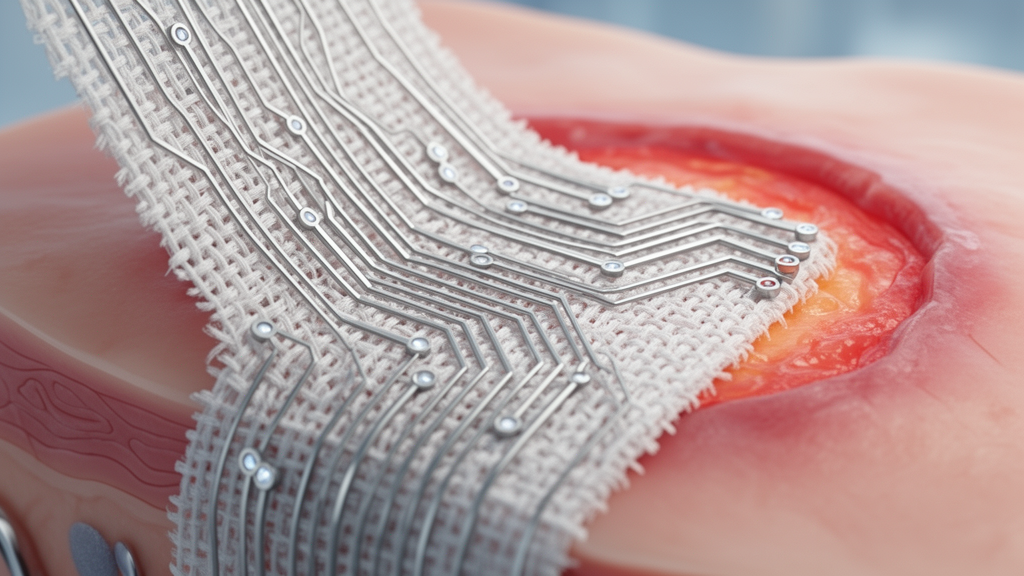
Researchers have engineered a flexible, breathable microiontronic textile that uses electrobioactive ion gating to deliver precise, programmable doses of medication directly to cutaneous wounds. By integrating laser-induced graphitization on conventional textile fabrics with electropolymerized conducting polymers, the experimental platform overcomes longstanding trade-offs between rigid electronic delivery devices and conventional passive wound dressings. In preclinical testing evaluating the device on dorsal skin wounds in mice, the electrically triggered textile accelerated tissue regeneration and achieved 99.2 percent wound closure within two weeks, outperforming passive patches and untreated control conditions without inducing harmful thermal effects.
Conventional topical drug delivery systems, such as hydrogels, polymer films, and electrospun fibrous mats, rely predominantly on passive mass transport mechanisms including diffusion, swelling, and matrix degradation. Although these traditional dressings offer soft mechanical compliance and breathability, their passive nature makes real-time control over therapeutic dosage difficult to achieve. Passive systems frequently suffer from an initial burst release followed by declining concentrations, which impedes the dynamic adjustment of drug dosing required across evolving stages of tissue repair. Conversely, systemic administration through oral ingestion or intravenous injection often distributes therapeutics indiscriminately throughout the body, causing low local bioavailability at the wound bed alongside elevated systemic burdens.
To provide external, on-demand control over topical therapeutics, researchers have turned to active delivery platforms actuated by physical stimuli such as light, ultrasound, magnetic fields, and electrical currents. Electrically driven mechanisms offer distinct advantages at the cutaneous interface because they operate under safe, relatively low actuation voltages, provide rapid response times, and interface seamlessly with digital control electronics. Conducting polymers such as polypyrrole are uniquely suited for these platforms due to their mixed electronic and ionic conductivity. However, prior conducting polymer systems typically relied on dense, two-dimensional thin-film architectures, such as coated polyimide films. These planar configurations feature restricted internal cavity volume for accommodating ionic drug molecules, exhibit sluggish mass diffusion kinetics, and severely compromise air permeability and skin conformability during movement.
The newly reported microiontronic platform resolves these architectural limitations by establishing a multiscale, three-dimensional porous structure that preserves the intrinsic flexibility and breathability of woven textiles. Using an ink-free and mask-free commercial carbon dioxide laser operating at a 10.6-micrometer wavelength, 8.5 percent of full 60-watt power, and a scan speed of 170 millimeters per second with a 15-millimeter defocus distance, the team converted a commercial polyimide textile into conductive laser-induced graphene. This direct-writing process formed conductive backbones exhibiting an electrical conductivity exceeding 100 siemens per meter while retaining the original warp-weft intersticed microfibrillar network and preserving mechanical compliance, water-vapor transmission, and electrical stability across 50 repeated bending cycles.
Following the formation of the conductive graphene scaffold, the researchers in-situ electrosynthesized a functional polypyrrole interface within the inherent porous channels of the textile. Chronoamperometric electropolymerization was executed at a constant potential of 0.8 volts for one hour in an aqueous precursor solution containing 0.2 moles per liter of pyrrole monomer alongside 0.01 moles per liter of the selected therapeutic or model dopant. This electrochemical synthesis created an irregular, nano-cavitied intercalation morphology where densely aggregated nanoscale polymer protrusions enveloped the underlying graphene lamellas, establishing continuous electrical percolation networks and abundant accessible electroactive sites throughout the three-dimensional fibrous framework.
The operating mechanism of the microiontronic textile relies on the reversible electrochemical doping and dedoping properties of polypyrrole’s conjugated molecular backbone. During oxidative electropolymerization, the sp2-hybridized polymer chains develop positively charged radical cation sites that electrostatically attract and entrap counteranionic drug molecules to preserve overall electroneutrality. Theoretical modeling using density functional theory calculations at the B3LYP/6-31G* level confirmed complementary electrostatic potential distributions and favorable non-covalent interactions between the polymer chains and model dopant molecules. Cathodic polarization subsequently suppresses the hole carrier density of the polymer framework, triggering electrostatic ion exchange and controlled structural relaxation that expels the sequestered therapeutic molecules into surrounding media.
To evaluate the release kinetics and electrical responsiveness of the microiontronic textile, the authors first investigated the delivery of a model anionic molecule, phenol red, across various potentiostatic settings in phosphate-buffered saline at pH 7.2. When held at an electrical potential of 0 volts, representing the off-state, the textile demonstrated negligible passive leakage, maintaining baseline confinement of the entrapped molecules. Upon applying cathodic potentials, the platform exhibited tiered release kinetics, delivering cumulative concentrations of 6.4 micromoles per liter at -0.3 volts and 78 micromoles per liter at -0.9 volts within 60 minutes. The initial release rates scaled from 0.21 micromoles per liter per minute at -0.3 volts to 2.64 micromoles per liter per minute at -0.6 volts and 5.80 micromoles per liter per minute at -0.9 volts.
Comparative benchmarking highlighted significant structural advantages of the three-dimensional microiontronic textile over conventional dense planar films. A planar polyimide film coated with polypyrrole achieved a model drug loading capacity of 2095 micrograms per square centimeter, whereas the hierarchical microiontronic textile achieved 3374 micrograms per square centimeter, representing an enhancement of approximately 1.61 times. Furthermore, under an applied cathodic bias of -0.9 volts, the planar film exhibited an initial release rate of 3.83 micromoles per liter per minute, compared to 5.80 micromoles per liter per minute in the textile platform. Scanning electron microscopy and energy-dispersive X-ray spectroscopy confirmed the progressive, potential-dependent reduction of elemental sulfur from 5.9 percent down to 5.3 percent at -0.3 volts and 1.4 percent at -0.9 volts, while the fibrous textile architecture remained physically intact.
To establish therapeutic utility, the researchers fabricated wearable bandages containing dexamethasone phosphate disodium, a potent glucocorticoid used to regulate inflammation and support cutaneous healing. The dexamethasone-loaded microiontronic textile displayed voltage-dependent release kinetics mirroring the model system, with release rates under -0.9 volts being approximately five times higher than those observed under -0.3 volts. Ultraviolet-visible absorption spectroscopy across the 200 to 600 nanometer spectrum demonstrated that released dexamethasone retained its characteristic 242-nanometer absorption profile and structural integrity without chemical degradation during the electrochemical actuation process.
Preclinical evaluation in male BALB/c mice between 6 and 8 weeks of age verified the in vivo therapeutic performance of the integrated three-electrode textile patch applied directly over dorsal skin wounds. In mice receiving electrochemically triggered treatment consisting of a 15-minute stimulation period at -0.9 volts immediately following patch application, planimetric analysis documented accelerated wound contraction compared to untreated control wounds and passive, unstimulated patches. By day 14, wounds treated with the -0.9 volt triggered patch achieved 99.2 percent closure, whereas the -0.3 volt triggered patch group reached a residual wound area ratio of 6.5 percent, the passive patch reached 9.1 percent, and electrical stimulation alone without drug release yielded 16.7 percent, nearly identical to the untreated control at 16.2 percent.
Histological and immunofluorescence evaluations conducted on day 14 confirmed favorable tissue remodeling and immune modulation beneath the electro-triggered dressing. Hematoxylin and eosin staining revealed continuous re-epithelialization and restored epidermal and dermal architecture, while Masson’s trichrome staining showed mature, well-organized collagen deposition characteristic of reduced scarring. Concurrently, immunofluorescence staining revealed marked downregulation of both inducible nitric oxide synthase, a marker of pro-inflammatory M1 macrophages, and cluster of differentiation 206, indicating an overall phenotypic shift toward pro-resolution tissue recovery. Temperature monitoring during electrical actuation showed negligible Joule heating, confirming that the accelerated wound healing stemmed directly from programmed drug release rather than non-specific thermal or electrical phenomena.
Subject of Research: Wearable microiontronic textiles for programmable topical drug delivery in wound management
Article Title: A Hierarchical Microiontronic Textile with Electrobioactive Ion Gating for Wearable and Programmable Topical Drug Delivery Towards Smart Wound Management
Article References: Qian, J., Yuan, Y., & Mak, W. C. (2026). A Hierarchical Microiontronic Textile with Electrobioactive Ion Gating for Wearable and Programmable Topical Drug Delivery Towards Smart Wound Management. Advanced Fiber Materials. https://doi.org/10.1007/s42765-026-00799-8
Image Credits: AI Generated
DOI: 10.1007/s42765-026-00799-8
Keywords: microiontronics, smart textiles, topical drug delivery, wound healing, conducting polymers, polypyrrole, laser-induced graphene, controlled drug release, electrochemical actuation, dexamethasone, wearable bioelectronics, intercalation, e-textiles, macrophage polarization, preclinical therapeutics, electronic-ionic coupling
News Source: Denise Maddox. (November 22, 2026). Smart Microiontronic Textile Delivers Programmable Wound Healing in Preclinical Testing. Scienmag.