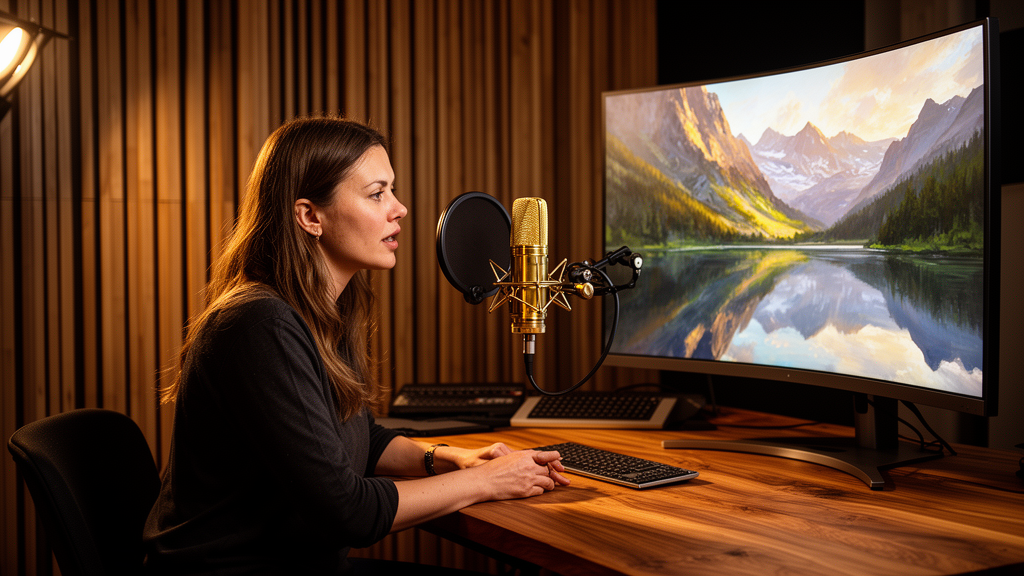
A multimodal framework combining speech-guided entity consistency networks and temporal acoustic attention has demonstrated substantial improvements in generating photorealistic images directly from continuous speech signals without intermediate text transcriptions. Developed to address fundamental obstacles in cross-modal machine learning, the architecture resolves persistent issues where generative systems confuse acoustically identical homophones or invert subject roles during complex pronoun sequences. By integrating self-supervised phoneme representations with structured memory buffers and adversarial generation, the system achieved a Fréchet Inception Distance of 11.87 and an entity-action accuracy of 99.23 percent across standard speech-caption benchmarks, marking a significant technical advancement over previous end-to-end and retrieval-based speech-to-image architectures.
Direct speech-to-image generation aims to synthesize photorealistic, semantically aligned visual scenes straight from spoken audio waveforms, bypassing conventional automatic speech recognition pipelines that transcribe spoken words into text before feeding them into text-to-image generators. While removing text transcription avoids compounding transcription errors, direct conversion presents distinct challenges due to the fundamental modality gap separating speech and vision. Speech signals are continuous, unaligned, and highly susceptible to background noise, regional accent variation, and coarticulatory shifts. Unlike textual descriptions, which present discrete lexical tokens simultaneously, spoken utterances arrive sequentially over time. This incremental arrival forces conventional generative frameworks to commit prematurely to visual features before hearing the full syntactic context, often resulting in severe single-entity bias and role-swapping errors where actions are assigned to the wrong grammatical subjects.
A critical barrier in direct speech-driven synthesis involves phonetic ambiguity, most notably encountered in homophones such as bare and bear or flower and flour. In raw acoustic feature space, homophones share virtually indistinguishable Mel-Frequency Cepstral Coefficients and overlapping spectral envelopes. Standard generative models that map acoustic features directly to visual representations frequently cause these distinct concepts to collapse into identical latent coordinates, producing nonsensical or unintended imagery. Furthermore, direct models routinely struggle with pronoun chains and multi-subject descriptions, such as sentences where two individuals perform simultaneous actions. When processing spoken phrases like she is painting while he reads, sequential models often drop secondary entities entirely or depict inverted scenes with a male painter and a female reader due to the absence of explicit syntactic markers in continuous speech.
To overcome these structural limitations, the authors engineered the Speech-Guided Phoneme Temporal Net, an end-to-end deep learning framework composed of two complementary subsystems: the Speech-Guided Entity Consistency Network, known as SGEC-Net, and the Phoneme Temporal Generative Adversarial Network. Rather than relying on a single acoustic encoder, the architecture bifurcates speech processing into specialized pathways dedicated to high-level syntactic tracking and fine-grained acoustic disambiguation. The SGEC-Net extracts contextual phoneme embeddings using a self-supervised HuBERT backbone to identify grammatical subjects and actions, whereas the Phoneme Temporal GAN utilizes a Wav2Vec 2.0 encoder coupled with contrastive projection layers to map phonetic variations into distinct geometric clusters without requiring intermediate text representations.
Within the SGEC-Net pipeline, extracted phoneme representations are fed into a dedicated Entity-Action Memory Buffer configured to hold up to 128 entity-action pairs. Using named entity recognition across phoneme embeddings, the buffer logs subjects and their associated verbs, assigning unique identifiers to prevent premature commitments while preserving sequential dependencies across the entire utterance. To eliminate role confusion, a Pronoun-Aware Dependency Parsing module continuously cross-references pronouns against preceding referents stored in the memory buffer. These structured representations are subsequently refined using Adaptive Bi-Directional Cross-Attention, which calculates attention weights across both past forward context and future backward context. By evaluating incoming phonemes alongside upcoming syntactic cues, this bi-directional mechanism dynamically adjusts entity attributions before the model generates intermediate visual features.
Simultaneously, the Phoneme Temporal GAN operates on acoustic features extracted by the multi-layer convolutional encoder and transformer context network of Wav2Vec 2.0. To prevent homophones from collapsing in latent space, the architecture introduces Phoneme-Aware Contrastive Embedding, projecting contextual embeddings into a 512-dimensional metric space optimized with a contrastive loss function and explicit cluster centroid regularization. This contrastive objective enforces maximum separation between phonetically similar words that possess distinct semantic meanings. To capture subtle nuances that spectral coefficients alone miss, the framework incorporates a Coarticulation-Aware Temporal Attention mechanism. This module dynamically scores phonetic importance while integrating prosodic vectors encompassing fundamental frequency pitch contours, energy profiles, and temporal segment durations, allowing the model to exploit micro-acoustic differences inherent in natural spoken coarticulation.
The latent outputs generated by the SGEC-Net and the Phoneme Coarticulation Temporal Attention pathway are merged through a feature concatenation layer and a fully connected fusion block activated by a Gaussian Error Linear Unit function. This fused 512-dimensional representation is delivered to a generative adversarial network consisting of a four-block upsampling generator and a five-block convolutional discriminator trained with spectral normalization. The generator optimizes a combined objective incorporating adversarial synthesis loss, contrastive separation loss, and entity consistency loss. During training, the discriminator penalizes visual inconsistencies between generated 256 by 256 pixel images and ground-truth dataset images, ensuring that the final synthesized outputs accurately reflect the complex semantic interactions and fine phonetic distinctions conveyed by the original speech signal.
Experimental evaluation was conducted on two benchmark speech-caption collections: the Flickr8k Audio Captions Corpus, comprising 8,000 images with 40,000 spoken utterances totaling approximately 46 hours, and the large-scale SpokenCOCO dataset, containing 123,287 images with 615,000 spoken captions spanning roughly 742 hours. The researchers trained the system for 50 epochs using the Adam optimizer with cosine annealing schedules on an Intel i5 processor with 8 gigabytes of memory under a 64-bit Windows environment. In comparative benchmarking where baseline models were re-evaluated under identical conditions, the proposed framework achieved an Inception Score of 13.72, surpassing competing architectures such as SpeechCLIP at 7.68, Fusion-S2iGAN at 5.06, and AttnGAN at 3.55. The framework achieved an Audio-Image Similarity score of 86.79 percent, outperforming AudioToken with contrastive learning at 68.23 percent, ImageBind at 67.48 percent, and Wav2Clip at 47.76 percent.
Statistical validation across five independent experimental runs demonstrated strong stability and reproducibility, yielding a mean Fréchet Inception Distance of 11.87 with a standard deviation of plus or minus 0.11, significantly lower than the 13.09 reported for Fusion-S2iGAN. Paired t-tests against baseline models demonstrated statistical significance with p-values below 0.001. In ablation experiments systematically isolating individual components, removing the SGEC-Net produced the most severe overall degradation, lowering accuracy from 99.23 percent to 95.41 percent and raising the Fréchet Inception Distance to 14.52. In stress tests focused exclusively on complex pronoun chains, disabling pronoun-aware dependency parsing caused entity-action accuracy to drop from 98.74 percent down to 88.47 percent, while removing phoneme-aware contrastive embeddings from homophone-heavy test subsets dropped recognition accuracy from 97.92 percent to 87.64 percent, confirming the functional role of each specialized module.
Despite these empirical gains, the authors identified several technical limitations inherent to the current design. The framework remains vulnerable to performance degradation in the presence of heavy environmental noise, spontaneous speech irregularities, and strong regional accent variations that deviate from the training distribution. Furthermore, the internal decision-making mechanics governing entity-action memory transitions and acoustic cross-attention lack explicit interpretability methods, constraining independent verification of model decisions during failure states. Future research priorities outlined by the team include integrating noise-robust multilingual speech backbones, developing explainable artificial intelligence techniques such as attention heatmaps and dimensionality reduction visualizations, and conducting comprehensive human evaluation studies to validate perceived semantic fidelity and ambiguity resolution across real-world deployment scenarios.
Subject of Research: Multimodal artificial intelligence framework for direct speech-to-image synthesis with phonetic and entity disambiguation
Article Title: Enhancing direct speech-to-image generation using speech-guided phoneme temporal net
Article References: S R, C. R., & Kavya, N. P. (2026). Enhancing direct speech-to-image generation using speech-guided phoneme temporal net. Systems and Soft Computing, 9, Article 200688. https://doi.org/10.1016/j.sasc.2026.200688
Image Credits: AI Generated
DOI: 10.1016/j.sasc.2026.200688
Keywords: speech to image, multimodal AI, phoneme contrastive learning, entity action consistency, homophone disambiguation, generative adversarial networks, HuBERT, Wav2Vec 2.0, coarticulation temporal attention, speech representation, cross modal synthesis, deep learning, natural language processing, computer vision, Flickr8k, SpokenCOCO
News Source: Blake Davidson. (November 22, 2026). Speech-Guided Phoneme Temporal Net Improves Multimodal Speech-to-Image Generation Accuracy. Scienmag.