Machine learning models trained on routine agricultural records can accurately track indoor ammonia concentrations under conventional evaluation schemes, but their predictive capacity deteriorates sharply when deployed prospectively or tested across shifting seasons. In a detailed experimental investigation conducted in a commercial naturally ventilated dairy barn, researchers demonstrated that gradient-boosted decision trees achieved high statistical agreement when evaluated with standard randomized data partitions, reaching a coefficient of determination of 0.836 on an independent test set. However, when the exact same algorithms were subjected to rigorous time-aware validation designs that preserved chronological order and separated training records from subsequent test windows, their predictive performance suffered a substantial decline, dropping to an explanatory score of just 0.103 in weekly walk-forward trials. These findings reveal that high accuracy figures obtained through random train-test splits in livestock housing models largely stem from temporal autocorrelation and information leakage between adjacent hours rather than the extraction of stable physical relationships governing gas volatilization.
Continuous empirical quantification of indoor gas concentrations is necessary for planning farm-level mitigation techniques and deploying automated climate interventions, yet direct instrumentation remains economically prohibitive for commercial scale adoption. Standardized measuring protocols require research-grade optical hardware, including cavity ring-down spectrometers, heated sampling lines held at elevated temperatures to prevent condensation, continuous multipoint switching systems, and regular biweekly calibrations to survive dusty, humid agricultural environments. Faced with these financial and maintenance bottlenecks, agricultural engineers have increasingly explored whether ambient microclimate sensors, herd management logs, and automated milking metrics could serve as indirect non-gas proxies for barn-scale gas generation, bypassing the necessity of installing continuous chemical analyzers across production facilities.
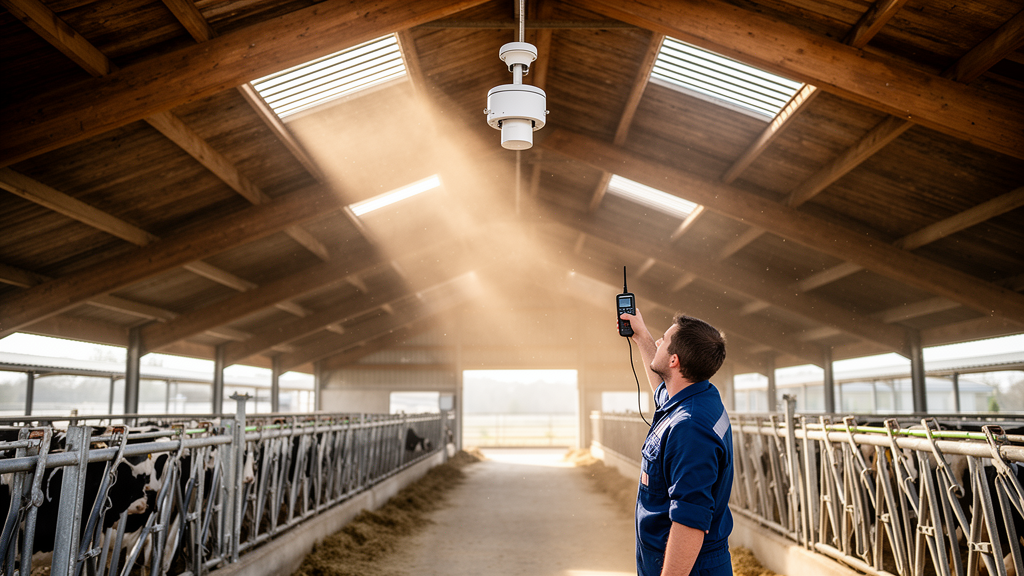
To investigate the technical viability and generalization limits of non-gas proxy estimation, researchers collected high-frequency environmental and herd observations from an operational free-stall dairy building in north-eastern Germany housing between 56 and 60 Holstein-Friesian cows. The facility measured 38.88 meters by 17.65 meters, with a floor layout composed of roughly twenty percent slatted flooring and eighty percent solid concrete alleys serviced by an automated scraping robot and a mechanical alley scraper. Production, physiological, and milking parameters were recorded by an automated milking station where lactating cows received a forage-based total mixed ration supplemented with concentrates. High-precision reference gas measurements were established at a height of 2.7 meters using cavity ring-down spectroscopy operated under international verification standards, generating an authenticated dataset of 5,225 valid hourly observations spanning ten consecutive months from April 2025 through January 2026 across multiple distinct seasonal transitions.
The engineering team assembled eighteen exogenous, routinely logged non-gas candidate predictors to model indoor ammonia concentrations without incorporating any direct gas measurements or historical autoregressive target inputs. These predictors encompassed microclimatic variables including indoor and outdoor temperatures, relative humidity measurements, wind speed, and decomposed vector representations of wind direction. Farm operational features included binary indicators for summer cooling water sprays and ordinal codes capturing alley cleaning cycles occurring at one-, two-, or three-hour intervals. Herd and physiological dimensions were represented by cow inventory counts, mean animal body mass, average pregnancy durations, daily herd-level milk yields, milk fat and protein percentages, electrical conductivity, somatic cell counts, and mean milk temperatures. Crucially, the investigators omitted ventilation rate estimates derived from carbon dioxide mass balances because calculating air exchange requires continuous carbon dioxide instrumentation, which directly violates the cost-saving principles of a purely non-gas proxy framework.
Initial modeling explored several competitive ensemble architectures, including Random Forest, Histogram-based Gradient Boosting, XGBoost, and CatBoost, with missing predictors imputed using training-fold medians and numerical scales normalized through robust interquartile scaling. Under standard random five-fold cross-validation, every tree-based architecture achieved an average coefficient of determination exceeding 0.80, with CatBoost establishing the strongest overall baseline at 0.846 alongside a root mean square error of 0.120 parts per million. When evaluated on a canonical random seventy-fifteen-fifteen split, CatBoost attained a test score of 0.836 and a root mean square error of 0.131 parts per million, vastly outperforming a simplified five-parameter linear baseline that reached an explanatory score of only 0.075 with an error of 0.312 parts per million. Numerical stress testing through Gaussian noise injections confirmed that CatBoost remained structurally stable against minor sensor noise, preserving an explanatory score of 0.760 even when subjected to ten percent predictor perturbations.
The apparent predictive competence of the ensemble model dissolved when the research team replaced randomized data splits with structured temporal partitioning designs. Grouping observations by individual calendar days and weeks within five-fold cross-validation reduced the mean coefficient of determination to 0.456 and 0.252, respectively, indicating that preventing observations from the same short time windows from populating both training and testing folds diminished predictive skill. The collapse became far more pronounced under chronological validation, in which the first eighty percent of historical data served as the training domain and the final twenty percent served as the prospective test target. In this chronological configuration, CatBoost yielded a negative coefficient of determination of -0.069 and a root mean square error of 0.369 parts per million. Introducing a forty-eight-hour purge buffer between training and test sets to eliminate immediate boundary overlap further depressed prospective performance to -0.246, performing worse than naive historical climatological averages.
To evaluate prospective operational utility against a realistic temporal baseline, the authors benchmarked model outputs against a lag-one persistence model, which simply projects the preceding hour’s measured ammonia concentration forward into the current hour. Under an expanding-window weekly walk-forward validation structure incorporating a strict forty-eight-hour purge across 2,946 prospective test hours, CatBoost managed an overall coefficient of determination of only 0.103 and a root mean square error of 0.318 parts per million. On identical timestamp-matched intervals, the simple persistence benchmark achieved a coefficient of determination of 0.888 and an error of 0.114 parts per million, resulting in a negative relative skill score of -1.798 for the machine learning algorithm. During an extreme autumn test week where observed barn concentrations surged beyond 2.0 parts per million, the fixed model predictions remained trapped between 0.5 and 0.9 parts per million, demonstrating an inability to capture rapid temporal deviations without access to recent gas observations.
Evaluating the algorithms across seasonal boundaries via leave-one-season-out validation revealed acute vulnerability to environmental distribution shift. Although CatBoost sustained high within-season explanatory scores ranging between 0.762 and 0.896 when tested on randomized samples extracted from each respective season, holding out entire seasonal blocks completely degraded its generalization capacity. When trained on the remaining three seasons, model transfer to withheld winter data achieved a near-zero coefficient of determination of 0.016, while transfer to spring and autumn produced negative scores of -0.666 and -0.729, respectively. Model degradation reached its nadir during summer holdout testing, plummeting to an explanatory score of -1.468 with an error of 0.315 parts per million. Detailed diagnostic partitioning across temperature and wind quintiles demonstrated that this summer failure was distributed evenly across microclimatic conditions rather than isolated to extreme heat events, confirming that the learned proxy relationships failed to maintain validity across shifting seasonal regimes.
Interpretability investigations using SHapley Additive exPlanations and permutation feature importance revealed complex, distributed dependencies across the predictor suite that explained the model’s brittle temporal transfer. Global attribution rankings initially highlighted alley cleaning frequency as the single most influential variable, followed by daily total milk yield, milk temperature, milk fat content, and indoor air temperature. Further empirical examination, however, showed that the high importance of the cleaning feature was heavily confounded by operational farm events: the facility’s adjacent exercise yard had been closed between May and July 2025, altering indoor manure accumulation patterns. When the cleaning variable was recoded to represent physical scraping intervals alone, its permutation importance dropped precipitously from 0.269 to 0.083, illustrating how decision trees can inadvertently latch onto indirect administrative artifacts that happen to correlate with broader seasonal intervals.
Systematic feature-group ablation underscored substantial information redundancy among the input categories while identifying atmospheric drivers as the true backbone of the predictive structure. Completely removing the entire climate and wind group induced the largest degradation in cross-validated performance, decreasing the coefficient of determination by 0.143, whereas removing the management group comprising cleaning frequency and water spray operations reduced predictive accuracy by only 0.005. Production and milk quality variables accounted for an intermediate performance decline of 0.045, reflecting physiological associations where milk total yield and protein fractions loosely mirror dietary nitrogen utilization efficiency and urinary urea excretion. High collinearity metrics, including variance inflation factors reaching 28.5 for milk fat and approximately 26.7 for indoor and outdoor humidity, confirmed that tree refitting readily compensates for excluded individual features by exploiting parallel correlations embedded across related sensor streams.
The study provides critical methodological guidance for data-driven modeling in precision livestock systems, showing that standard random validation protocols create an illusion of predictive power in environmental time series. Because hourly barn microclimates exhibit intense autocorrelation extending past forty-eight hours, randomized splits inadvertently leak information across folds, masking the true difficulty of prospective nowcasting. The authors conclude that while routinely collected farm metrics can help characterize baseline gas dynamics within stable, well-observed operational regimes, uncalibrated static proxy models cannot reliably replace direct gas sensing across unseen operational periods. Future development in commercial livestock monitoring must abandon random evaluation in favor of walk-forward and cross-seasonal benchmarks, while exploring hybrid physics-guided architectures and periodic low-cost sensor recalibration to achieve dependable, long-term environmental tracking in naturally ventilated housing.
Subject of Research: Machine learning prediction and temporal generalization of indoor ammonia concentrations in naturally ventilated dairy housing
Article Title: Indoor NH 3 concentration estimation from routinely available farm data: model learning and temporal generalization in dairy housing
Article References: Mehmood, T., Amon, T., Höhne, M. M. C., & Janke, D. (2026). Indoor NH3 concentration estimation from routinely available farm data: model learning and temporal generalization in dairy housing. Journal of Agriculture and Food Research, 32, Article 103458. https://doi.org/10.1016/j.jafr.2026.103458
Image Credits: AI Generated
DOI: 10.1016/j.jafr.2026.103458
Keywords: ammonia emissions, dairy housing, machine learning, CatBoost, temporal generalization, walk-forward validation, natural ventilation, precision livestock farming, cavity ring-down spectroscopy, feature attribution, SHAP analysis, distribution shift, autocorrelation, agricultural microclimate, milk production proxies, environmental monitoring
News Source: Alan Morgan. (November 22, 2026). Farm Data Predicts Barn Ammonia but Fails Prospective Time-Aware Testing. Scienmag.