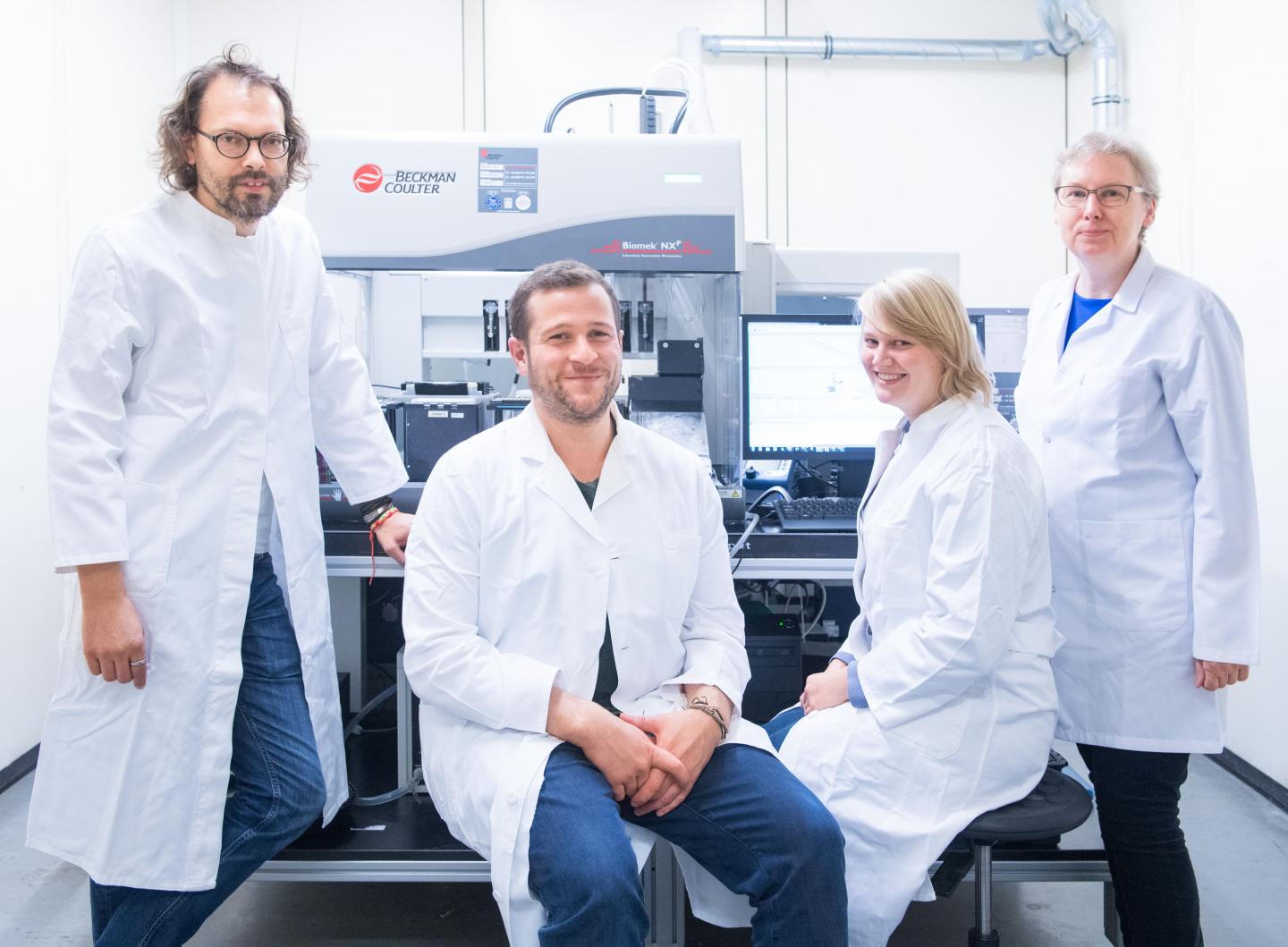
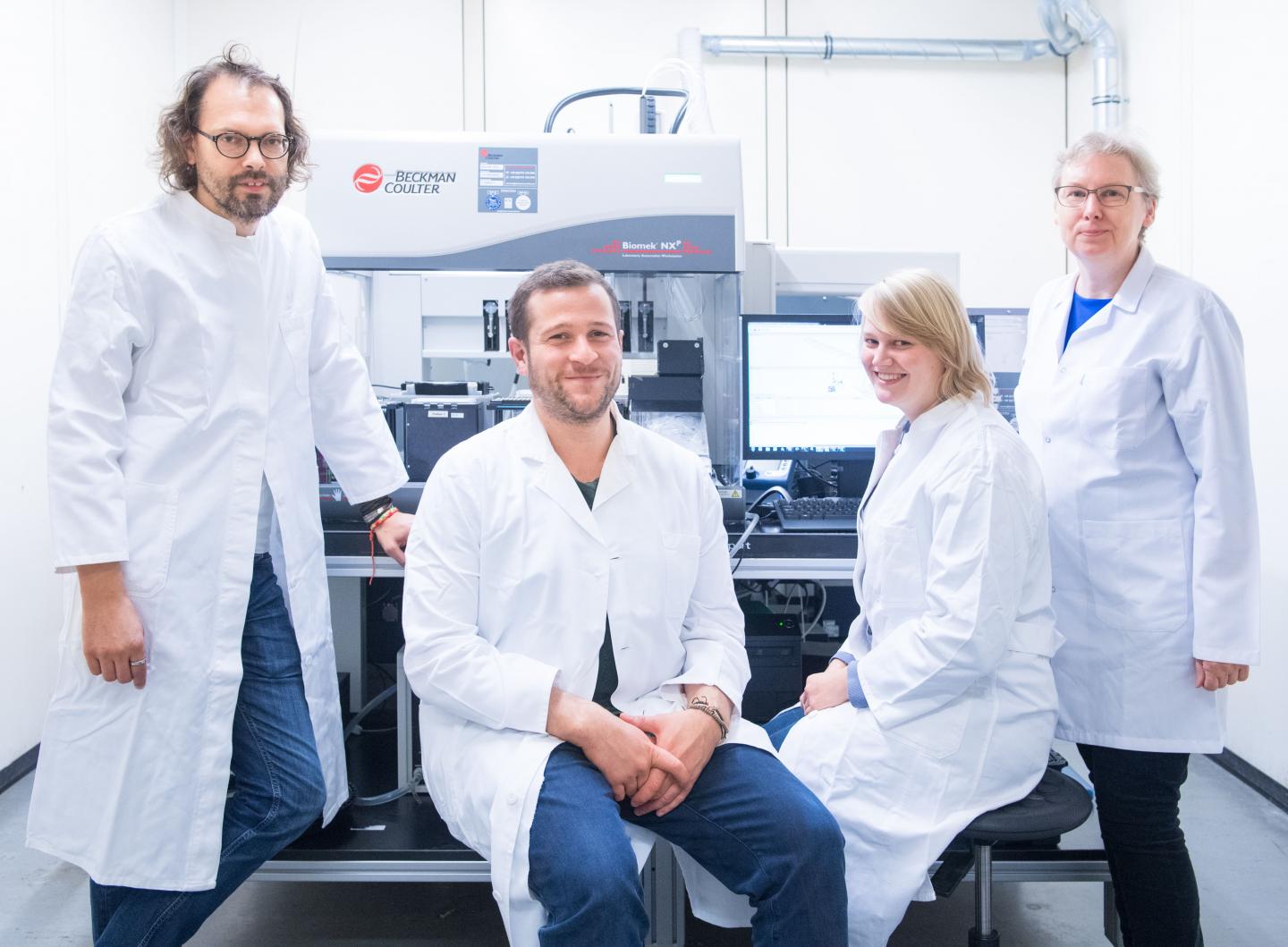
Credit: Photo: Volker Lannert/Uni Bonn
The newly discovered substance is a so-called RNA aptamer. Aptamers are molecules that are related to DNA, the carrier of the genetic information in our cells. They can specifically bind to unique target structures of proteins and thereby block them.
"Our aptamer interferes with the communication between two important types of immune cells – T cells and dendritic cells," says Prof. Dr. Irmgard Förster, who heads the department of "Immunology and Environment" at the LIMES Institute of the University of Bonn. She is also a member of the Excellence Cluster "ImmunoSensation", a major center of immunological research in Germany.
Allergies occur when immune responses react in an uncontrolled way against otherwise harmless substances from the environment. Among other culprits, T-cells are responsible for the resulting damage. These guardians of the immune system normally kill diseased cells, such as those infected by a virus. Patrolling T cells are activated by so-called dendritic cells, which are distributed throughout the body and sense signs of an infection or tissue damage. If they find something suspicious, they alert the killer troops by releasing certain chemoattractant proteins (chemokines) that resemble odorants. In humans there are about 50 different types of these signaling substances. One of them is CCL17. T cells have a receptor that can "smell" CCL17 – the CCR4 receptor – which allows them to follow the signal to its source.
"We have succeeded in producing an aptamer that specifically binds to CCL17," explains Prof. Förster. "It thus prevents CCL17 from docking to the CCR4 receptor. This way, we were able to partly block the migration of T cells to the dendritic cells. Mice treated with the aptamer therefore showed a far weaker inflammatory response to a contact allergen. "
Two chemokines stimulate the same receptor
It is known that the binding of CCL17 to the CCR4 receptor plays an important role in allergies. Other research groups have already tried to inhibit the CCR4 receptor (the "nose" of the T cells). Surprisingly, this strategy had no success – on the contrary: the allergic reaction was even more pronounced in tests. This may be associated with a specific property of the receptor: It can also be activated by at least one other chemokine – CCL22. CCL22 seems to have a different effect on CCR4 than CCL17. Researchers speculate that CCL22 (or possibly also other chemokines) inhibits the immune reaction – and does not stimulate it like CCL17. If the receptor is completely blocked, the allergic reaction can therefore even increase.
"Using aptamers, such mechanisms can be explored much more precisely," says Prof. Dr. Günter Mayer, a chemist who led the study together with Prof. Förster. Mayer heads the Center for Aptamer Research and Development at the LIMES Institute. "At present, we are able to produce aptamers comparatively simple and fast, with an astounding specificity for certain target structures," he says. The current aptamer is a good example: In even the smallest amounts it efficiently neutralizes CCL17, while completely ignoring CCL22.
The study highlights the importance of the chemokine-dependent communication between T cells and dendritic cells in the context of allergy, and potentially also in autoimmune disorders such as rheumatism or atherosclerosis. The researchers now aim to develop a similar aptamer against human CCL17 to be able to translate their findings from the animal model to clinical application.
###
Media Contact
Prof. Dr. Irmgard Förster
[email protected]
0049-228-736-2780
@unibonn
http://www.uni-bonn.de
Related Journal Article
http://dx.doi.org/10.1016/j.ymthe.2017.10.005