Researchers investigating advanced electrode architectures have demonstrated that combining electrochemical anodization with subsequent microwave nitrogen plasma functionalization significantly enhances the energy storage performance of copper oxide nanostructures. The experimental work, conducted by an international research team, systematically evaluated how varying anodization durations in alkaline solution and subsequent two-hour nitrogen plasma exposures alter the structural, morphological, and electrochemical properties of films grown directly on metallic copper substrates. The primary finding reveals that an optimized sample anodized for six hundred seconds and treated with microwave nitrogen plasma achieved an areal capacitance of 1250 millifarads per square centimeter during cyclic voltammetry at a scan rate of five millivolts per second in aqueous potassium hydroxide. This represents an almost tenfold enhancement over its untreated counterpart, establishing a practical dual-engineering approach for producing resilient, high-capacity transition metal oxide electrodes for intermediate energy storage devices.
Supercapacitors occupy a critical technical niche within modern energy storage frameworks, bridging the operational divide between the fast power delivery of electrostatic capacitors and the dense energy storage capacities typical of conventional chemical batteries. To meet escalating global energy requirements while curbing carbon emissions, materials scientists have heavily investigated transition metal oxides because their varied oxidation states, notable theoretical capacitances, and mechanical robustness provide excellent foundations for pseudocapacitive charge storage. Nevertheless, the practical deployment of copper oxides in energy devices has been consistently constrained by relatively poor baseline electrical conductivity and destructive volumetric fluctuations during extended charge-discharge cycling, which lead to mechanical degradation and rapid capacitance loss over repeated operations.
To mitigate these structural and electronic limitations, the investigators utilized electrochemical anodization as a controllable and scalable fabrication pathway to synthesize nanostructured copper oxide directly onto metallic copper plates. High-purity copper plates with a thickness of 0.8 millimeters served simultaneously as the synthesis substrate and as the integrated current collector. The preparation began with thorough degreasing of the copper plates via successive ten-minute ultrasonic baths in acetone and ethanol, followed by deionized water rinsing and air drying at room temperature. Anodization was subsequently performed in a two-electrode electrochemical cell comprising a platinum foil counter electrode and the prepared copper working electrode, each presenting an active surface area of approximately one square centimeter. The process was driven by a constant anodic current density of 10 milliamperes per square centimeter inside a 2 molar sodium hydroxide electrolyte across carefully monitored time intervals ranging from zero to 900 seconds.
The underlying electrochemical mechanism governing the anodization protocol entails three discrete and coordinated reaction stages within the alkaline electrolyte. Under the steady applied current density, metallic copper atoms undergo electrochemical oxidation, liberating cuprous and cupric cations alongside free electrons into the immediate interfacial zone. These newly formed copper cations rapidly react with available hydroxide ions in the alkaline bath, inducing the nucleation of intermediate cuprous hydroxide and cupric hydroxide surface species. To facilitate complete crystallization and obtain well-defined oxide phases, the anodized precursors were subjected to thermal annealing at 400 degrees Celsius for one hour in air. This heating stage dehydrated the hydroxide intermediates, driving their transformation into stable crystalline cuprous oxide and cupric oxide layers adhering firmly to the conductive metallic copper base.
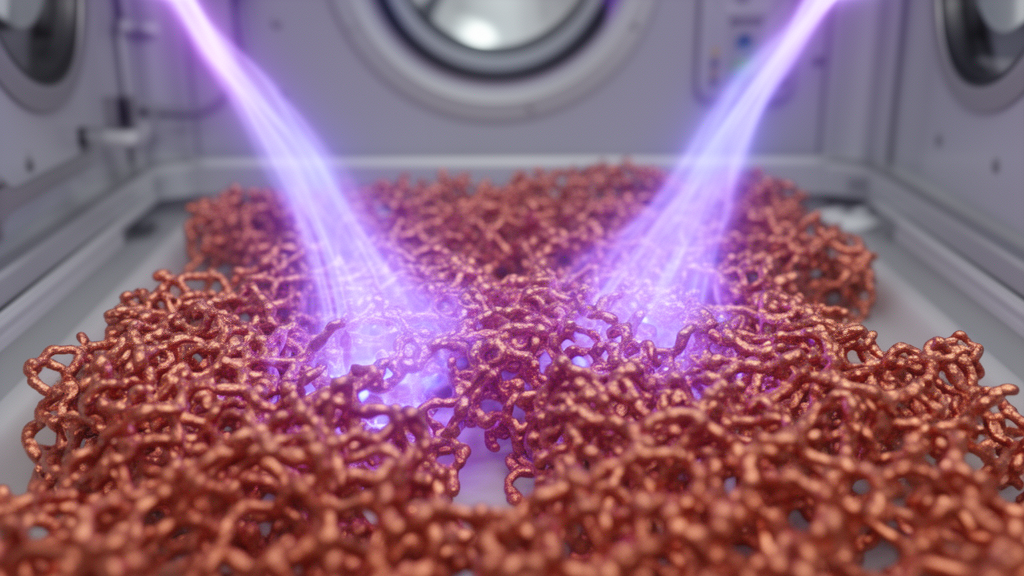
Following thermal annealing, selected copper oxide samples were introduced into a specialized single-source plasma reactor equipped with a high-frequency microwave generator operating at 2.45 gigahertz and 180 watts of microwave power. Before initiating plasma discharge, the reaction chamber was evacuated to a base pressure of 0.001 millibar for five minutes to eliminate atmospheric contaminants. A continuous stream of high-purity nitrogen gas was subsequently introduced at a controlled flow rate of 10 standard cubic centimeters per minute, stabilizing the internal processing pressure at 1 millibar. The microwave nitrogen plasma was then generated, and an electrical bias voltage of negative 50 volts was applied directly to the copper oxide substrate via a specialized high-voltage power supply for an uninterrupted duration of two hours, followed by natural cooling to ambient temperature under controlled laboratory conditions.
Structural characterization carried out through X-ray diffraction using cobalt K-alpha radiation revealed that the anodization duration dictates the phase distribution across the copper surface. At an anodization duration of 300 seconds, the films exhibited a biphasic mixture comprising monoclinic cupric oxide and cubic cuprous oxide, with persistent diffraction lines originating from the unreacted underlying metallic copper substrate. As anodization extended to 600 seconds, the characteristic diffraction peaks for cupric oxide, particularly along the (111) and (020) crystallographic planes, intensified significantly while substrate peaks attenuated, reflecting progressive oxidation and oxide thickening. By 900 seconds, monoclinic cupric oxide dominated the diffraction profiles almost entirely. Calculations using the Debye-Scherrer equation demonstrated that the cuprous oxide (111) crystallite size expanded from 7.64 nanometers at 300 seconds to 9.33 nanometers at 600 seconds, before contracting to 6.99 nanometers at 900 seconds. Concurrently, dislocation density decreased from 17.15 to 11.49 multiplied by 10 to the power of 15 per square meter before climbing to 20.42 multiplied by 10 to the power of 15 per square meter at 900 seconds.
Subjecting the optimized 600-second anodized sample to microwave nitrogen plasma induced a noticeable restructuring of phase ratios and crystallographic order without introducing entirely new diffraction lines. X-ray diffraction patterns after plasma functionalization showed an attenuation of cupric oxide reflections alongside a marked relative enhancement of cuprous oxide peaks, signaling a partial reduction of cupric oxide back to cuprous oxide. Under plasma exposure, the crystallite size of the cuprous oxide phase expanded to a maximum of 10.71 nanometers, while dislocation density dropped to 8.72 multiplied by 10 to the power of 15 per square meter, confirming structural ordering. Room-temperature Raman spectroscopy further corroborated this phase modification; pristine samples exhibited sharp vibrational modes at 292, 340, and 630 reciprocal centimeters characteristic of tenorite cupric oxide, whereas plasma-treated films showed broadened bands and a shift of the high-wavenumber mode from 630 to 650 reciprocal centimeters, evidencing lattice distortion and oxygen vacancy generation.
Morphological investigations through field-emission scanning electron microscopy illustrated a striking geometric evolution across processing parameters. The bare copper substrate exhibited a relatively smooth, irregular surface that gave way to tiny rod-like features partially covering the surface after 300 seconds of anodization. At 600 seconds, the material developed a dense, highly uniform, and porous network of fully fused nanorods displaying high aspect ratios and excellent structural continuity. In contrast, extending the anodization duration to 900 seconds led to pronounced nanorod agglomeration and structural collapse driven by excessive oxide growth and internal material stresses. Subsequent nitrogen plasma treatment of the optimal 600-second sample radically restructured these features, reducing nanorod dimensions by roughly one half and generating fine, porous agglomerated morphologies with extensive microporous networks that substantially increased effective surface area.
Surface chemical states evaluated by X-ray photoelectron spectroscopy confirmed that the unexposed sample surface was dominated by divalent copper ions, characterized by a primary binding energy peak near 933 to 934 electron volts and pronounced shake-up satellite features. Following nitrogen plasma exposure, the primary copper peak shifted to 932.9 electron volts and shake-up satellites diminished sharply, verifying the predominance of monovalent copper species associated with cuprous oxide. High-resolution nitrogen core-level spectra revealed the emergence of a new distinct peak at 398.5 electron volts, confirming the incorporation of chemisorbed nitrogen and copper-nitrogen bonding within the outermost atomic layers. Furthermore, contact angle goniometry revealed that surface wettability was dramatically altered; while the pristine 600-second sample displayed a water contact angle of 80.8 degrees, plasma-treated samples exhibited an ultra-low contact angle of 4.3 degrees, establishing an intensely superhydrophilic interface that facilitates intimate contact with aqueous electrolytes.
Electrochemical evaluation conducted in 1 molar aqueous potassium hydroxide using a three-electrode arrangement confirmed extraordinary operational gains following plasma functionalization. Electrochemical impedance spectroscopy revealed that charge transfer resistance across the electrode-electrolyte interface dropped substantially after plasma processing, while electron lifetime calculated from Bode phase diagrams increased dramatically from 64 milliseconds for the untreated 600-second sample to 1592 milliseconds for the plasma-treated sample. Mott-Schottky analyses displayed negative slopes verifying p-type semiconducting behavior across all specimens, while donor carrier density increased from 8.12 multiplied by 10 to the power of 23 per cubic centimeter to 1.11 multiplied by 10 to the power of 24 per cubic centimeter after treatment, reflecting improved electronic conductivity and enhanced charge separation.
Quantitative cyclic voltammetry and galvanostatic charge-discharge measurements underscored the enhanced energy storage capability of the engineered electrodes. Voltammetric profiles between 0.0 and 0.6 volts versus a silver/silver chloride reference showed classic pseudocapacitive Faradaic redox signatures associated with copper valence transitions. The areal capacitance of the plasma-treated electrode reached 1250 millifarads per square centimeter at five millivolts per second, contrasting sharply with the 133 millifarads per square centimeter recorded for the untreated 600-second sample and the 82.7 millifarads per square centimeter observed for the over-oxidized 900-second electrode. At a higher scan rate of 150 millivolts per second, the plasma-treated film maintained an areal capacitance of 839 millifarads per square centimeter, reflecting sustained kinetic responsiveness despite electrolyte diffusion limitations.
Application of Dunn’s kinetic deconvolution method revealed that the overall charge storage mechanism combines surface capacitive processes and diffusion-controlled Faradaic reactions, with the capacitive contribution rising from 55 percent at one millivolt per second to 74 percent at six millivolts per second for the plasma-treated electrode. Finally, extended endurance evaluations conducted at a continuous current density of 5 milliamperes per square centimeter demonstrated 100 percent capacitance retention after 1000 consecutive charge-discharge cycles, highlighting remarkable interfacial robustness and positioning these dual-engineered copper oxide nanostructures as highly promising candidate materials for next-generation pseudocapacitive devices.
Subject of Research: Electrochemical supercapacitive performance of anodized copper oxide nanostructures modified by microwave nitrogen plasma functionalization
Article Title: Enhanced supercapacitive performance of CuO/Cu2O/Cu nanostructures: a comparative study before and after plasma functionalization
Article References: Aoun, S., Ahmed, I. B., Gritli, I., Redolfi, M., & Assaker, I. B. (2026). Enhanced supercapacitive performance of CuO/Cu2O/Cu nanostructures: a comparative study before and after plasma functionalization. Materials for Renewable and Sustainable Energy, 15(2), Article 25. https://doi.org/10.1007/s40243-026-00367-5
Image Credits: AI Generated
DOI: 10.1007/s40243-026-00367-5
Keywords: supercapacitors, copper oxide, anodization, nitrogen plasma, plasma functionalization, areal capacitance, nanostructures, electrochemical impedance spectroscopy, cyclic voltammetry, galvanostatic charge-discharge, nanowires, surface wettability, carrier lifetime, p-type semiconductor, energy storage, transition metal oxides
News Source: Faith Mcneil. (November 21, 2026). Nitrogen Plasma Functionalization Boosts Supercapacitive Energy Storage in Copper Oxide Nanostructures. Scienmag.