In a comprehensive numerical investigation published in the Journal of King Saud University – Engineering Sciences, researchers evaluated the predictive capacity of several equivalent fluid formulations against empirical benchmarks and established that Attenborough’s acoustic porous media model reliably predicts the normal incidence sound absorption spectra and reverberation cutback of packed beds composed of near-spherical particles. Porous structures represent an essential class of noise reduction and vibration damping devices across diverse settings, ranging from architectural environments like sports complexes, auditoriums, industrial workspaces, and houses of worship, to transportation and aerospace engineering contexts including automotive exhaust mufflers, catalytic converters, and aircraft treatments. Traditional soundproofing materials span natural fibres such as hemp, wool, cotton, felt, and fur, synthetic fibres including melamine, kevlar, polyester, and polyurethane, as well as sintered porous metals and ceramics.
The study addressed a fundamental challenge in acoustic media analysis: capturing how non-acoustic microstructural parameters govern the macroscopic propagation of sound waves through granular arrays. In porous media theory, the acoustic response is governed by non-acoustic parameters that dictate visco-inertial dissipation and thermal relaxation mechanisms. These intrinsic parameters include flow permeability, void fraction or open porosity, kinematic tortuosity, dynamic shape factor, and steady flow shape factor, alongside static thermal permeability, static viscous tortuosity, and static thermal tortuosity. Equivalent fluid formulations translate these microscopic geometric descriptors into macroscopic continuum values, specifically the complex surface acoustic impedance and the complex acoustic propagation coefficient. Historically, classical models such as the Delany-Bazley-Mikki framework, the Wilson relaxation model, and the Zwikker-Kosten formulation have been applied across various acoustic substrates.
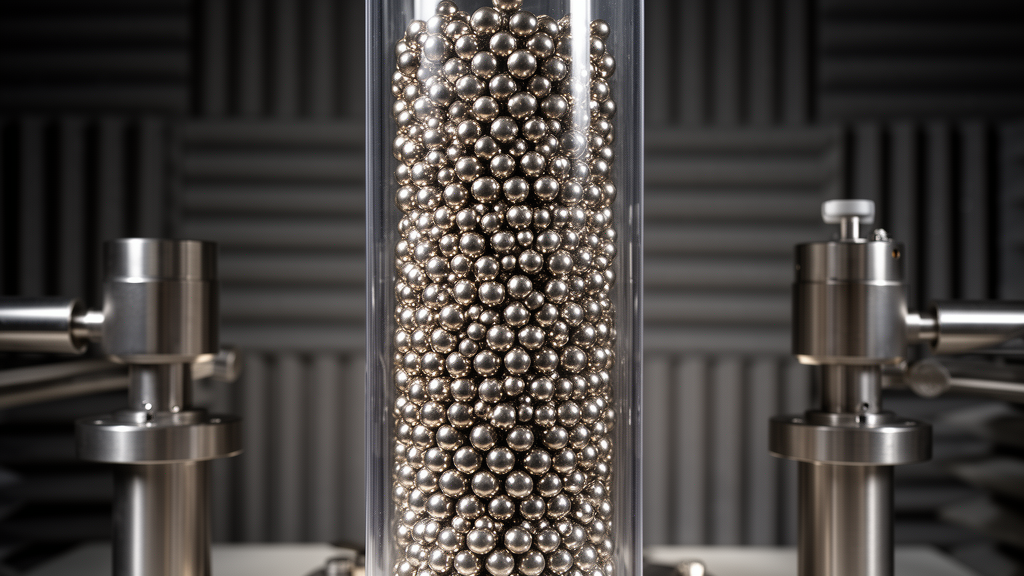
To overcome the limitations of simplified approximations, the research team implemented a rigorous two-stage numerical methodology that linked pore-scale fluid dynamics with macroscopic acoustic wave propagation. The initial stage involved extracting representative non-acoustic properties from three-dimensional virtually generated packed spheres having nominal diameters of 1, 2, and 3 millimetres. By integrating discrete element modelling to simulate physical granular packing with computational fluid dynamics in COMSOL Multiphysics, the investigators modelled low-velocity fluid flow by resolving the Navier-Stokes equations across representative volume elements. Boundary conditions across the three-dimensional unit cells applied uniform velocity at the inlet, zero static pressure at the exit plane, and symmetric conditions on lateral boundaries. The flow permeability across void fractions ranging from 0.34 to 0.45 was derived by fitting the simulated velocity-pressure drop data to the Hazen-Darcy formulation. These numerically calculated void fractions closely mirrored empirical porosity measurements obtained from natural aggregates using mercury intrusion porosimetry, validating the structural fidelity of the virtual models.
A critical outcome of this microscopic CFD analysis was the refined characterisation of the Kozeny constant and tortuosity within dense spherical packings. Fitting permeability, particle diameter, and void fraction data into the classic Kozeny-Carman empirical relation yielded an optimal Kozeny constant of 4.64. Additional computational revisions performed on densely packed arrays with a void fraction of 0.33 confirmed that this constant maintained strong agreement with established empirical trends, exhibiting a coefficient of determination greater than or equal to 0.99. This close alignment corroborated the applicability of the Ergun relation for predicting viscous-dominated pressure drops in densely packed granular media. To account for structural anisotropy and tortuous path lengths, the researchers evaluated multiple analytical tortuosity models. They confirmed that assuming a constant tortuosity of the square root of two, as historically suggested for uniform granular media, is fundamentally inadequate across varying packing densities. Instead, the analytical tortuosity formulation proposed by Weissberg, which expresses tortuosity as a direct function of porosity based on electrical conductivity measurements in packed spheres, produced tortuosity values between 1.387 for loose beds and 1.543 for dense arrangements, perfectly matching measured acoustic profiles.
In the second stage of the study, the investigators translated these derived non-acoustic parameters into acoustic wave simulations by solving the Helmholtz linear acoustic equations across macroscopically defined impedance tube geometries. The numerical domain replicated the internal physical dimensions of a standard four-microphone AFD 1200-AcoustiTube system, which comprises an acoustic speaker source, a transmission waveguide, and a sample testing compartment. Operating conditions assumed ambient air at standard saturated temperature and atmospheric pressure. Hard-sound wall boundary conditions were assigned to the exterior tube boundaries, with Floquet periodicity applied to sidewalls and an incident plane wave excitation of 1.0 Pascal acting uniformly across the source domain. The computational model evaluated both two-dimensional and three-dimensional half-tube domains to determine the optimal balance between spatial mesh resolution, convergence speed, and acoustic calculation accuracy.
Mesh sensitivity analyses revealed essential insights regarding computational efficiency in acoustic finite element modelling. The meshing scheme applied mapped quadrilateral elements within the source domain and free triangular meshes throughout the waveguide and porous material domains. Setting the minimum element edge length to the minimum acoustic wavelength divided by 2000, combined with maximum element growth rates of 1.3 and curvature factors of 0.3, ensured excellent spatial convergence. When the maximum edge length was set to a coarse resolution of the speed of sound divided by the maximum frequency limit, cell density dropped to 32 and deviation from experimental acoustic absorption coefficients at 100, 1000, 2000, and 4000 Hertz approached 50 percent. Ultimately, an intermediate maximum edge length of the speed of sound divided by sixty times the maximum frequency limit, corresponding to 11,750 cells, demonstrated less than a 0.05 percent discrepancy compared to a full three-dimensional half-tube mesh containing approximately 7.5 million cells, justifying the routine use of rapid, highly accurate two-dimensional simulations.
Quantitative validation of the numerical acoustic model was established across a broadband frequency range spanning 0 to 7 kilohertz by direct comparison against published experimental measurements for glass beads with a mean diameter of 0.68 millimetres and Coustone porous aggregates with a mean diameter of 0.74 millimetres, having void fractions of 0.38 and 0.40 respectively. The simulated normal incidence absorption spectra produced by the Delany-Bazley-Mikki, Wilson, and Zwikker-Kosten models exhibited severe divergence from experimental curves. While the phenomenological DBM model only proved accurate when applied to highly porous metallic sponges with porosities exceeding 0.95, both the Johnson-Champoux-Allard formulation and Attenborough’s equivalent fluid model reliably tracked the experimental data. Remarkably, when Attenborough’s model was implemented with a shape factor ratio of 1.0, its predicted absorption curves completely overlaid the experimental measurements across the entire frequency range, outperforming the five-parameter JCA model without requiring complex corrections for dynamic thermal characteristic lengths.
To evaluate overall acoustic efficacy, the authors calculated comprehensive single-number rating metrics from the simulated spectra, including the Noise Reduction Coefficient, the Sound Absorption Average, the quarter-wavelength layer resonance peak absorption coefficient, the corresponding peak frequency, and the half-peak absorption bandwidth. Systematic parametric sweeps revealed that the quarter-wavelength absorption peaks occurred predominantly in the audible spectrum between 3.0 and 4.0 kilohertz. Granular beds composed of 1-millimetre spheres achieved an outstanding maximum absorption peak of 0.964 and an extensive half-bandwidth of 2730 Hertz, alongside an advantageous spectral shift toward lower frequency minima, whereas increasing particle size to 3 millimetres shifted peak absorption toward higher frequencies and noticeably degraded overall absorption performance.
The study also systematically explored the acoustic consequences of altering void fraction and particle packing density. Increasing the void fraction from 0.33 in densely packed arrangements to 0.43 in loosely packed configurations reduced tortuosity and noticeably diminished the broadband sound absorption spectra. This reduction is directly linked to the expansion of interstitial pore channels, which alters the propagation path of incident pressure waves. In dense configurations with a void fraction of 0.33, the tortuous geometry forces vibrating air molecules into intimate contact with the solid particle surfaces, inducing substantial thermal boundary layer dissipation and visco-inertial losses at frequencies above 1 kilohertz. At frequencies below 1 kilohertz, interparticle collisions remain largely elastic, dissipating minimal energy across long acoustic wavelengths. Furthermore, while varying packing density showed negligible impact on total specific surface area, decreasing the particle diameter significantly increased the specific surface area, thereby enhancing acoustic attenuation through augmented viscous shear and thermal conduction.
A primary practical outcome of the research was delineating an optimal parameter envelope for granular acoustic absorbers based on flow permeability. By mapping combined sound absorption ratings across particle sizes from 0.2 to 4.0 millimetres and void fractions from 0.33 to 0.49, the authors discovered that peak acoustic performance clusters tightly within an intrinsic permeability range of 0.3 to 2.0 times ten to the negative ninth square metres. Granular assemblies whose permeability values fall outside this designated operational zone exhibit sharply deteriorated acoustic metrics, with reverberation cutback values routinely dropping by more than half compared to the optimised configurations.
Finally, the authors examined structural modifications to enhance low-frequency sound absorption in the optimised granular beds by incorporating backing air cavities and expanding porous layer thickness. Numerical simulations indicated that while increasing material thickness shifted quarter-wavelength resonance peaks toward lower frequencies, introducing an air gap behind a thinner granular layer provided superior low-frequency attenuation between 0 and 2000 Hertz. This back-cavity configuration achieved substantial broadband noise suppression without the penalty of added structural mass or material volume. By confirming that Attenborough’s equivalent fluid model coupled with Weissberg’s tortuosity accurately predicts granular acoustic behaviour, this investigation establishes a reliable computational roadmap. Material manufacturers and noise control engineers can now systematically design custom, highly efficient packed granular absorbers tailored to stringent acoustic performance standards while minimising empirical trial and error.
Subject of Research: Acoustic modelling and reverberation cutback optimisation in granular porous media
Article Title: Numerical modelling and optimisation of reverberation cutback for packed spheres
Article References: Otaru, A. J., Manko, Z., Odumu, O. E., Isah, A. G., & Corfield, M. R. (2026). Numerical modelling and optimisation of reverberation cutback for packed spheres. Journal of King Saud University – Engineering Sciences, 38(2), Article 12. https://doi.org/10.1007/s44444-025-00096-6
Image Credits: AI Generated
DOI: 10.1007/s44444-025-00096-6
Keywords: Acoustic Porous Media, Attenborough Model, Packed Spheres, Sound Absorption Coefficient, Reverberation Cutback, Permeability, Tortuosity, Void Fraction, Computational Fluid Dynamics, Discrete Element Modelling, Helmholtz Linear Acoustics, Noise Reduction Coefficient, Sound Absorption Average, AcoustiTube Simulation, Back Cavity, Pore Morphology, Weissberg Tortuosity, Granular Media Acoustics
News Source: Audrey Campbell. (November 21, 2026). Attenborough Model Optimizes Sound Absorption in Packed Spherical Noise Control Beds. Scienmag.