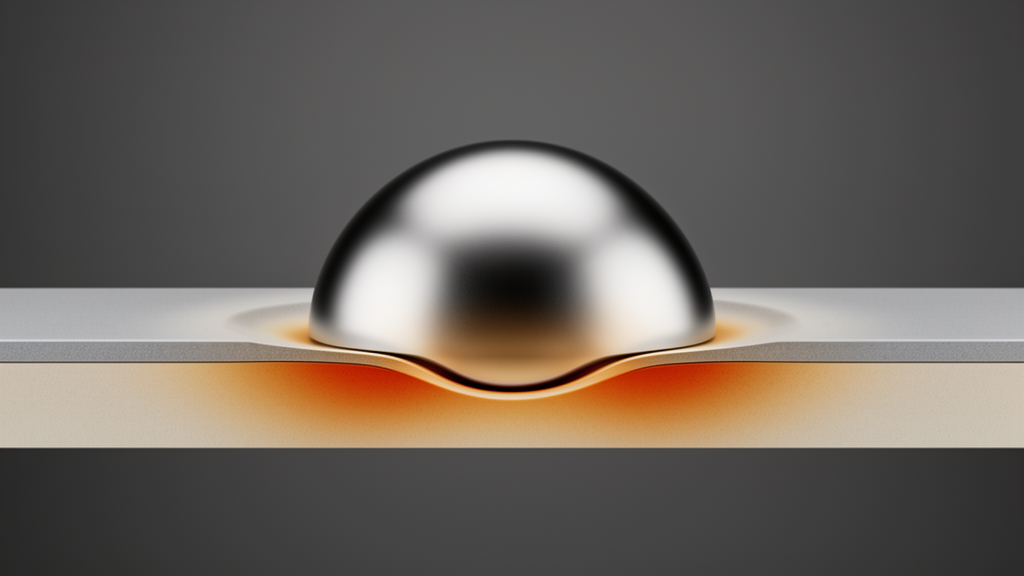
Numerical investigations into the elastic-plastic contact behavior between opposing hemispheres have demonstrated that foundation boundary conditions fundamentally govern mechanical deformation, lateral displacement, and internal stress redistribution under heavy contact loads. Computational tribologists using two-dimensional axisymmetric finite element analysis discovered that mounting hemispherical bodies upon deformable foundations rather than completely rigid bases triggers pronounced structural stress dissipation across expanding contact interfaces. While classical contact mechanics formulations frequently treat supporting substrates as perfectly immobile fixtures, comparative simulations reveal that allowing transverse compliance at the base substantially reduces catastrophic localized stress concentrations at elevated loadings. Under light mechanical loads up to one kilonewton, maximum contact pressure variations between rigid and compliant foundations remain well under one percent. However, when applied loads increase toward fully plastic regimes, the deviation in maximum contact pressure between deformable and rigid systems expands dramatically, reaching up to forty-eight percent depending directly upon the geometric diameter ratio between the contacting spherical bodies.
The physical configuration evaluated in the finite element framework comprises an upper hemisphere maintaining a fixed diameter of seventeen point five millimeters pressed directly against a lower hemisphere of variable dimensions across seven distinct diameter ratios denoted from ratio one through ratio seven. To systematically evaluate non-linear structural behavior, the researchers modeled the hemispherical solids using an elastic-perfectly plastic brass alloy possessing an elastic modulus of ninety-six gigapascals, a Poisson ratio of zero point thirty-four, and a characteristic yield strength of three hundred ten megapascals. In the baseline rigid configuration, the base boundary conditions completely constrain displacement across all spatial directions. Conversely, the deformable configuration introduces base flexibility by restricting vertical movement while permitting unconstrained lateral translation along the transverse plane. The contact pair was computationally simulated as frictionless, utilizing the upper hemisphere as the dominant master contact surface pressing against the smaller, highly conforming lower hemisphere under hard contact formulations with non-linear penalty stabilization to suppress numerical overconstraint.
To ensure rigorous numerical accuracy throughout severe non-linear material yielding, the finite element modeling was executed within ABAQUS CAE using four-node bilinear axisymmetric quadrilateral elements with reduced integration, designated as CAX4R elements. An extensive mesh convergence analysis evaluated global element dimensions spanning from zero point eight millimeters down to zero point zero one millimeters across each geometric configuration. Convergence criteria demanded that successive mesh refinements restrict relative discrepancies in dimensionless interference, vertical displacement, and vertical stress below two percent under active plastic deformation. For the equal-dimension configuration, an element size of zero point zero five millimeters was established for deformable foundations and zero point zero three millimeters for rigid foundations, whereas an element dimension of zero point zero eight millimeters proved computationally optimal and stable for diameter ratios ranging from ratio two through ratio seven.
The computational framework underwent extensive quantitative validation against established analytical and numerical contact models developed by Hertz, Kogut and Etsion, Jackson and Green, You and Tang, and Chen and colleagues. For dimensionless interference levels below one hundred ten, the simulation outputs demonstrated strong correlation across all diameter ratios, yielding coefficients of determination exceeding zero point ninety-eight. Within this small-interference elastic regime, the formulation established by Kogut and Etsion achieved the lowest mean absolute percentage error, varying between one point seven and five point four percent. As plastic deformation deepened through dimensionless interference levels between one hundred ten and five hundred, the formulation proposed by Chen and coworkers provided the closest correspondence with the numerical data, maintaining mean absolute percentage errors generally below five percent while earlier models suffered significant divergence due to restrictive small-deformation assumptions.
A critical divergence in mechanical response emerged once normalized loading exceeded the classical validity limit where the ratio of contact radius to asperity radius exceeds zero point four hundred twelve, corresponding to dimensionless interference thresholds around three hundred thirty-three point ninety-seven. In identical-radius contact pairs denoted as ratio one, displacement profiles began deviating noticeably from standard Jackson and Green formulations at normalized loads of nine hundred seventy-seven point seventy-two, with deviations steadily climbing to ten point seventy-nine percent at higher loads. In marked contrast, intermediate diameter ratios two and four tracked conventional theoretical predictions closely up to normalized loads of eighteen hundred thirty-three and twenty-seven hundred fifteen, respectively, before diverging significantly at deeper plastic penetration, ultimately producing foundation-dependent deviations that exceeded thirty-six and forty-one percent under extreme loadings.
The early behavioral deviation identified in equal-diameter hemispheres stems directly from Saint-Venant displacement field redistribution across differing boundary constraints. Contour evaluations show that in deformable base systems, peak lateral displacement concentrates heavily within the upper hemisphere directly receiving the external load. Under rigid base boundary conditions, displacement is forcefully redirected into the lower hemisphere constrained against the immobile foundation, proving that local constraint differences fundamentally alter internal displacement fields even under identical global normal forces. In the highest diameter ratio configuration, denoted as ratio seven, geometric asymmetry concentrates applied compressive loads into an exceptionally small lower hemispherical volume. This sharp geometric disparity renders the mechanical assembly extraordinarily sensitive to foundation compliance, generating a twenty-nine percent lateral displacement variance at two hundred fifty newtons and exceeding sixty-eight percent divergence under severe compressive loading.
Examination of internal von Mises stress distributions revealed fundamentally divergent failure risks between compliant and unyielding structural mountings. Across high diameter ratios subjected to six thousand newtons of compressive force, rigid bases constrained transverse material movement, creating intense stress concentrations and steep stress gradients tightly confined to the immediate interface zone. Conversely, deformable bases accommodated lateral expansion, distributing mechanical stresses across a substantially broader volumetric footprint and mitigating localized stress peaks. This compliance-driven stress dissipation caused the maximum von Mises stress in ratio seven deformable configurations to rise by approximately thirty-seven percent as boundary constraints relaxed, demonstrating how substrate flexibility facilitates expansive plastic redistribution rather than confining intense multiaxial strain within narrow interfacial zones that accelerate premature crack initiation.
Analysis of contact pressure profiles under heavy mechanical loading exposed complex interfacial restructuring and contact geometry alterations. Under six thousand newtons of normal force, where contact enters fully plastic regimes with normalized loads exceeding two hundred eighty-eight point seventy-nine, maximum contact pressure deviations between rigid and deformable mountings reached nineteen percent for ratio one at thirty kilonewtons, forty-eight percent for ratio two at thirty kilonewtons, twelve percent for ratio four at ten kilonewtons, and sixteen percent for ratio seven at six kilonewtons. In the extreme geometric contrast of ratio seven, the contact interface unexpectedly fractured into a central unloading zone surrounded by an outer annular contact ring separated by a microscopic non-contact gap. While the central patch experienced localized pressure unloading, the outer peripheral corners supported elevated compressive contact stresses, a phenomenon driven by lateral base expansion and unrestricted plastic material flow.
These detailed contact mechanics observations offer vital foundational principles for the physical design of tribological interfaces, metal-forming tooling, and biomedical joint prostheses. In industrial forming dies where sustained mechanical durability depends upon uniform plastic strain dissipation and mitigated surface wear, integrating controlled base compliance provides a direct mechanism to relieve damaging contact pressure spikes. Conversely, in precision biomedical implants such as artificial hip prostheses modeling spherical femoral ball and acetabular cup articulation under cyclic body loads, rigid foundation constraints remain imperative to preserve strict geometric tolerances, maintain kinematic positioning, and prevent excessive global lateral deformation that could impair operational implant stability over extended service lifetimes.
The researchers underscored several clear boundary conditions and analytical scope limitations governing the current computational findings. The finite element simulations were strictly confined to static loading scenarios and assumed an idealized elastic-perfectly plastic material response without incorporating strain hardening, rate-dependent plastic flow, or thermal dissipation effects. Furthermore, surface micro-roughness and frictional sliding resistance were omitted to isolate normal contact mechanics, and direct physical experiments were not conducted for extreme non-linear geometries. The study authors concluded that future research must incorporate advanced hardening laws, surface roughness profiles, thermal-mechanical coupling, and physical experimental validation to advance the predictive design of compliant contact interfaces across aerospace, manufacturing, and biomedical engineering systems.
Subject of Research: Elastic-plastic contact mechanics between deformable hemispheres on rigid versus deformable bases
Article Title: Elastic–plastic contact between two hemispheres: a comparison study of deformable and rigid bases
Article References: Lamura, M. D. P., Ginting, H. A., Maula, M. I., Ambarita, M., Hidayat, T., Bayuseno, A. P., & Jamari, J. (2026). Elastic–plastic contact between two hemispheres: a comparison study of deformable and rigid bases. Journal of King Saud University – Engineering Sciences, 38(3), Article 19. https://doi.org/10.1007/s44444-026-00099-x
Image Credits: AI Generated
DOI: 10.1007/s44444-026-00099-x
Keywords: contact mechanics, finite element method, elastic-plastic deformation, base flexibility, hemispherical contact, von Mises stress, contact pressure distribution, tribology, ABAQUS simulation, brass alloy mechanics, diameter ratio effects, lateral displacement, Saint-Venant principle, Hertzian contact theory, plastic flow mechanics, asperity contact modeling, boundary condition effects
News Source: Denise Maddox. (November 21, 2026). Hemisphere Contact Simulations Reveal Base Flexibility Drastically Reshapes Elastic-Plastic Stress Distribution. Scienmag.