A research team investigating stationary energy storage technologies has demonstrated a planar molten sodium laboratory cell that operates stably at an intermediate temperature of 150 °C by pairing a sodium iodide and aluminum chloride eutectic catholyte with a NASICON ceramic solid electrolyte. The experimental system, described in a study published in Materials for Renewable and Sustainable Energy, addresses significant thermal and mechanical constraints inherent in conventional high-temperature sodium systems by lowering the operating temperature while maintaining reversible redox behavior, stable cell overpotentials, and an energy efficiency exceeding 95 percent across 50 galvanostatic charge–discharge cycles spanning more than 1200 hours of continuous operation.
Large-scale stationary storage systems are increasingly critical for buffering the intermittent output of renewable installations such as wind and solar power generation facilities. Although lithium-ion battery technology currently dominates electrochemical grid-scale deployment, concerns surrounding raw material cost, resource availability, and long-term sustainability have directed renewed focus toward sodium-based chemistries. Molten sodium systems, including legacy sodium–sulfur and sodium–metal halide configurations such as the ZEBRA battery, offer attractive intrinsic safety, long cycle life, and high energy density due to the abundance and favorable electrochemical properties of metallic sodium. However, traditional molten sodium cells require high operational temperatures typically ranging between 270 °C and 350 °C to sustain adequate ionic conductivity and maintain the active cathode materials in a fully molten state, which accelerates cell degradation, limits sealing options, and demands complex thermal management hardware.
To overcome these high-temperature operational drawbacks, the researchers synthesized an inorganic eutectic mixture composed of 60 mol % sodium iodide and 40 mol % aluminum chloride. Preliminary compositional screenings, guided by phase diagrams and visual assessments of fluidity and thermal stability, identified this 60:40 mol % ratio as optimal for maintaining a stable liquid phase at 150 °C without signs of phase segregation or salt precipitation. The liquid catholyte serves simultaneously as an ionically conductive electrolyte and an electrochemically active cathode medium. Charge storage within this system is governed by the reversible iodide/triiodide redox equilibrium, in which the cathodic reaction involves the conversion of triiodide and two electrons into three iodide ions, yielding an overall cell reaction of two sodium atoms reacting with triiodide to produce two sodium ions and three iodide ions.
Because elemental iodine does not participate directly in electrochemical reactions in the solid or vapor phase without forming polyiodide complexes, the formation and interconversion of polyiodides serves as the essential charge-storage mechanism. To ensure that an adequate concentration of active species remained available across the selected operating window, small quantities of elemental iodine were added to the salt mixture to compensate for iodide species that do not directly participate in redox processes. Based on the quantity of catholyte introduced into the planar cell chambers, the theoretical capacity of the prototype system was estimated at approximately 250 mAh. Galvanostatic testing was intentionally conducted within a controlled 54 mAh capacity window to preserve phase stability and prevent compositional degradation during cycling.
Physical separation between the metallic sodium anode and the liquid catholyte was achieved using a sodium-ion conducting ceramic disk belonging to the NASICON structural family, defined by the general chemical formula Na1+xZr2SixP3−xO12. The NASICON material features a three-dimensional open framework composed of corner-sharing zirconium octahedra and silicon or phosphorus tetrahedra, providing continuous, interconnected channels that facilitate rapid sodium-ion transport. Solid electrolyte disks were prepared by ball milling sodium carbonate, zirconium dioxide, silicon dioxide, and ammonium dihydrogen phosphate precursor powders in ethanol for 24 hours. The resulting powder mixture was preheated at 600 °C for 4 hours to drive off volatile species, calcined at 1150 °C for 4 hours in air, milled again in a planetary mill, uniaxially pressed into pellets at approximately 140 MPa, and finally sintered at 1250 °C for 4 hours.
Structural characterization confirmed that the sintered NASICON ceramic disks had a thickness of 1.6 mm, an ionic conductivity of 4.46 × 10⁻² S cm−1, and a pycnometric density of 3.14 g cm−3. X-ray diffraction patterns verified that the crystalline NASICON framework represented the predominant phase, accompanied by minor secondary phases attributable to zirconium dioxide and sodium phosphate. Scanning electron microscopy revealed a dense microstructure across both the surface and the fractured cross section, although the grain size distribution exhibited variation with grain diameters ranging from 2 to 15 μm. Energy-dispersive X-ray spectroscopy corroborated the expected elemental composition necessary for reliable sodium-ion conduction.
The experimental setup incorporated two specialized laboratory cell designs housed inside an inert-atmosphere glove box to protect reactive sodium and iodine species from oxygen and moisture contamination. Quartz was chosen as the structural body material to resist thermal stress and abrupt temperature changes during heating. An initial symmetric sodium/NASICON/sodium cell, arranged in a V-shaped geometry inclined at approximately 45 degrees, enabled molten sodium to wet the ceramic surface via gravitational flow to evaluate sodium-ion transport while minimizing surface tension effects. To address poor sodium wetting on the ceramic disk in the charge–discharge configuration, the polished ceramic surface was roughened by sanding and coated with a conductive graphite-based carbon ink dispersed in isopropanol, yielding a mechanically stable carbon interlayer that prevented delamination and promoted uniform liquid metal spreading.
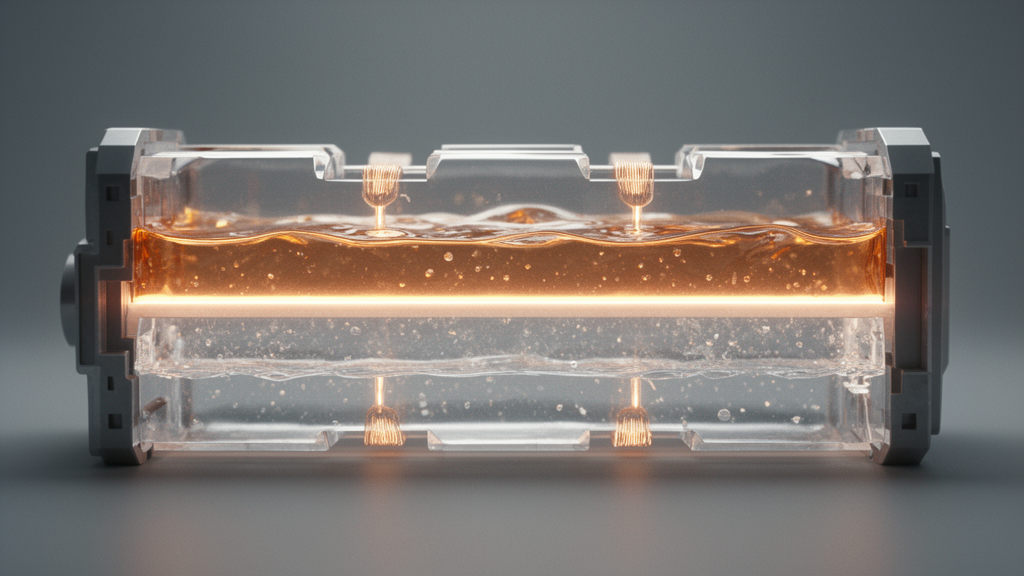
For full electrochemical evaluations, the team assembled a coaxial planar cell containing an excess of metallic sodium in the anode chamber and a porous carbon felt current collector housed within the cathode chamber. The carbon felt structure allowed the molten halide catholyte to infiltrate its conductive fibrous network, substantially increasing the electrochemically active surface area and promoting uniform current distribution. Molybdenum rods guided through polytetrafluoroethylene septa established electrical connections without sealing metals directly into the quartz, thereby mitigating mechanical stress and microcrack development. The dual chambers were clamped with mechanical fixtures over O-ring gaskets to withstand the autogenous pressure created by volatile iodine vapor generated at elevated charging potentials, while top-mounted reservoirs accommodated fluid volume variations during cycling.
Electrochemical properties of the molten catholyte were initially characterized using cyclic voltammetry at 150 °C in a three-electrode quartz cell equipped with an aluminum reference electrode. Over five consecutive sweeps recorded at a scan rate of 100 mV s−1, the voltammograms revealed two primary electrochemical processes. A lower-potential feature centered at approximately 0.85 V versus Al/Al3+ corresponded to reversible aluminum deposition and dissolution involving chloroaluminate species. A broader and more prominent redox process centered between 1.65 and 1.75 V versus Al/Al3+ reflected the oxidation of iodide ions into polyiodides and their subsequent reduction during the reverse scan. The continuous, overlapping nature of the polyiodide response was attributed to rapid dynamic chemical equilibria among iodide, triiodide, and pentaiodide species, influenced by the Lewis acidity of aluminum chloride. Minor differences observed during the first cycle reflected interfacial conditioning and local ionic rearrangement, after which the voltammetric response exhibited high reproducibility up to an anodic current increase beyond 1.9 V.
Electrochemical impedance spectroscopy monitored the resistive contributions of the full cell across extended operating periods at 150 °C. The ohmic resistance remained nearly constant throughout the test, whereas the polarization resistance decreased from 5.69 Ω after 5 hours to approximately 4.3 Ω after prolonged operation, driving a net reduction in total cell resistance from 14.41 to 13.27 Ω that remained stable up to 100 hours. This decline in polarization resistance was attributed to progressive wetting of the carbon felt current collector by the liquid catholyte, expanding the effective contact area and facilitating interfacial charge transfer. Constant-current galvanostatic cycling conducted at a current density of 1.4 mA cm−2, beginning from an open-circuit voltage of 3.06 V, demonstrated flat, highly reproducible charge and discharge plateaus with an average operating cell voltage of approximately 3.24 V.
Long-term galvanostatic cycling within the 54 mAh capacity limit confirmed substantial interfacial and chemical stability. Over the course of 50 continuous charge–discharge cycles, representing more than 1200 hours of testing, the terminal charging voltage exhibited a minor drift of only 0.02 V, confirming that the molten halide catholyte maintained excellent chemical compatibility with the adjacent NASICON ceramic separator. Throughout the multi-week evaluation, the calculated round-trip energy efficiency remained consistently above 95 percent, presenting performance characteristics that rival or exceed conventional high-temperature molten salt battery systems while operating more than 120 °C below standard operational thresholds.
Despite these encouraging performance metrics, the researchers acknowledged specific operational boundaries and technical constraints in the prototype system. Volatile iodine vapor generation at elevated states of charge produces autogenous internal cell pressure that requires robust mechanical clamping and hermetic seals. Furthermore, capacity utilization was constrained within a partial state-of-charge window to prevent phase segregation of the halide salt. The authors noted that future development must focus on scaling planar cell architectures toward higher-capacity prototypes, evaluating alternative halide mixtures to further optimize melting behavior, and refining electrode current-collector geometries to support prolonged cycling in scalable stationary energy storage installations.
Subject of Research: Intermediate-temperature molten sodium batteries utilizing eutectic halide catholytes and NASICON solid electrolytes
Article Title: Intermediate-temperature molten sodium batteries based on NaI–AlCl3 catholytes and NASICON solid electrolytes
Article References: Brancato, B., Frusteri, L., Mastronardo, I., & D’Urso, C. (2026). Intermediate-temperature molten sodium batteries based on NaI–AlCl3 catholytes and NASICON solid electrolytes. Materials for Renewable and Sustainable Energy, 15(3), Article 37. https://doi.org/10.1007/s40243-026-00381-7
Image Credits: AI Generated
DOI: 10.1007/s40243-026-00381-7
Keywords: molten sodium battery, NASICON solid electrolyte, eutectic catholyte, sodium iodide, aluminum chloride, stationary energy storage, intermediate temperature, iodide triiodide redox couple, energy efficiency, electrochemical impedance spectroscopy, cyclic voltammetry, galvanostatic cycling, charge discharge testing, carbon felt current collector, interfacial resistance, secondary phases
News Source: Faith Mcneil. (November 21, 2026). Intermediate-Temperature Molten Sodium Battery Achieves High Efficiency with Halide Catholyte. Scienmag.