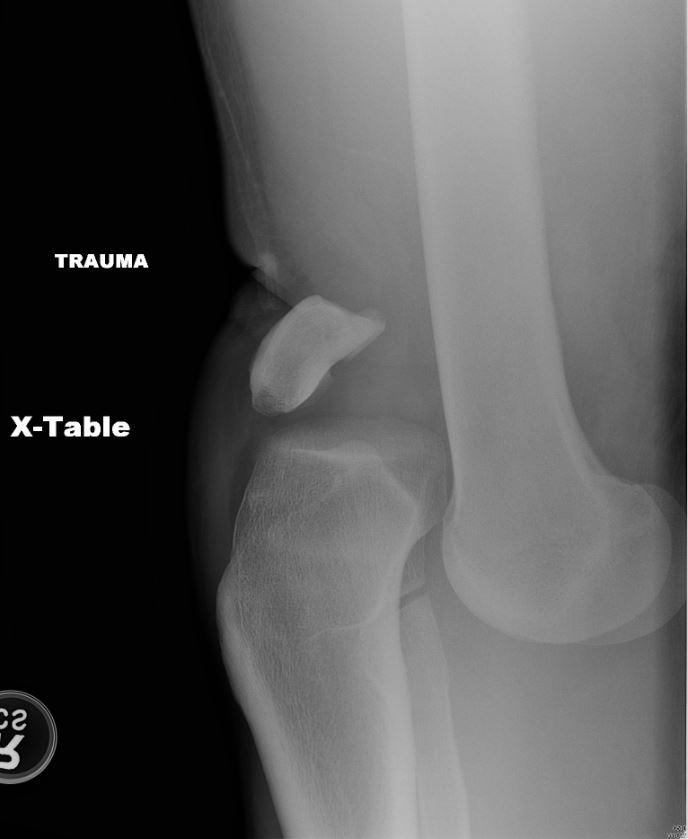
Credit: Courtesy Dr. Joey Johnson
A new study of more than 19,000 knee dislocation cases in the U.S. between 2000 and 2012 provides a painful indication of how the nation's obesity epidemic is changing the risk, severity and cost of a traumatic injury.
"Obesity greatly increases the complications and costs of care," said lead author Dr. Joey Johnson, orthopedic trauma fellow at the Warren Alpert Medical School of Brown University and a physician at Rhode Island Hospital. "As the rate of obesity increases, the rate of knee dislocations increases. The total number of patients who are obese is increasing, so we are seeing more of these problems."
Addressing obesity, said co-author Dr. Christopher Born, a professor of orthopaedics at Brown, could therefore help reverse the trends in the data reported in the Journal of Orthopaedic Trauma.
Obesity's effects
Knee dislocations occur when the knee is badly disrupted because of multiple torn ligaments in the joint. Typically, this happens in vehicle crashes or contact sports like football. But Johnson and Born were inspired to look into the role of obesity because of what they've observed clinically over the last five years: an increase in knee dislocations among obese patients with an increased risk of vascular injury to the main artery that runs down the leg behind the knee.
Moreover, Johnson and Born have seen an increase in "low-energy" causes of dislocations, especially among obese patients. A few years ago, for example, Johnson saw a patient who experienced a knee dislocation after stepping off a ladder while hanging curtains.
To understand what's going on more comprehensively, they analyzed records in the Nationwide Inpatient Sample, a database of patients who've had hospital stays. Over the study period, they found that obese or morbidly obese patients made up an increasing share of knee dislocation patients, rising to 19 percent of patients in 2012 compared to just 8 percent in 2000.
Vascular injury is a particularly severe complication because if undiscovered and untreated, it can lead to amputation of the leg. The team's calculations from the data revealed that the odds of vascular injury during a knee dislocation were twice as high among obese or morbidly obese people than for normal-weight people.
Johnson said this finding is particularly insidious because a common clinical assumption is that vascular injury might be less likely among people suffering a low-energy knee dislocation. He and Born said the new research suggests physicians should be especially vigilant about vascular injury in obese knee dislocation patients, regardless of the cause.
"Orthopaedic and emergency medicine clinicians should have a heightened awareness for the potential of a knee dislocation in the obese patient following a low-energy fall," Born said. "That subset of obese patients who come in with complaints of knee pain need to be carefully evaluated so as not to miss a potentially catastrophic vascular injury."
The stakes, Johnson added, could be the leg itself.
"You don't want to be fooled," he said. "That patient could lose the leg, and their life could be changed forever."
In addition to increased incidence and the likelihood of vascular injury, the researchers looked at the costs of care. Patients with vascular injury, which was twice as likely among obese patients, stayed in the hospital for an average of 15.3 days, while patients without vascular injury stayed for an average of 7.4 days. In keeping with that difference, average hospitalization costs were $131,478 for vascular injury cases and $60,241 for those who avoided vascular damage.
"This study shows the power of using large databases to glean meaningful clinical and economic information that can significantly impact health care costs," Born said.
Though the data leave off in 2012, which is when Johnson began his residency, he said the trends are quite likely to have remained on track.
"Nothing would lead me to believe that the trend has been halted in any way," he said.
###
In addition to Johnson and Born, the paper's other authors are Justin Kleiner, Dr. Stephen Klinger, Dr. Philip McClure and Dr. Roman Hayda from the Department of Orthopaedic Surgery at Brown University and Rhode Island Hospital.
Media Contact
David Orenstein
[email protected]
401-863-1862
@brownuniversity
http://news.brown.edu/
Original Source
http://news.brown.edu/articles/2017/11/knees http://dx.doi.org/10.1097/BOT.0000000000001027