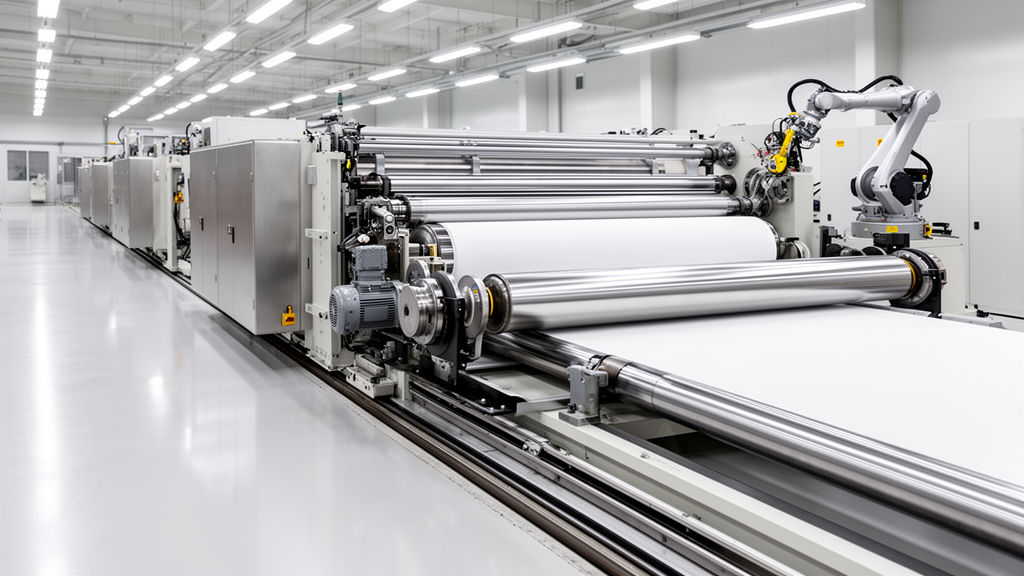
An automated docking system designed for industrial slitter machines reduced average docking duration to 12.3 seconds, representing a 73.1 percent decrease compared to manual procedures while achieving a mean docking error of 12.7 millimeters, according to findings from physical industrial experiments. The evaluation confirmed that the engineered platform successfully satisfied every hard real-time operational constraint across varying defect quantities and differing film thicknesses during continuous manufacturing trials.
The investigation addressed the operational demands of processing aluminum-plastic film, a material experiencing heightened industrial utilization alongside the rapid expansion of new energy electric vehicles. In commercial production environments, slitter machines perform critical cutting and treatment functions on rolls of aluminum-plastic film that contain localized defect spots. Automating the mechanical docking sequence targets the elimination of intensive manual labor previously required to align and treat these defective sections.
Constructed within the formal framework of Cyber-Physical Systems, the automation architecture specifically manages defect spot treatment across complex fabrication lines. To resolve defect omission failures that frequently arise when standard first-in-first-out scheduling operates across multiple observation areas, the researchers formulated a novel first-in-last-out task stack algorithm.
To maintain rigorous structural modularity and strict separation of concerns throughout the cyber-physical control architecture, the complete mechanism was systematically decomposed into ten loosely coupled timed automata templates.
The design team conducted formal verification of the control architecture using the UPPAAL verification tool suite to guarantee operational safety prior to deployment. The automated model checking verified critical system properties, encompassing complete freedom from deadlocks, mutual exclusion across active servo modes, and the deterministic ordering correctness of the task stack. All formal verification procedures for these core system properties were completed comprehensively within 33 seconds.
To bridge the theoretical formalisms with working shop-floor machinery, the authors established an exact one-to-one correspondence between the verified timed automata models and their operational Python software implementation. The developers made the complete software source code publicly accessible to enable direct reproducibility and practical deployment. In physical shop trials, the resulting 12.7-millimeter mean positioning error corresponded to 33 percent of typical manual operational error, delivering a validated model-driven framework connecting formal verification directly to physical manufacturing execution.
Subject of Research: Automated slitter machine docking for industrial defect spot management
Article Title: Systematic design of automatic docking function for a slitter machine using timed automata
Article References: Ouyang, Z., & Wang, H. (2027). Systematic design of automatic docking function for a slitter machine using timed automata. Cluster Computing, 30(1), Article 55. https://doi.org/10.1007/s10586-026-06817-z
Image Credits: AI Generated
DOI: 10.1007/s10586-026-06817-z
Keywords: slitter machines, automatic docking, timed automata, cyber-physical systems, aluminum-plastic film, defect spot management, first-in-last-out algorithm, task stack scheduling, UPPAAL verification, deadlock freedom, servo mode mutual exclusion, stack ordering correctness, model-driven engineering, hard real-time systems, industrial automation, electric vehicle materials, Python implementation
News Source: Denise Maddox. (November 20, 2026). Automated Slitter Machine Docking Reduces Defect Alignment Time by 73 Percent. Scienmag.