• HOME
  • NEWS
  • EXPLORE
    • CAREER
      • Companies
      • Jobs
    • EVENTS
    • iGEM
      • News
      • Team
    • PHOTOS
    • VIDEO
    • WIKI
  • BLOG
  • COMMUNITY
    • FACEBOOK
    • INSTAGRAM
    • TWITTER
Saturday, November 21, 2026
BIOENGINEER.ORG
No Result
View All Result
  • Login
  • HOME
  • NEWS
  • EXPLORE
    • CAREER
      • Companies
      • Jobs
        • Lecturer
        • PhD Studentship
        • Postdoc
        • Research Assistant
    • EVENTS
    • iGEM
      • News
      • Team
    • PHOTOS
    • VIDEO
    • WIKI
  • BLOG
  • COMMUNITY
    • FACEBOOK
    • INSTAGRAM
    • TWITTER
No Result
View All Result
Bioengineer.org
No Result
View All Result
Home NEWS Science News Technology

Micelle Confinement and Photocurable Hydrogels Boost Triplet Upconversion Efficiency Sevenfold

by
November 20, 2026
in Technology
Reading Time: 2 mins read
0
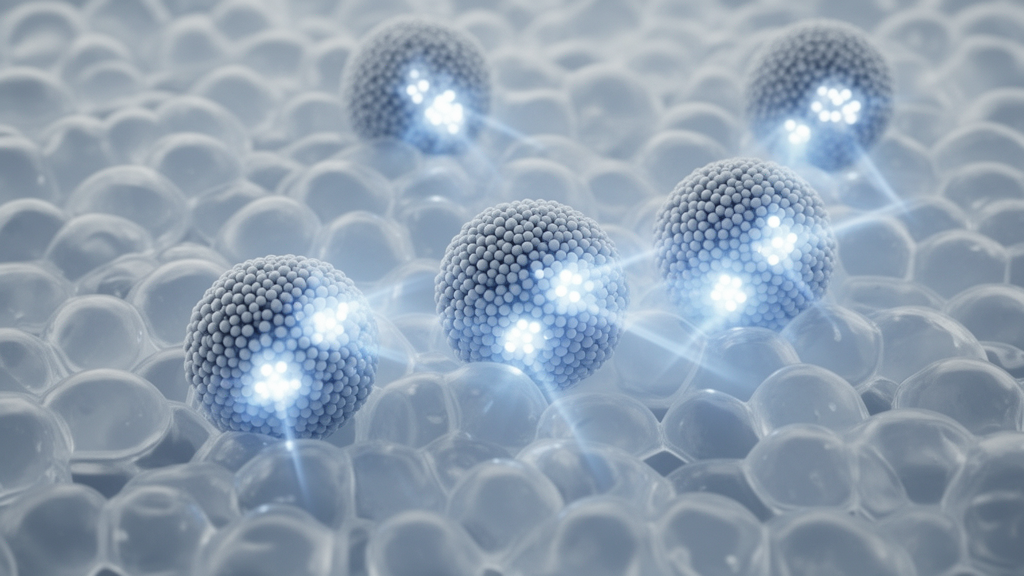
Micelle Confinement and Photocurable Hydrogels Boost Triplet Upconversion Efficiency Sevenfold

Micelle Confinement and Photocurable Hydrogels Boost Triplet Upconversion Efficiency Sevenfold

Share on FacebookShare on TwitterShare on LinkedinShare on RedditShare on Telegram

Researchers have developed a synergistic strategy combining micelle confinement with a photocurable hydrogel oxygen barrier to significantly enhance triplet–triplet annihilation upconversion. The system achieved a sevenfold increase in upconversion efficiency over micelle-free configurations, addressing key bottlenecks that have historically limited practical applications in solar energy conversion and photoelectrocatalysis.

Triplet–triplet annihilation upconversion functions by converting low-energy incident photons into higher-energy photons. Despite its technological promise, operational implementation in solid matrices has been severely restricted by oxygen-induced triplet quenching and the poor dispersion of sensitizer and annihilator pairs within solid hosts.

Standard encapsulation methods can partially reduce oxygen quenching, but they generally fail to provide precise control over sensitizer and annihilator dispersion.

To overcome these structural limitations, the study introduced stable Triton X-100 surfactant micelles to house zinc meso-tetraphenylporphine and perylene as a model sensitizer and annihilator pair. The resulting nanoconfinement-facilitated dispersion substantially improved light harvesting compared with alternative surfactant formulations.

The platform also relies on the in situ photopolymerization of hydroxyethyl acrylate. This photocuring reaction forms a robust hydrogel matrix that acts as a physical barrier against oxygen diffusion while simultaneously modulating the size of the embedded micelles to suppress triplet quenching.

The synthesized material enabled efficient green-to-blue spectral conversion while maintaining stability. Under simulated sunlight illumination, employing the upconversion hydrogel as a spectral conversion layer markedly increased the photocatalytic water splitting performance of a cadmium sulfide photoelectrode.

The authors reported that integrating surfactant micelle sizing directly with photocurable barrier hydrogels provides a simple, scalable processing route for stable upconversion materials. However, tests were conducted specifically using a zinc meso-tetraphenylporphine and perylene model pair alongside cadmium sulfide photoelectrodes under simulated laboratory sunlight.

Subject of Research: Triplet–triplet annihilation upconversion in photocurable hydrogels

Article Title: Micelle size effect on TTA upconversion in photocurable hydrogels for photoelectrocatalytic water splitting

Article References: Chen, W., Li, X., Chen, J., Zhang, H., & Huang, Y. (2026). Micelle size effect on TTA upconversion in photocurable hydrogels for photoelectrocatalytic water splitting. Journal of Materials Science. https://doi.org/10.1007/s10853-026-14114-8

Image Credits: AI Generated

DOI: 10.1007/s10853-026-14114-8

Keywords: triplet-triplet annihilation, upconversion, photocurable hydrogels, micelle size effect, photoelectrocatalytic water splitting, photocatalysis, solar energy conversion, zinc meso-tetraphenylporphine, perylene, TX-100, hydroxyethyl acrylate, CdS photoelectrode, oxygen barrier, triplet quenching, green-to-blue conversion, energy materials

News Source: Denise Maddox. (November 20, 2026). Micelle Confinement and Photocurable Hydrogels Boost Triplet Upconversion Efficiency Sevenfold. Scienmag.


Tags: CdS photoelectrodeenergy materialsgreen-to-blue conversionhydroxyethyl acrylatemicelle size effectoxygen barrierperylenephotocatalysisphotocurable hydrogelsphotoelectrocatalytic water splittingsolar energy conversiontriplet quenchingtriplet-triplet annihilationTX-100upconversionzinc meso-tetraphenylporphine
Share12Tweet7Share2ShareShareShare1

Related Posts

Review Links Atomic Scale Characterization and Machine Learning to Materials Science Advances

Review Links Atomic Scale Characterization and Machine Learning to Materials Science Advances

November 21, 2026
Enhanced 3D ResNet Model Classifies Active Pulmonary Tuberculosis on Chest CT

Enhanced 3D ResNet Model Classifies Active Pulmonary Tuberculosis on Chest CT

November 21, 2026

Lightweight CPU Fingerprinting Enhances Post-Quantum BIKE Key Generation Against Seed Prediction

November 21, 2026

Graphene-Iron Composites Optimize Polycyclic Aromatic Hydrocarbon Removal in Wastewater Treatment

November 21, 2026

POPULAR NEWS

  • Enhanced 3D ResNet Model Classifies Active Pulmonary Tuberculosis on Chest CT

    Enhanced 3D ResNet Model Classifies Active Pulmonary Tuberculosis on Chest CT

    29 shares
    Share 12 Tweet 7
  • Analysis of Real-World Data Details Skin Toxicities Across Eleven Targeted Cancer Drugs

    29 shares
    Share 12 Tweet 7
  • Lightweight CPU Fingerprinting Enhances Post-Quantum BIKE Key Generation Against Seed Prediction

    29 shares
    Share 12 Tweet 7
  • Regional Biopsy Matches Standard Sampling for Suspected Prostate Cancer Across PI-RADS Scores

    29 shares
    Share 12 Tweet 7

About

We bring you the latest biotechnology news from best research centers and universities around the world. Check our website.

Follow us

Recent News

Plasma Proteomics Reveals Distinct Resistance and Survival Signatures in Lung Cancer

Alternative CAR Cell Therapies Show Promise Against Aggressive Pleural Mesothelioma

Ginsenoside Rh3 Alleviates Cisplatin-Induced Kidney Damage in Mouse and Cell Models

Subscribe to Blog via Email

Enter your email address to subscribe to this blog and receive notifications of new posts by email.

Join 89 other subscribers
  • Contact Us

Bioengineer.org © Copyright 2023 All Rights Reserved.

Welcome Back!

Login to your account below

Forgotten Password?

Retrieve your password

Please enter your username or email address to reset your password.

Log In
No Result
View All Result
  • Homepages
    • Home Page 1
    • Home Page 2
  • News
  • National
  • Business
  • Health
  • Lifestyle
  • Science

Bioengineer.org © Copyright 2023 All Rights Reserved.