In an in vivo animal study, a composite wound dressing scaffold fabricated from biopolymers and soybean-derived hydroxyapatite achieved 90 percent wound closure in rats within seven days. The formulation, combining chitosan Schiff base, alginate, and hydroxyapatite derived from soybeans, significantly outperformed treatment outcomes in both curcumin and saline control groups. The investigation, published in the Journal of Materials Science, evaluated whether incorporating soybean-sourced minerals into biopolymer matrices could produce functional, biodegradable scaffolds capable of supporting tissue regeneration.
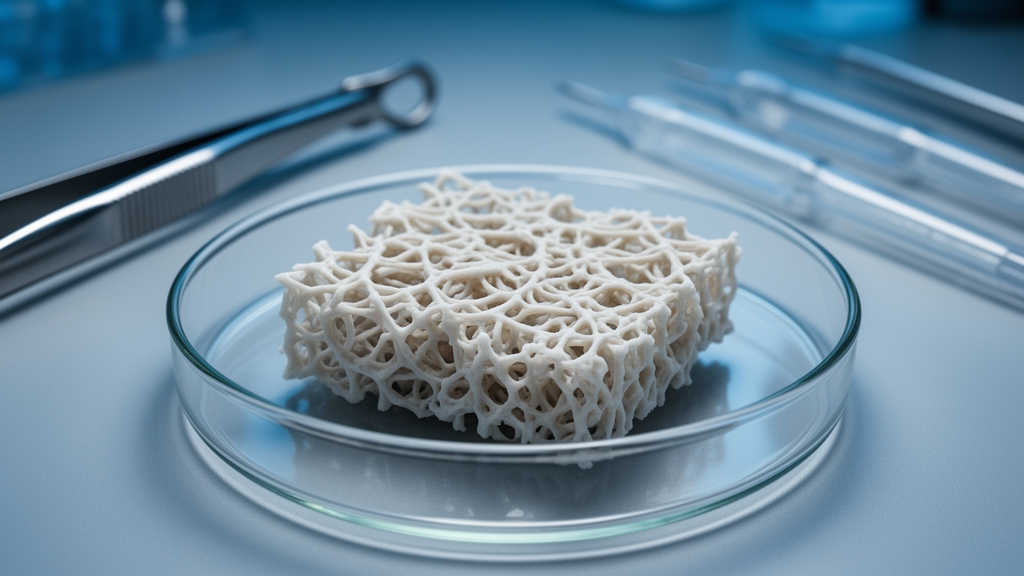
The research team developed two distinct ternary material blends to evaluate performance differences across polymer combinations. Using a solvent casting fabrication process, the authors prepared scaffolds composed of chitosan Schiff base, alginate, and soybean-derived hydroxyapatite, designated as CSB/AL/HAP(SB), alongside an alternative blend replacing alginate with carboxymethyl cellulose, designated as CSB/CMC/HAP(SB). Characterization via Fourier-transform infrared spectroscopy and X-ray diffraction confirmed successful molecular interactions and amorphization among the blended constituents. Furthermore, scanning electron microscopy imaging revealed porous scaffold structures suitable for facilitating cellular infiltration.
Laboratory biodegradation assays demonstrated that the blending process conferred a controlled degradation profile compared to single-component materials. Unmodified chitosan Schiff base degraded rapidly, showing 60 percent degradation within two hours, whereas the ternary blends exhibited markedly slower, more controlled breakdown rates. In biocompatibility assessments, MTT assays verified that the composite biomaterials were non-toxic to cells, maintaining cell viability levels above 95 percent across the tested samples.
The researchers assessed the antioxidant and antimicrobial performance of both ternary formulations. In DPPH radical scavenging assays, both the CSB/CMC/HAP(SB) and CSB/AL/HAP(SB) scaffolds demonstrated antioxidant activity, yielding half-maximal inhibitory concentration values above 120 micrograms per milliliter. Antimicrobial screening established significant antibacterial and antifungal properties for the scaffolds, which produced clear inhibition zones measuring up to 30 millimeters against Streptococcus pneumoniae and up to 28 millimeters against the fungal pathogen Aspergillus flavus.
The findings indicate that biopolymer blends incorporating soybean-derived hydroxyapatite provide a biodegradable scaffold platform combining biocompatibility, antimicrobial defenses, and antioxidant properties. The accelerated 90 percent closure observed by day seven highlights the wound-healing potential of the CSB/AL/HAP(SB) formulation under preclinical conditions. However, the reported results reflect laboratory evaluations and rat wound models, meaning that clinical efficacy in human patients cannot be inferred without dedicated human clinical trials.
Subject of Research: Soybean-derived hydroxyapatite and biopolymer scaffolds for wound healing
Article Title: Fabrication and evaluation of chitosan Schiff base/biopolymer scaffolds with soybean-derived hydroxyapatite for wound healing applications
Article References: Gomathi, T., Santhanalakshmi, K., Breeth Retna, S. R., Lavanya, R., John Joseph, J., Radha, E., & Vijayakumar, S. (2026). Fabrication and evaluation of chitosan Schiff base/biopolymer scaffolds with soybean-derived hydroxyapatite for wound healing applications. Journal of Materials Science. https://doi.org/10.1007/s10853-026-14051-6
Image Credits: AI Generated
DOI: 10.1007/s10853-026-14051-6
Keywords: hydroxyapatite, soybean-derived hydroxyapatite, chitosan Schiff base, alginate, carboxymethyl cellulose, wound healing, biopolymer scaffolds, solvent casting, biodegradation, DPPH assay, antioxidant activity, Streptococcus pneumoniae, Aspergillus flavus, antimicrobial activity, MTT assay, cell viability, rat wound models
News Source: Denise Maddox. (November 20, 2026). Soybean Hydroxyapatite Scaffolds Accelerate Rat Wound Healing in Laboratory Study. Scienmag.