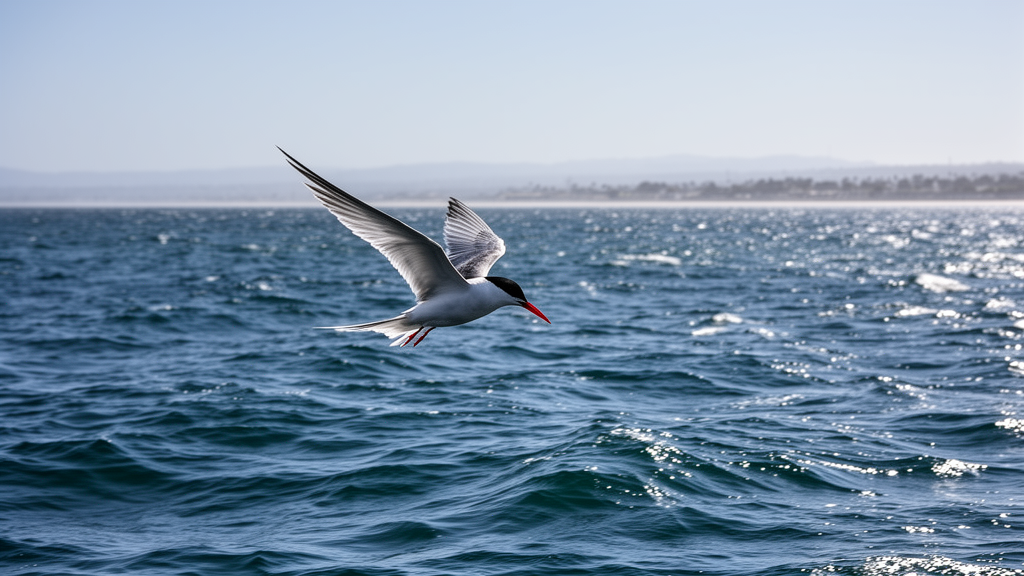
Breeding common terns in the Gulf of Maine substantially expanded their foraging ranges and lengthened their foraging trips when availability of high-quality forage fish declined, yet this behavioral flexibility failed to prevent reduced chick provisioning and lower reproductive success. Tracking data collected across four breeding seasons showed that in years when the birds’ preferred prey items were scarce, the terns increased their trip durations by 23% to 87% and expanded their foraging ranges by 17% to 51%. Rather than staying within the immediate vicinity of their nesting grounds, parent terns traveled to distant marine waters up to approximately 150 kilometers from the colony. These findings reveal that while central place foraging seabirds can adjust their spatial search patterns in response to changing marine prey distributions, the energetic toll of extended journeys can limit their ability to deliver sufficient food to their young.
The study was conducted by researchers tracking the largest common tern (Sterna hirundo) breeding colony in the Gulf of Maine, located on White and Seavey Islands roughly 10 kilometers off the New Hampshire coast. The twin islands, spanning approximately 3.25 hectares and joined by a land bridge during part of the tidal cycle, supported between 3,069 and 3,413 nesting pairs each breeding season from May through August. The Gulf of Maine is warming more rapidly than most of the global ocean, causing pronounced changes in the abundance and distribution of the small schooling fish that seabirds rely upon. Because common terns are single-prey loaders that transport only one prey item at a time back to their chicks, and income breeders that rely directly on immediate feeding rather than energy reserves to produce eggs, their reproductive output is tightly bound to local foraging conditions.
To investigate how marine environmental changes influence seabird movement, researchers captured adult terns during incubation and early chick brooding across four breeding seasons from 2021 through 2024. Birds were fitted with lightweight, solar-powered GPS tracking devices attached via leg-loop harnesses engineered to fall off naturally after the breeding season. The combined mass of the tag and harness accounted for only 3 to 4 percent of each adult’s body mass, with birds returning to their nests an average of 19 minutes after release. Genetic sex identification was conducted from collected contour feathers, while chicks were banded to monitor their growth and fledging success alongside colony-wide productivity monitoring plots.
To determine how movement behaviors shifted under different environmental conditions, the team analyzed positional fixes using three-state Hidden Markov Models that separated bird locations into resting or nesting, transiting, and actively foraging states based on movement velocity and turning angles. Foraging positions were then analyzed with kernel utilization distributions to determine both the core 50 percent and overall 95 percent foraging ranges for each season. Individual foraging trips departing from and returning to the nesting colony were evaluated using Bayesian generalized linear mixed-effects models that accounted for year, day of the season, bird sex, and breeding status, while treating individual identity as a random effect to adjust for repeated measures.
Colony-level diet and breeding performance over the four study years were evaluated against a baseline ten-year reference period spanning 2011 through 2020. During that decade, common tern diets were typically dominated by lipid-rich, high-energy fish: herrings accounted for 29 percent of prey items by number, juvenile hakes and rockling represented 45 percent, and sand lances comprised 8 percent. Unpreferred prey items, including small invertebrates and round, deep-bodied Atlantic butterfish that tern chicks struggle to swallow, made up the remainder. During favorable years in the study, such as 2022 and 2024, preferred prey deliveries remained stable or elevated, and pairs maintained typical clutch sizes and fledged one or two chicks at rates comparable to historic averages.
In contrast, the 2021 and 2023 breeding seasons exhibited sharp declines in local prey quality and reproductive productivity. In those two poor prey years, provisioning of herrings and hakes dropped significantly, accompanied by a marked rise in deliveries of low-value invertebrates and oversized butterfish. Concurrently, the proportion of clutches containing only a single egg rose, and the frequency of nests failing to fledge any chicks climbed well above baseline figures. These dual indicators demonstrated that forage fish scarcity set in early enough to reduce egg production and persisted throughout the weeks of chick rearing, creating severe energetic bottlenecks for the nesting population.
These fluctuations in prey abundance drove pronounced changes in common tern foraging flights. During productive years, the birds restricted their foraging to waters within approximately 10 to 40 kilometers of White and Seavey Islands, concentrating their efforts around coastal interfaces and nearby estuaries such as the Piscataqua and Merrimack river mouths. During the poor seasons of 2021 and 2023, however, the birds dramatically expanded their geographic reach. The core foraging distribution pushed southward across coastal and offshore Massachusetts waters and into northeastern Cape Cod, with birds repeatedly traveling more than 150 kilometers to locate prey patches.
Statistical modeling indicated that trip duration, cumulative travel distance, and maximum extent from the nesting colony all increased substantially during poor prey years regardless of the sex of the bird. Foraging metrics also escalated non-linearly across the calendar season in all years, aligning with predictions of prey depletion zones known as Ashmole’s halo, where intensive feeding by thousands of nesting birds gradually exhausts local prey aggregations. Birds that suffered complete nest failure also made significantly longer and wider foraging journeys than those still attending eggs or chicks, reflecting the release from central place nesting obligations once dependent offspring were lost.
A notable pattern within the expanded foraging distribution was the frequent utilization of Stellwagen Bank, an ocean ridge encompassed within a national marine sanctuary south of the colony known for predictable aggregations of sand lances. While herring and hake deliveries declined sharply during poor years, the proportion of sand lance in chick diets remained steady or even increased. This contrast indicates that terns deliberately made extended open-water flights to target reliable sand lance grounds when nearer waters lacked sufficient schools of herring and hake. However, the long transit times required to reach Stellwagen Bank limited the frequency of feedings parents could deliver to their broods.
The study highlights fundamental bioenergetic trade-offs for long-lived seabirds navigating changing marine environments. When foraging trips require hours of active flight over dozens of kilometers, adults must burn substantial energy simply navigating to and from feeding grounds, which may force them to prioritize their own maintenance over chick nourishment. Because adult common terns may live and breed for up to two decades, evolutionary theory predicts they will not compromise their own survival for a single struggling brood. As ongoing ocean warming continues to alter the distribution of cold-water forage fishes across the Northwest Atlantic, proactive marine spatial protections and prey management may become indispensable to safeguard central place foraging seabirds from chronic reproductive failure.
Specific device configurations and deployment routines helped ensure that tracking data reflected authentic breeding behavior rather than capture stress or migratory shifts. Handling times during capture with walk-in traps averaged 7.6 minutes, ranging from 4 to 12 minutes, during which biologists measured body mass and wing cord. Because common terns rely on daylight for plunge-diving, the solar-powered tags were programmed to shut down at night, typically between 22:00 and 03:00 Eastern Standard Time, conserving battery life for regular daytime fixes every 10 to 20 minutes. Positional data were transmitted via ultra-high frequency link to colony base stations when birds moved within 200 meters of receiving antennas. Researchers excluded tracking records from August to prevent late-season pre-migratory flights from distorting breeding range models. Furthermore, statistical rarefaction analyses established that tracking five to ten birds was sufficient to achieve stable colony-level space use estimates, confirming that interannual differences in range size reflected real distributional shifts rather than sample size variation.
Colony diet and reproductive measurements relied on standardized protocols maintained by the Isles of Shoals Tern Restoration Project. Field teams observed between 40 and 62 nests annually from three observation blinds and stationary video platforms, recording prey species identities and estimating total prey lengths relative to adult bill lengths to evaluate consumed biomass. Colony productivity assessments tracked between 72 and 116 nests situated within enclosed plots across the colony, with chicks monitored every three to four days until reaching the 15-day fledging benchmark. To evaluate annual differences across multiple comparisons, the authors applied one-sample proportion tests with Bonferroni corrections against the 2011 to 2020 baseline. Shifts were deemed biologically significant only if they achieved statistical significance and exhibited a proportional change of at least 0.10, matching the baseline standard deviations observed for prey proportions, lengths, clutch sizes, and fledge rates.
The authors noted several environmental and methodological caveats when interpreting links between foraging effort and reproductive output. Beyond prey scarcity, heavier rainfall recorded in June and July of 2021 and 2023 likely contributed to chick mortality, as young offspring with poor body condition struggle to thermoregulate during wet weather. Furthermore, direct surveys of local fish stocks were not conducted simultaneously, requiring researchers to infer prey availability from chick provisioning. However, recent fecal DNA metabarcoding on the colony corroborated the observational methods, confirming that visual prey identifications were reliable and that adult diets contained similar proportions of prey types to those provisioned to chicks.
Subject of Research: Common tern foraging movement flexibility, chick provisioning, and reproductive outcomes in the Gulf of Maine
Article Title: Linkages among foraging movements, prey provisioning, and reproduction in a central place foraging seabird
Article References: Caldwell, A., Craig, E., Hermann, N. T., & Furey, N. B. (2026). Linkages among foraging movements, prey provisioning, and reproduction in a central place foraging seabird. Movement Ecology, 14(1), Article 52. https://doi.org/10.1186/s40462-026-00675-5
Image Credits: AI Generated
DOI: 10.1186/s40462-026-00675-5
Keywords: common tern, Sterna hirundo, foraging movements, central place foraging, Gulf of Maine, chick provisioning, reproductive success, forage fish, GPS tracking, hidden Markov models, ocean warming, White and Seavey Islands, herring, hake, sand lance, Atlantic butterfish, Stellwagen Bank
News Source: Drew Townsend. (November 20, 2026). Common Terns Expand Foraging Ranges When Preferred Forage Fish Become Scarce. Scienmag.