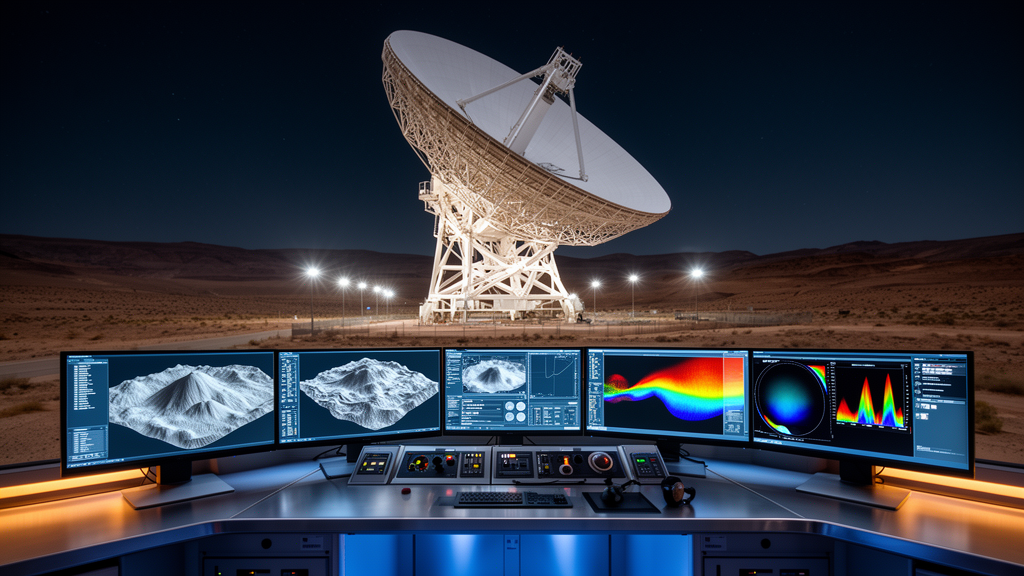
Researchers Yu-Ming Yang, Daniel Kahan, Dustin Buccino, Elias Barbinis, Walid Majid, and Clement Lee have introduced the Planetary Data System Radio Science Data Viewer, an open-source graphical software application designed to inspect and decode complex radiometric tracking records from interplanetary exploration. Designated as PRSDV, the standalone program provides quick-look visualization capabilities for deep space tracking data stored in the Tracking and Navigation File format, also known as TRK-2-34. These tracking files represent the primary radiometric observation type recorded across NASA’s Deep Space Network, capturing high-precision radio interactions between ground tracking stations and robotic spacecraft across the solar system. Developed using MATLAB App Designer, the software allows planetary scientists, orbit determination specialists, and instrument engineers to inspect closed-loop tracking measurements without building custom decoding scripts for binary archives. The tool directly addresses the challenge of accessing archived space communications, translating raw tracking records into intelligible plots that reveal spacecraft motion, signal performance, and radio transmission characteristics across planetary science investigations.
The Tracking and Navigation File architecture encompasses observations gathered across decades of robotic exploration, serving as the core repository for deep space radio science throughout NASA’s historical and contemporary flight manifests. Documented datasets supported by the PDS4 archive standard include tracking sequences acquired from planetary missions such as Dawn, InSight, Juno, Lucy, MAVEN, Messenger, and OSIRIS-REx. Beyond these cataloged PDS4 collections, the underlying TRK-2-34 format preserves tracking records from a broad range of landmark exploratory missions, including Magellan, Venus Express, the Gravity Recovery and Interior Laboratory lunar orbiters, the Lunar Reconnaissance Orbiter, the Mars Reconnaissance Orbiter, Cassini, Voyager 1, Voyager 2, and New Horizons. Within the operational framework of deep space tracking, TNFs represent the current evolutionary stage of radio science archives, having replaced earlier closed-loop products such as Archival Tracking Data Files and Orbit Data Files. As additional historical missions migrate into the modern PDS4 standard, accessibility to these extensive radiometric libraries becomes vital for ongoing planetary analysis.
Radiometric tracking files generated by the Deep Space Network record fundamental signal properties, including received carrier frequency, phase measurements, transmitted signal strength, and ground antenna parameters such as system noise temperature. Over decades of mission operations, these observational records have proved essential for investigating anomalies, assessing communications performance, and extracting subtle gravitational signatures. Historical analyses demonstrate the critical utility of these records, such as the investigation by Turyshev and colleagues in 2010, which examined decades of radiometric tracking to probe the Pioneer Anomaly, a slight, unexplained constant acceleration directed toward the Sun observed on Pioneers 10 and 11. Tracking records also provided diagnostic evidence to identify the cause behind the loss of the Mars Climate Orbiter in 1999 through Doppler and ranging observations. Furthermore, Buccino and colleagues in 2022 demonstrated how phase averaging and compression techniques applied to TRK-2-34 measurements mitigated noise during the Mars InSight Rotation and Interior Structure Experiment. Similar tracking files underpin core planetary interior and gravity field determinations at Mars and Titan.
Despite containing rich engineering and scientific measurements captured during tracking passes, Tracking and Navigation Files present substantial accessibility hurdles because they are formatted as complex binary files that require specialized decoding. Standard Formatted Data Units containing DSN tracking records cannot be read directly in standard text editors or generic spreadsheet tools, demanding detailed familiarity with raw file specifications. While official structural documentation is maintained within the Planetary Data System, researchers have historically needed to develop specialized translation software or execute low-level parsing routines merely to inspect archived passes. The PRSDV application resolves this technical bottleneck by providing an automated quick-look capability, enabling researchers to open files and extract targeted data fields without interpreting native binary structures. By reading adjoining PDS4 metadata labels formatted in Extensible Markup Language, the application bridges the gap between raw binary storage and interactive scientific evaluation, establishing a standardized environment where planetary dynamicists and cross-disciplinary researchers can swiftly review archived radiometric observations.
The focused design of PRSDV fills a distinct technical niche when compared against other software packages distributed across the Planetary Data System ecosystem. As detailed in comparative evaluations of PDS software tools, the standard PDS4 Viewer provides general-purpose inspection and basic plotting for standard XML-labeled arrays, images, ASCII tables, and basic binary tables, yet it cannot natively decode complex Deep Space Network binary structures such as TRK-2-34 SFDUs. Conversely, specialized tools such as the Small Bodies Data Viewer focus on asteroidal and cometary observations, accommodating photometry, spectra, and shape models without supporting large planetary orbiters or closed-loop radiometric tracking files. Advanced programmatic libraries such as PyTrk234 and SpiceyPy offer powerful capabilities for raw TRK-2-34 file processing, trajectory analysis, spacecraft attitude evaluation, and automated pipeline execution using SPICE geometry kernels, but they lack graphical user interfaces and require Python scripting expertise. PRSDV uniquely provides an accessible, non-programmatic graphical interface specifically tailored to visualize closed-loop radio science and DSN tracking records.
Architecturally, the PRSDV application is constructed to operate as a self-contained visualization utility, integrating NASA’s open-source PDS4 transform software package to read and extract designated data fields from labeled Tracking and Navigation Files. The software is released under the permissive Apache License 2.0 and is hosted openly within the NASA-PDS GitHub repository under version 1.0. Although developed within the MATLAB App Designer environment, the deployed application functions as a standalone executable that does not require users to possess a MATLAB commercial license or install the full MATLAB programming environment. Users across Linux, macOS, and Windows operating systems can execute the program after installing a compatible runtime package on their local machines. For operational environments requiring custom integration or specialized security configurations, the complete MATLAB source code is distributed alongside precompiled executables, allowing research institutions and mission operations centers to compile the codebase locally or adapt its functional blocks to fit specialized computing infrastructure.
Version 1.0 of the application supports three primary radiometric data types widely employed in planetary radio science: Type 1 for Downlink Carrier Phase, Type 9 for Frequency Ramps, and Type 16 for Carrier Frequency Observables. Within these categories, the software implements a rigorous mathematical filtering mechanism that allows investigators to isolate specific subsets of tracking passes. The set of selected configuration data points is formally defined as the union of individual configuration subsets, where each subset represents the intersection of user-selected operational parameters. These selectable parameters include ground downlink stations, receiving frequency bands, transmitting uplink stations, and specific Doppler modes. Users configure their visual query through a graphical configuration table; once choices are designated, clicking the selection button executes the filtering algorithm, visually confirmed when an interface indicator light changes from red to green. If a user leaves subset boxes unchecked, the filtering logic defaults to selecting all data points across that category, such as selecting a single ground station while retaining all associated uplink stations and bands.
Upon establishing the desired data filtering criteria, users initiate data rendering by engaging the primary plotting control within the application’s graphical interface. PRSDV automatically extracts observational metadata directly from the accompanying XML label file to construct accurate plot titles, assign appropriate engineering units, and label coordinate axes. To accommodate scientific reporting and custom visualization requirements, the interface incorporates a manual legend update tool, allowing researchers to modify plot titles, edit textual descriptions, and adjust axis legends before finalizing figures. In addition to generating interactive on-screen graphics, the software incorporates an automated data export function. Whenever a user clicks the plotting command, the application generates an ASCII-formatted text file containing the exact filtered data points displayed on the graph, depositing the file directly into the application directory. This immediate tabular output enables scientists to transition seamlessly from rapid visual inspection to external numerical modeling, algorithmic fitting, or joint analysis with complementary spacecraft datasets.
The operational workflow and analytical capabilities of PRSDV are demonstrated through an illustrative analysis of radiometric tracking data collected during the Juno spacecraft’s close flyby of Jupiter. The case study examines Tracking and Navigation Files recorded during the Perijove-14 pass on July 15 and 16, 2018, corresponding to Day of Year 196 and 197. By loading the PDS4 XML label file into the application’s data interface, researchers selected the Type 1 Downlink Carrier Phase dataset and extracted Field 67, representing carrier signal-to-noise spectral density. Applying the configuration filtering controls, the analysis isolated signals received by Deep Space Station 14 operating in the microwave X-band. The resulting plots illustrate residual frequency variations spanning from minus one to four hertz around Juno’s closest approach to Jupiter at 05:58 UTC. Furthermore, the visual outputs clearly differentiate residual frequency noise patterns between one-way and three-way radio propagation modes, providing critical observational inputs required to model Jupiter’s gravitational field, internal planetary structure, the Io plasma torus, and spacecraft trajectory solutions.
By establishing an open-source visual gateway into archived radiometric records, PRSDV lowers the barrier for historical data reanalysis, supporting future deep space mission design and geophysical research. Archival re-examination is particularly valuable for upcoming planetary initiatives, such as applying historical Galileo and Magellan radio tracking to inform mission planning for Europa Clipper, DAVINCI, and VERITAS. While Version 1.0 establishes robust visualization for raw observables such as Doppler frequency shifts and received signal power, the authors note clear functional boundaries: the initial release does not perform automated derivation of higher-level science products, nor does it support open-loop radio formats such as CCSDS-RDEF. To expand these analytical boundaries, the development team is actively advancing PRSDV Version 2.0. This forthcoming upgrade will incorporate SPICE orbital and planetary ephemeris kernels, directly integrating spacecraft flight dynamics, pointing geometry, and celestial observation context into the interactive viewing platform, thereby further empowering the international planetary science community to interrogate deep space radio tracking archives.
Subject of Research: Planetary radio science data visualization software for NASA Deep Space Network tracking files
Article Title: PDS radio science data viewer (PRSDV)
Article References: Yang, Y.-M., Kahan, D., Buccino, D., Barbinis, E., Majid, W., & Lee, C. (2026). PDS radio science data viewer (PRSDV). SoftwareX, 36, Article 103215. https://doi.org/10.1016/j.softx.2026.103215
Image Credits: AI Generated
DOI: 10.1016/j.softx.2026.103215
Keywords: Planetary Data System, Radio Science, Deep Space Network, PRSDV, Tracking and Navigation Files, TRK-2-34, PDS4, Juno Spacecraft, Doppler Residuals, Carrier Phase, MATLAB App Designer, Spacecraft Navigation, Gravity Modeling, Jupiter Science, Open Source Software, SPICE Kernels, Pioneer Anomaly, InSight Mission
News Source: Denise Maddox. (November 20, 2026). Open-Source PRSDV Tool Visualizes Deep Space Network Planetary Radio Science Data. Scienmag.