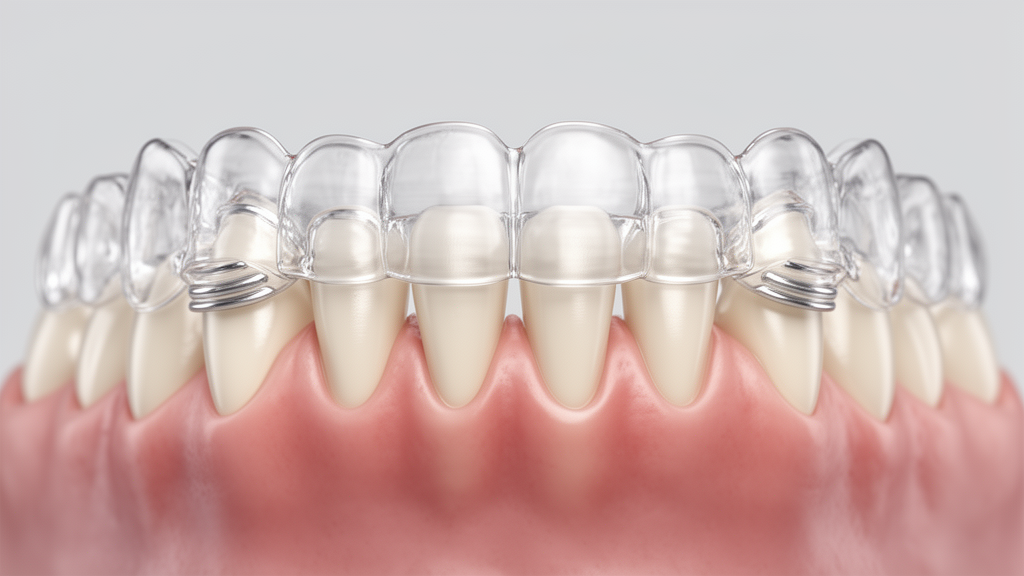
A computational biomechanics investigation using finite element analysis has found that modified power ridges created through localized aligner thickening improve root torque control compared to conventional indented designs during simulated maxillary central incisor movement. The research, published in BMC Oral Health, evaluated how structural variations in clear aligners influence three-dimensional tooth displacement and periodontal ligament stress distribution when delivering palatal root torque.
In this investigation, researchers led by Yaya Hong, Yuchen Zheng, Jingke Gu, Yoshiya Hashimoto, and Shuyan Liu examined the mechanical effects of 3D-printed modified power ridges on the maxillary central incisors under a simulated 1° palatal root torque. The investigation utilized finite element analysis to systematically observe how localized geometry modifications altered forces transmitted through the tooth root and surrounding supporting tissues.
The study established three comparative finite element analysis groups based on the morphometry of the power ridge applied to the maxillary central incisors. The first served as a control group without power ridges. The second, designated as the power ridge group, featured conventional local indentations on the aligner surface. The third, representing the modified power ridge group, incorporated localized thickening of the clear aligner material. Across both modified and conventional designs, the team tested power ridge heights of 0.1 mm, 0.2 mm, 0.25 mm, 0.3 mm, 0.4 mm, and 0.5 mm to evaluate the specific role of ridge elevation.
When the 1° torque was applied across the simulations, the maxillary central incisor initially displayed a tendency toward labial inclination. The mechanical behavior of the tooth shifted noticeably as the height of the power ridges was adjusted. As the designed height increased from 0.1 mm to 0.25 mm, the center of rotation for the tooth progressively moved occlusally in both the conventional power ridge and modified power ridge groups, with the modified thickening configuration producing a more pronounced occlusal shift.
Further height increments produced distinct changes in tooth movement patterns. When the power ridge height reached 0.3 mm, the simulation revealed that both the crown and the root exhibited palatal movement accompanied by a tendency toward intrusion.
The finite element simulations also mapped stress distribution within the periodontal ligament during torque application. Across the tested models, periodontal stress was concentrated primarily in the apical area and the labial cervical area of the incisor. However, when the ridge height was elevated to 0.4 mm and 0.5 mm, an additional stress concentration emerged in the mesial cervical area of the periodontal ligament.
Based on these findings, the authors concluded that the 3D-printed modified power ridge demonstrated superior efficacy for root torque control compared with conventional power ridges at identical heights. Within the tested dimensions, the 0.25 mm height was identified as the relatively favorable configuration for torque expression, while higher elevations introduced cervical stress concentrations and altered displacement dynamics.
The researchers noted that these findings reflect computational estimates derived from a single-patient simulation under a 1° palatal root torque condition. As a biomechanical model, the results describe predicted physical displacements and localized stress distributions rather than direct clinical outcomes in diverse patient populations.
Subject of Research: Biomechanics of 3D-printed modified power ridges in clear aligner orthodontic torque control
Article Title: 3D‑printed modified power ridges for optimized torque control of maxillary incisors in clear aligner treatment: a finite element analysis
Article References: Hong, Y., Zheng, Y., Gu, J., Hashimoto, Y., & Liu, S. (2026). 3D‑printed modified power ridges for optimized torque control of maxillary incisors in clear aligner treatment: a finite element analysis. BMC Oral Health. https://doi.org/10.1186/s12903-026-10369-4
Image Credits: AI Generated
DOI: 10.1186/s12903-026-10369-4
Keywords: clear aligners, power ridges, finite element analysis, orthodontics, maxillary incisors, palatal root torque, periodontal ligament, stress distribution, tooth movement, 3D printing, biomechanics, orthodontic torque, dental research, cervical stress, aligner thickening
News Source: Ophelia Keating. (November 20, 2026). Modified Clear Aligner Power Ridges Improve Maxillary Incisor Torque Control in Simulation. Scienmag.