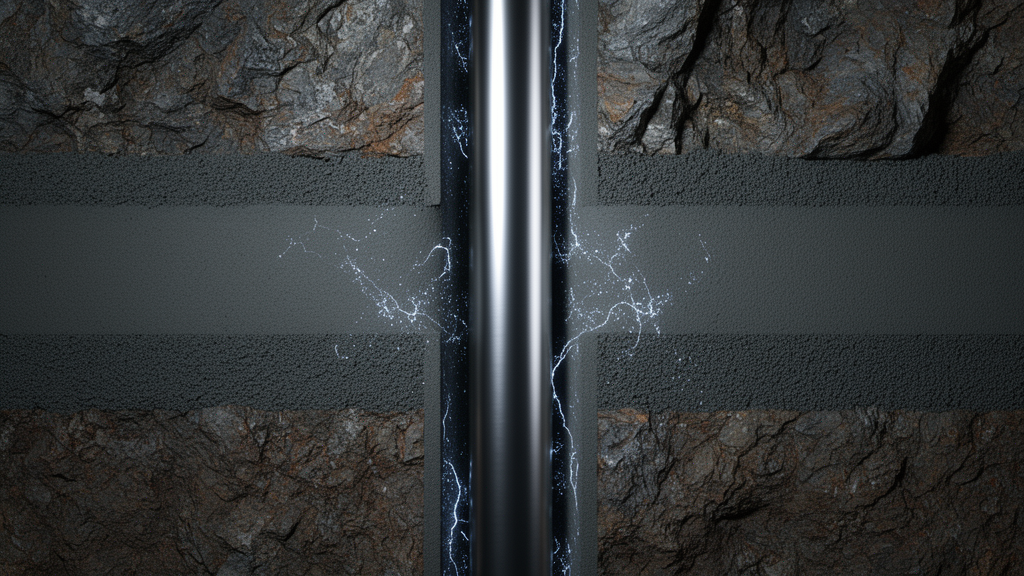
A research team has demonstrated an intelligent, intrinsic self-sensing wellbore cement system capable of continuous real-time monitoring and early warning for structural failures under simulated downhole conditions. Cement sheaths placed in oil and gas wells are routinely subjected to severe downhole environments, where cyclic pressure fluctuations and aggressive chemical exposure induce cumulative plastic deformation, micro-fracture propagation, and hazardous fluid channeling. Conventional field evaluation methodologies, including acoustic and density logging, provide only discrete, retrospective inspections that suffer from significant detection lag and cannot capture damage initiation as it occurs. While embedded monitoring hardware such as electrical resistance strain gauges, optical fibers, and piezoelectric ceramic sensors have been evaluated in laboratory environments, these discrete devices present severe operational limitations. Strain gauges deliver isolated single-point data, optical fibers face fragile survival rates during installation, and piezoelectric ceramics exhibit poor interfacial compatibility that often promotes localized stress concentrations or debonding from the surrounding matrix. To overcome these mechanical and sensing bottlenecks, the researchers formulated an intrinsically conductive Class G well cement composite incorporating an electrostatically self-assembled carbon nanotube and nano-carbon black hybrid filler, establishing an integrated sensing framework coupled with two distinct artificial intelligence architectures to track and predict downhole damage.
This hybrid exhibits a distinct botryoid or grape-cluster morphology, wherein spherical NCB aggregates represent the grapes and elongated CNTs act as the branching stems. The synthesized filler possesses an overall specific surface area between 65 and 75 square meters per gram, an outer CNT diameter exceeding 50 nanometers, and an isolated NCB specific surface area of 23 square meters per gram. When dispersed into the cementing matrix, this spatial arrangement creates an interconnected NCB-CNT-NCB network structure. Individual carbon nanotubes span across adjacent carbon black clusters, preventing the severe particle entanglement and re-agglomeration that frequently disable single-filler conductive additives such as pristine carbon nanotubes, graphene, carbon fibers, or nickel powders. Because of their elevated surface energy, the hybrid fillers serve as active nucleation sites throughout the hydrating cement paste, encouraging the dense, uniform crystallization of hydration products directly against the filler boundaries. This interfacial integration densifies the hardened paste, refines microscopic pore networks, inhibits microcrack formation, and activates mechanical crack bridging, pinning, and deflection mechanisms without requiring specialized liquid ultrasonic dispersion techniques.
Specimen preparation and testing protocols followed American Petroleum Institute Recommended Practice 10B-2 using standard dry-mixing procedures adopted in field cementing operations. Class G oil well cement was dry-blended with the composite CNT/NCB powder, a chemical dispersant, and a retarder before water was added at a fixed water-to-cement ratio of 49 percent by weight of cement (BWOC). The study systematically evaluated eight distinct composite formulations designated by their nanofiller content: A0 (0 percent control), A0.5 (0.5 percent), A1 (1.0 percent), A3 (3.0 percent), A5 (5.0 percent), A6 (6.0 percent), A7 (7.0 percent), and A8 (8.0 percent BWOC). Under a constant confining pressure of 20 megapascals and an axial strain progression rate of 0.05 percent per minute, the incorporation of 1 percent filler enhanced both compressive strength and elastic modulus relative to the neat control slurry. Although dosages of 3 percent and 5 percent experienced minor compressive strength reductions, their compressive strengths remained above 45 megapascals—fully complying with oilfield cementing criteria—while maintaining elastic modulus values comparable to control samples. Conversely, dosages between 6 and 8 percent caused notable drops in both compressive strength and modulus, which the authors attributed to particle agglomeration and internal matrix weakening.
Slurry workability and rheological behavior were evaluated across varying thermal conditions to ensure pumpability in practical casing operations. Rheological tests performed using rotational viscometers at 25 and 90 degrees Celsius revealed that both plastic viscosity and yield point climbed as nanofiller concentrations rose, driven by accelerated early hydration and higher paste consistency. At 25 degrees Celsius, plastic viscosity and yield point remained relatively stable at 0 and 1 percent additions, increased sharply at 3 percent, and climbed steeply thereafter, establishing an ambient rheological threshold of 3 percent. Under an elevated temperature of 90 degrees Celsius, both rheological parameters remained stable up to 5 percent filler concentration before undergoing rapid escalation, demonstrating a higher thermal threshold of 5 percent. Thickening time evaluations conducted inside a high-pressure, high-temperature consistometer operated at 70 megapascals and 100 degrees Celsius established that the composite cement slurries preserved a stable thickening trajectory characterized by an abrupt, right-angled thickening profile favorable for rapid set and fluid-channeling mitigation. Slurries formulated below the 5 percent threshold maintained manageable initial consistency and adequate placement windows, whereas mixtures containing 6 to 8 percent required excessive dispersant dosages to maintain acceptable fluidity.
The piezoresistive sensing performance of hardened cement prisms measuring 30 by 30 by 60 millimeters was investigated by measuring the fractional change in electrical resistivity (FCR) during cyclic compressive loading. Two embedded copper-mesh electrodes positioned 30 millimeters apart recorded electrical resistance, while orthogonal strain gauges mounted at specimen midpoints monitored longitudinal and transverse strain under 30 compression cycles applied at 1.2 millimeters per minute across amplitudes of 30, 50, and 70 percent of ultimate compressive strength. Unloaded resistivity measurements indicated that electrical resistivity remained elevated above 250 ohm-meters for filler dosages up to 3 percent, decreased substantially between 3 and 5 percent, and fell toward near-zero values above 5 percent, identifying 5 percent as the conductive percolation threshold. Cyclic testing showed that the absolute FCR peaked at this 5 percent threshold, attaining 5.3, 9.5, and 14.1 percent under the 30, 50, and 70 percent loading amplitudes—representing 6.3, 7.1, and 6.1 times the response magnitudes of neat control specimens. Comprehensive multi-property analysis established 5 percent CNT/NCB as the optimal design, yielding a slurry fluidity of 21 centimeters, a thickening time of 226 minutes, a compressive strength of 46.2 megapascals, and an elastic modulus of 10.3 gigapascals.
Dynamic mechanical-electrical synchronization during cyclic loading revealed key behavioral differences between unfunctionalized cement and the nanofiller-modified composites. In neat control specimens, electrical resistance signals exhibited severe noise, erratic signal jumps, and significant response lag, recording an average phase delay of 7.3 seconds relative to mechanical strain curves, particularly under 50 percent loading amplitudes. In contrast, the incorporation of the CNT/NCB hybrid stabilized the internal conductive pathways, producing smooth, continuous FCR curves that tracked cyclic strain oscillations with minimal noise. The 5 percent composite exhibited the shortest overall response delay, reducing the average signal lag to 5.2 seconds, closely followed by the 3 percent and 1 percent mixtures with average delays of 5.3 and 5.8 seconds, respectively. At each constant filler content, peak FCR expanded systematically with increasing load amplitude because larger internal deformations compress the inter-particle gaps between adjacent conductive clusters, enhancing quantum tunneling conduction and field-emission transport. However, the experimental raw signals also displayed inherent non-linearities, baseline drift, and peak deviations under heavy cyclic loading, necessitating algorithmic intervention to accurately translate piezoresistive data into reliable mechanical strain values.
To overcome raw signal non-linearities and response lag during mechanical deformation, the researchers developed the Adaptive Gated Residual Reconstruction Network (AGRR-Net) for predictive strain modeling. The training and evaluation dataset encompassed 50,744 discrete data points gathered from 18 experimental groups combining six filler concentrations (0, 1, 3, 5, 6, and 8 percent) and three cyclic stress amplitudes (30, 50, and 70 percent). Preprocessing resolved sampling rate discrepancies and acquisition delays between the DH3820 digital acquisition system and strain instrumentation by establishing a unified temporal reference axis and applying Akima non-linear interpolation for phase alignment. The curated time series was partitioned into training, validation, and test subsets using a 75:10:15 split, using 60 preceding time steps of FCR data to forecast target strain across the subsequent five time steps. AGRR-Net improves upon standard Gated Recurrent Unit (GRU) frameworks through three structural mechanisms: an operating-condition embedding layer executing super-gated feature calibration to filter dynamic inputs, an adaptive time-domain importance gating mechanism that fuses global mean representations with instantaneous states to prevent long-sequence memory decay, and an adaptive residual input pathway that directly projects current mechanical states to the output layer to supply physical inertia with minimal parameter overhead.
Comparative evaluation against established sequence forecasting models proved the superior accuracy and stability of the AGRR-Net architecture. When benchmarked on the identical test partition against standard GRU, Informer, Time-Series Mixer (TSMixer), and MultiPatchFormer architectures, AGRR-Net achieved the lowest error across all statistical evaluation metrics. AGRR-Net recorded a test mean absolute error (MAE) of 49.73 and a root mean square error (RMSE) of 97.53, substantially outperforming Informer (which recorded an MAE of 102.22 and an RMSE of 159.51) and MultiPatchFormer (which yielded an MAE of 113.95 and an RMSE of 154.23). Furthermore, AGRR-Net achieved the lowest mean absolute percentage error (MAPE) at 4.97 percent, corresponding to an overall strain prediction accuracy of 95 percent. The reconstructed strain curves accurately captured rapid inflection points and peak strain transitions during dynamic cycling, confirming that deep physical feature calibration can mitigate signal instability, non-linear sensor drift, and transmission delay in real-time wellbore integrity monitoring.
The monitoring system was extended to detect downhole fluid channeling through a physical laboratory casing apparatus that simulated gas and water migration within the annular cement sheath. The experimental apparatus held cement slurry within an annular space bounded by concentric inner and outer steel casings, equipped with temperature controllers to heat the slurry up to 90 degrees Celsius and an external pressurized water source to induce channeling pathways. Multimeter channels and pressure transducers simultaneously logged electrical resistivity and hydrostatic pressure. The tests revealed a pronounced inverse correlation between the two signals: as channeling fluid penetrated the sheath and hydrostatic pressure escalated rapidly, electrical resistivity dropped sharply, exhibiting distinct inflection points at channeling onset. Neat cement slurries produced noisy, highly erratic electrical readings with substantial lag. Conversely, slurries containing self-sensing CNT/NCB additives smoothed signal trajectories and noticeably accelerated response times, confirming that electrical resistance anomalies reliably serve as real-time precursor indicators of fluid leakage.
To process the complex, non-linear fluid channeling data, the authors designed the active learning-based incremental deep-broad learning algorithm (LAI-DeepBL). The model was trained on 4,388 experimental time-series samples collected under temperatures of 60, 70, and 90 degrees Celsius and water flow rates of 5, 10, 20, and 25 milliliters. Statistical analysis showed that while electrical resistivity was slightly left-skewed (mean of 9.30 kilo-ohm-meters, median of 9.85 kilo-ohm-meters, skewness of -0.24, kurtosis of 8.56), the hydrostatic pressure target was heavily right-skewed and long-tailed (mean of 18.66 kilopascals, median of 15.90 kilopascals, skewness of 7.50, kurtosis of 59.50) with numerous anomalous outliers. To resolve this imbalance under an 80 percent annotation budget, LAI-DeepBL partitioned the target space using dynamic histogram discretization, defining sparse long-tail regions where sample density fell below 30 percent of the global average. A weighted vertex k-center active learning algorithm then prioritized boundary and sparse samples by applying a distance scaling factor of 0.5 to sparse intervals and 1.0 to dense zones, eliminating redundant sampling. Using variables from three preceding time steps—resistivity, temperature, flow rate, and pressure—the model predicted future hydrostatic pressure. On the 15 percent test set, LAI-DeepBL achieved an MAE of 1.20, an RMSE of 2.48, and an MAPE of 2.47 percent, representing error reductions of 28.04, 54.61, and 91.08 percent compared to the baseline AI-DeepBL algorithm. While these laboratory findings confirm the viability of intrinsic self-sensing cement and intelligent predictive modeling, the authors emphasize that future research must evaluate long-term material durability under sustained high-pressure, high-temperature downhole aging, while exploring multimodal fusion that integrates acoustic emission and acoustic wave logging into the monitoring framework.
Subject of Research: Intelligent self-sensing oil well cement formulation and machine-learning early warning systems
Article Title: CNT/NCB-based self-sensing well cement enabling multisource monitoring and intelligent early warning of wellbore integrity
Article References: Lu, P., Li, Y., Bai, Z., Liu, L., & Li, X. (2026). CNT/NCB-based self-sensing well cement enabling multisource monitoring and intelligent early warning of wellbore integrity. Case Studies in Construction Materials, 25, Article e06730. https://doi.org/10.1016/j.cscm.2026.e06730
Image Credits: AI Generated
DOI: 10.1016/j.cscm.2026.e06730
Keywords: wellbore integrity, self-sensing cement, carbon nanotubes, nano-carbon black, fluid channeling, piezoresistivity, cyclic loading, AGRR-Net, LAI-DeepBL, oil well cementing, hydrostatic pressure, fractional change in electrical resistivity, percolation threshold, active learning, Class G cement, smart construction materials
News Source: Teresa Odom. (November 20, 2026). Self-Sensing Well Cement Monitors Downhole Integrity and Predicts Failures Using Machine Learning. Scienmag.