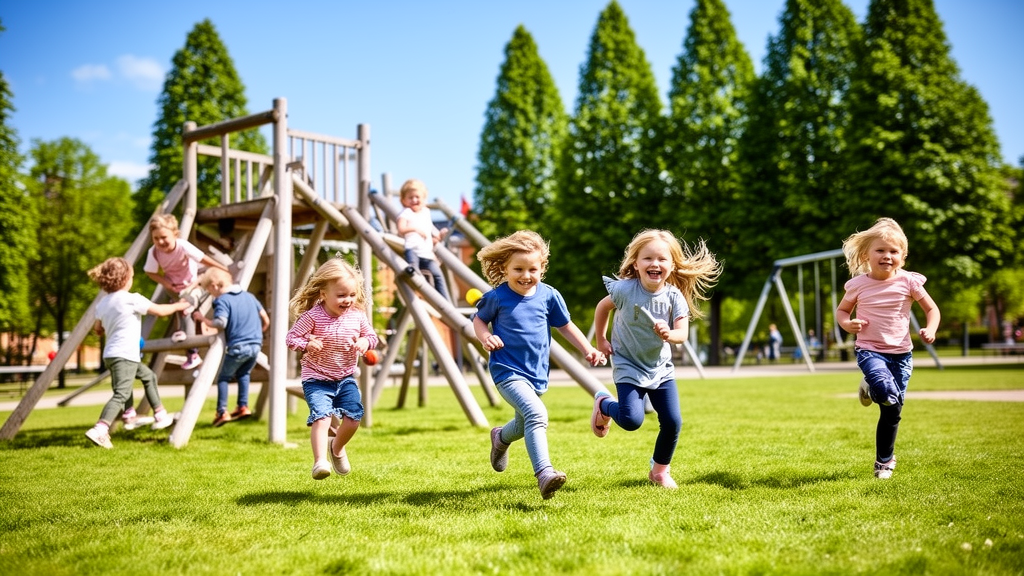
Three-year-old children residing in northern Sweden accumulate an average of 163 minutes of moderate-to-vigorous physical activity each day, surpassing international public health benchmarks according to continuous wrist-worn sensor measurements. The population-based investigation assessed movement data across 497 preschool-aged participants enrolled in the ongoing NorthPop Birth Cohort Study in Västerbotten County. Researchers determined that 99 percent of the monitored children achieved the World Health Organization guideline recommending at least 60 minutes of moderate-to-vigorous physical activity daily. Furthermore, every child in the study cohort achieved the broader global standard of accumulating at least 180 minutes of total daily physical activity. These actigraphy recordings offer continuous objective documentation of early childhood movement across full 24-hour cycles, identifying how specific developmental, social, and household routines correspond to active and motionless periods during the formative preschool window.
The study sought to resolve critical empirical gaps surrounding how much physical activity toddlers accumulate and which developmental or household factors predict movement before children enter formal schooling. The World Health Organization recommends that young children aged three to four years engage in at least 180 minutes of daily physical activity across varying intensities, including a minimum of 60 minutes spent in moderate-to-vigorous intensities. While habitual physical activity supports bone density, cardiometabolic health, motor skills, muscular strength, and healthy body composition, most existing research pools wide age brackets from two to six years into generalized analyses. Because physical activity patterns shift dynamically across early childhood, the research team focused exclusively on a narrow six-month developmental window among three-year-olds to isolate the distinct behavioral, environmental, and motor correlates that shape preschool movement.
Participant recruitment took place within the prospective NorthPop birth cohort, where families were originally enrolled during routine second-trimester ultrasound appointments across the Umeå healthcare district. When participating children reached three years of age, their parents received invitations between May 2020 and May 2023 to take part in an eight-day continuous actigraphy protocol. Of the 2,500 families invited, 1,005 accepted and were supplied with MotionWatch 8 actigraphy devices alongside structured activity diaries. Participating parents fitted the water-resistant monitors onto each child’s non-dominant wrist, recording movements continuously across weekdays and weekends, including during bathing, sports, and nocturnal sleep. A total of 993 watches were returned to the research laboratory, where signal-processing quality checks identified 498 recordings with at least four consecutive days of valid data and no continuous data gaps exceeding two hours. Excluding one child with suspected severe developmental impairment yielded a final analytic sample of 497 children.
Movement monitoring relied on single-axis accelerometry configured at a 50-hertz sampling rate with bandpass filtering between 3 and 11 hertz, recording cumulative counts over standardized 30-second measurement epochs. Intensity classifications were defined using cut-points previously calibrated on three-year-old children using identical devices and wrist positions. Thresholds categorized vigorous physical activity as at least 787 counts per epoch, moderate activity between 409 and 787 counts, light activity between 216 and 407 counts, sedentary behavior between 118 and 215 counts, and motionless behavior below 118 counts per 30 seconds. To isolate waking physical activity from nocturnal rest, an automated algorithm in the MotionWare software identified evening sleep onset and morning awakening. Motionless periods recorded during daytime naps were incorporated into the overall motionless category because specific nap timings could not be distinguished from quiet, motionless waking behavior.
Beyond sensor counts, the research protocol integrated parental questionnaires and Swedish national register data to compile comprehensive behavioral, socioeconomic, and developmental profiles. When children reached three and a half years of age, parents completed the validated Early Years Physical Activity Questionnaire, reporting the frequency and duration of specific domestic pastimes over the preceding four weeks. These activities encompassed craft sessions, toy play, television viewing, smartphone or computer use, book reading, active indoor play, garden play, and outings to parks and playgrounds. General neurodevelopment was documented through the five domains of the Ages and Stages Questionnaire, evaluating communication, gross motor function, fine motor control, problem-solving, and personal-social competencies. Concurrently, emotional and behavioral functioning was evaluated across conduct, emotional, peer, hyperactivity, and prosocial scales using the parent-reported Strengths and Difficulties Questionnaire.
The overall sample averaged 34 minutes of vigorous physical activity per day alongside 163 minutes of combined moderate-to-vigorous activity, with light movement bringing total physical activity to an average of 359 minutes daily. Measured behaviors revealed notable sex-specific distributions across the cohort. Boys accrued significantly more vigorous physical activity than girls, averaging 38 minutes compared to 30 minutes daily. Boys also spent more time in moderate-to-vigorous activity, averaging 170 minutes versus 156 minutes for girls, and registered marginally fewer total motionless minutes across full 24-hour periods. Over daytime waking hours, participants spent an average of 143 minutes in sedentary behavior and 310 minutes categorized as motionless. Children spent approximately 44 percent of their waking daytime hours engaged in total physical activity across light, moderate, and vigorous intensities.
To isolate independent predictors of activity durations, researchers constructed multivariable linear regression models using a backward stepwise procedure among 332 children with complete predictor datasets. Among neurodevelopmental domains, superior gross motor function on the Ages and Stages Questionnaire emerged as a positive predictor of time spent in vigorous and moderate-to-vigorous activities. Behavioral dimensions assessed by the Strengths and Difficulties Questionnaire also exhibited associations with movement durations. Children presenting higher hyperactivity scores spent more time in vigorous, moderate-to-vigorous, and total physical activity, an association primarily driven by items reflecting restless and overactive behaviors. Conversely, higher peer problem scores showed independent negative associations with vigorous, moderate-to-vigorous, and total activity durations, indicating that difficulties interacting with peers accompanied lower movement accumulation.
Domestic environment and lifestyle variables captured through parental reports demonstrated distinct associations with preschool movement profiles. Spending time playing outdoors and in playgrounds independently predicted higher accumulations of vigorous, moderate-to-vigorous, and total daily physical activity. In contrast, time allocated to digital media on computers or mobile phones was negatively associated with moderate-to-vigorous physical activity and total activity, while corresponding to increased time in sedentary and motionless categories. Engaging in crafting activities and being read to correlated with reductions in vigorous or moderate-to-vigorous movement durations alongside increases in motionless time. Household composition also played an influential role, as the presence of older siblings was positively associated with both moderate-to-vigorous and total physical activity, alongside reduced time spent motionless or sleeping.
Transportation habits and external societal conditions also corresponded with measured movement patterns across the multivariable evaluations. Travel by passenger car was positively associated with vigorous, moderate-to-vigorous, and total daily activity, whereas public transit usage was positively linked to sedentary and motionless behaviors. Because the surveillance period intersected with the coronavirus pandemic between May 2020 and February 2022, the presence of public pandemic restrictions was integrated into regression models. Children monitored during formal restriction periods exhibited higher vigorous, moderate-to-vigorous, and total physical activity, coupled with lower sedentary and motionless time. The investigators noted that Swedish preschools remained open throughout this era, meaning young children encountered fewer institutional constraints on free play than peers in countries that imposed stringent regional lockdowns.
The authors contextualized their findings within international movement literature, emphasizing that northern Swedish toddlers display substantially higher adherence to movement guidelines than cohorts monitored elsewhere in Europe and North America. Methodological factors, including device brand, non-dominant wrist wear, epoch duration, and population-specific calibration thresholds, explain some variance between studies. Several study limitations were noted by the investigative team. High-quality actigraphy data were acquired from an analytic subset of the invited cohort, and parent-reported activity logs did not capture structured movement opportunities provided within preschool classrooms. Furthermore, the exploratory nature of multivariable models across multiple correlated outcomes necessitates cautious interpretation of associations near standard significance thresholds, pending confirmation in prospective replication cohorts.
Subject of Research: Physical activity levels and behavioral correlates in preschool children
Article Title: Physical activity in Swedish 3-year-old children: associations with lifestyle and behavioral factors
Article References: Askeri, R., Lundberg-Ulfsdotter, R., Jansson, D., West, C. E., Sandlund, J., Davies, W. I. L., Wulff, K., & Domellöf, M. (2026). Physical activity in Swedish 3-year-old children: associations with lifestyle and behavioral factors. BMC Public Health, 26(1), Article 3441. https://doi.org/10.1186/s12889-026-30422-9
Image Credits: AI Generated
DOI: 10.1186/s12889-026-30422-9
Keywords: Physical activity, Preschool children, Actigraphy, Child health, Moderate-to-vigorous physical activity, Sedentary behavior, Gross motor skills, Outdoor play, Screen time, Pediatric health, NorthPop cohort, Behavioral development, MotionWatch 8, Early childhood, Public health guidelines, Child development, Lifestyle factors, Peer relations
News Source: Harold Sullivan. (November 20, 2026). Swedish Three-Year-Olds Exceed Global Physical Activity Guidelines in Actigraphy Study. Scienmag.