Geotechnical engineers investigating sustainable alternatives to conventional quarried stone columns have demonstrated that granular columns fabricated from recycled acrylonitrile butadiene styrene plastic substantially increase the shear strength and load-carrying capacity of soft kaolin clay under laboratory conditions. Across a battery of unconfined compression and unconsolidated undrained triaxial shearing procedures, the inclusion of granular polymer inclusions altered the stress distribution pathways within soft cohesive soil, offering an alternative mechanism for soil rectification that diverts synthetic polymers from landfills while reducing reliance on natural mineral aggregates such as gravel and quarry sand.
Expansive and fine-grained soft clays frequently present severe operational challenges in civil engineering because of their low shear strength, high compressibility, low hydraulic conductivity, and strong tendency to deform or settle under structural loading. Conventional ground improvement programs routinely deploy vibro-replacement stone columns constructed from natural crushed rock or gravel to dissipate pore water pressure and accelerate consolidation, but the continuous extraction of quarried aggregates raises substantial ecological concerns and logistical costs. Seeking to align foundation engineering with United Nations Sustainable Development Goals concerning sustainable infrastructure and environmental conservation, the investigative team explored whether ground acrylonitrile butadiene styrene resin could replicate the mechanical functions of coarse aggregates. ABS is an amorphous thermoplastic terpolymer comprising acrylonitrile, butadiene, and styrene monomers that exhibits high rigidity, dimensional stability, impact resistance, and chemical inertness, making its granulated form an intriguing candidate for granular load-bearing vertical inclusions.
The experimental program commenced with comprehensive material characterization of both the host soil and the polymeric inclusion material according to standardized geotechnical protocols. The soil used throughout testing was grade S300 kaolin clay retrieved from Selangor, Malaysia, which consisted of 53 percent clay-sized particles and 47 percent silt-sized fractions. Laboratory index testing established that the kaolin had a liquid limit of 38.00 percent, a plastic limit of 28.00 percent, and a resulting plasticity index of 10.00 percent, classifying it as an inorganic silt of slight plasticity designated as ML under the Unified Soil Classification System and A-4 under AASHTO specifications. Compaction evaluations conducted via the Standard Proctor Test revealed a maximum dry density of 1.53 megagrams per cubic meter achieved at an optimum moisture content of 19.50 percent, alongside a specific gravity of 2.63 and an exceptionally low hydraulic conductivity coefficient of 4.806 times 10 to the negative 12 meters per second, reflecting the poorly drained nature of the native matrix.
The reinforcing aggregate consisted of industrial ABS plastic pellets obtained from Toray Plastics in Pulau Pinang, Malaysia, which were thoroughly washed, sun-dried for 24 hours, mechanically ground, and separated by dry sieving to isolate the predominant 1.18-millimeter grain fraction. Standard small pycnometer tests determined the specific gravity of the ABS material to be 1.09, with minimum and maximum dry densities established at 0.563 and 1.090 grams per cubic centimeter, yielding a relative density of 94.86 percent when placed via controlled raining techniques at an in-situ density of 1.04 grams per cubic centimeter. Grain size distribution analysis indicated a coefficient of curvature of 1.67 and a uniformity coefficient of 1.27, classifying the ground polymer as poorly graded sand under unified criteria. Unlike the impermeable cohesive kaolin, the granular ABS demonstrated a hydraulic conductivity coefficient of 1.03 times 10 to the negative 4 meters per second, creating a vertical drainage pathway capable of assisting pore water dissipation under compressive loading regimes.
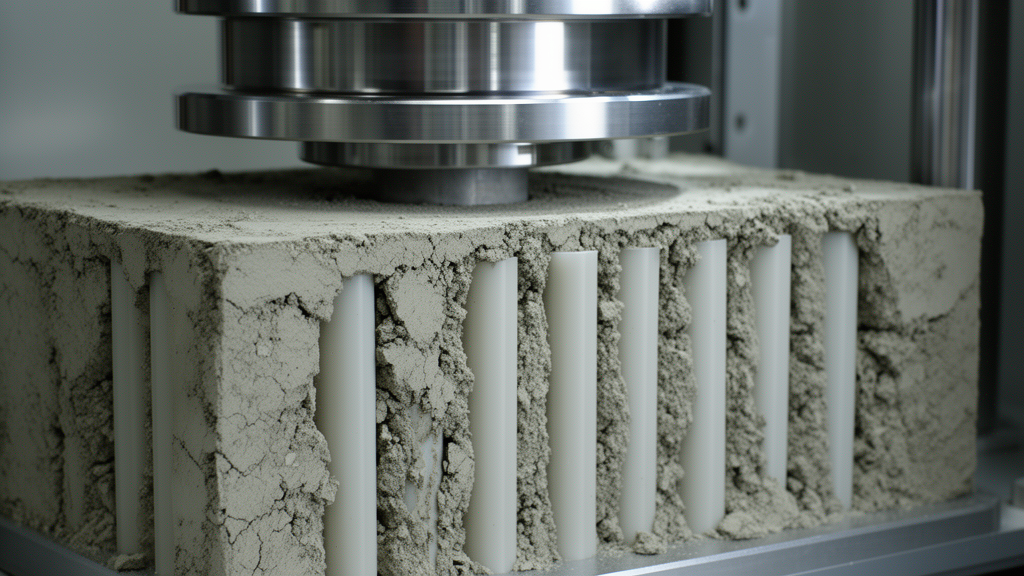
To prepare test specimens, compacted kaolin cylinders measuring 50 millimeters in diameter and 100 millimeters in height were formed in three sequentially tamped layers at optimum moisture content to ensure spatial homogeneity and expel trapped air voids. Boreholes of 8, 12, or 16 millimeters in diameter were drilled vertically into the center of the clay specimens using precise drilling bits held strictly perpendicular to specimen faces to prevent sidewall loosening or lateral particle dragging. These configurations generated area substitute proportions of 2.56, 5.76, and 10.24 percent, while volume intrusion proportions spanned from 1.28 percent to 10.24 percent and column intrusion to diameter ratios varied between 3.13 and 12.50.
Unconfined compression testing on unreinforced control specimens recorded a baseline average shear strength of 11.11 kilopascals across triplicate determinations. Installing granular ABS columns consistently elevated shear resistance across all geometric variations, although the magnitude of mechanical enhancement depended heavily on column geometry. The highest absolute strength improvement was recorded in specimen S0850, an 8-millimeter diameter column penetrating 50 millimeters into the soil cylinder, which attained an average shear strength of 22.55 kilopascals, representing an improvement of 102.91 percent over the unreinforced soil. Extending the 8-millimeter column penetration to 75 and 100 millimeters produced shear strengths of 19.32 and 19.86 kilopascals, reflecting improvements of 73.84 and 78.70 percent. In contrast, 12-millimeter diameter columns generated lower overall enhancements, yielding strengths of 16.51, 15.43, and 16.32 kilopascals at penetration ratios of 0.50, 0.75, and 1.00, while 16-millimeter diameter installations produced intermediate strengths of 16.67, 16.07, and 16.47 kilopascals across equivalent penetration increments.
The mechanics underlying these unconfined strength improvements stem from the extreme stiffness contrast between the constituent materials, with ground ABS possessing an elastic Young’s modulus of 2.1 gigapascals compared to 1.31 times 10 to the negative 3 gigapascals for the host kaolin clay. Because the polymer inclusion is substantially stiffer than the surrounding clay matrix, it attracts and concentrates a disproportionate fraction of applied axial loads, creating localized stress bulbs that direct forces downward while mobilizing interface shear resistance. However, larger column diameters and excessive column lengths disrupted uniform load transfer; the physical drilling required for wider 12-millimeter cavities induced localized disturbance and particle loosening that the replacement polymer volume could not fully offset. Furthermore, taller columns exhibited greater slenderness ratios that elevated susceptibility to lateral bulging under axial strain, explaining why the compact 8-millimeter diameter by 50-millimeter tall column configuration achieved superior load-carrying efficiency.
Confined performance was subsequently quantified through 119 unconsolidated undrained triaxial shear tests conducted across 13 distinct sample designs subjected to effective cell confining pressures of 100, 200, and 400 kilopascals without prior consolidation or drainage. Unreinforced kaolin exhibited a baseline cohesion intercept of 22.4 kilopascals and an internal friction angle of 24.4 degrees when interpreted using Mohr-Coulomb failure criteria across confining increments. Introducing ABS columns produced systematic increases in both parameters, with cohesion values rising across all configurations to between 23.2 and 32.8 kilopascals, while internal friction angles expanded to between 26.6 and 28.9 degrees.
Triaxial stress-strain profiles demonstrated that granular ABS columns enhanced specimen ductility and peak deviatoric stress capacity, extending axial strain limits before failure beyond 13.0 percent relative to 12.53 percent for untreated kaolin. Under 100 kilopascals of confining pressure, specimen S1250 exhibited the greatest deviatoric stress resistance, while specimen S1275 yielded peak performance under 200 kilopascals, and specimen S1250 again dominated under 400 kilopascals of confinement. Across these testing regimes, failure occurred primarily through gradual compression and localized bulging rather than abrupt shearing, confirming that confining pressures assist granular particle interlocking within the ABS core.
Rigorous statistical evaluations comprising one-way analysis of variance, Fisher’s least significant difference post-hoc tests, and Pearson correlation coefficients verified the statistical significance of geometric design variables on shear strength parameters at a threshold of p less than 0.05. One-way ANOVA identified significant variances among experimental groupings with an LSD threshold of 21.04, confirming that 8-millimeter columns differed significantly from 12-millimeter and 16-millimeter groupings whose overlapping error bars denoted statistically indistinguishable variations. Stepwise multiple linear regression filtered 83 preliminary models down to 21 candidate equations demonstrating coefficients of determination exceeding 0.95, from which diagnostic assessment using Mallows’s Cp criterion identified an optimal forecasting relationship that achieved a Cp value of 5.7424 against a target calculated value of 6.0 without overfitting, linking ultimate shear strength to column number, diameter, height, area substitute proportion, and confining pressure.
While these laboratory findings demonstrate that ground ABS plastic columns provide substantial short-term mechanical reinforcement in expansive kaolin, the investigators underscored critical physical and analytical boundaries inherent to the study. Testing was confined strictly to rapid, undrained unconsolidated shearing without preliminary specimen saturation or consolidation stages, meaning long-term consolidation phenomena such as secondary compression indices, hydraulic dissipation over extended temporal horizons, and critical state lines within p-prime q stress space remain uncharacterized. Moreover, thermoplastic ABS is known to exhibit vulnerability when exposed to strong organic solvents, esters, or highly acidic chemical environments, requiring detailed soil investigation reports to confirm geochemical compatibility prior to site application.
Subject of Research: Granular columns made of recycled ABS plastic for ground stabilization in expansive kaolin clay soils
Article Title: Ground stabilization in expansive soils using engineered plastic columns: a quantitative experimental study
Article References: Jun Shen, N., Hasan, M., Nedunchelian, N. T., & Hoque, M. I. (2026). Ground stabilization in expansive soils using engineered plastic columns: a quantitative experimental study. Journal of Umm Al-Qura University for Engineering and Architecture, 17(4), 1260-1287. https://doi.org/10.1007/s43995-026-00292-8
Image Credits: AI Generated
DOI: 10.1007/s43995-026-00292-8
Keywords: ground improvement, soil stabilization, ABS plastic, kaolin clay, granular columns, shear strength, unconfined compression test, unconsolidated undrained test, triaxial testing, sustainable geotechnics, plastic waste recycling, stone column alternative, stress bulb, area substitute proportion, Mallows Cp criterion, geotechnical engineering, cohesion parameter, friction angle
News Source: Denise Maddox. (November 20, 2026). Engineered ABS Plastic Columns Enhance Shear Strength in Stabilized Kaolin Clay. Scienmag.