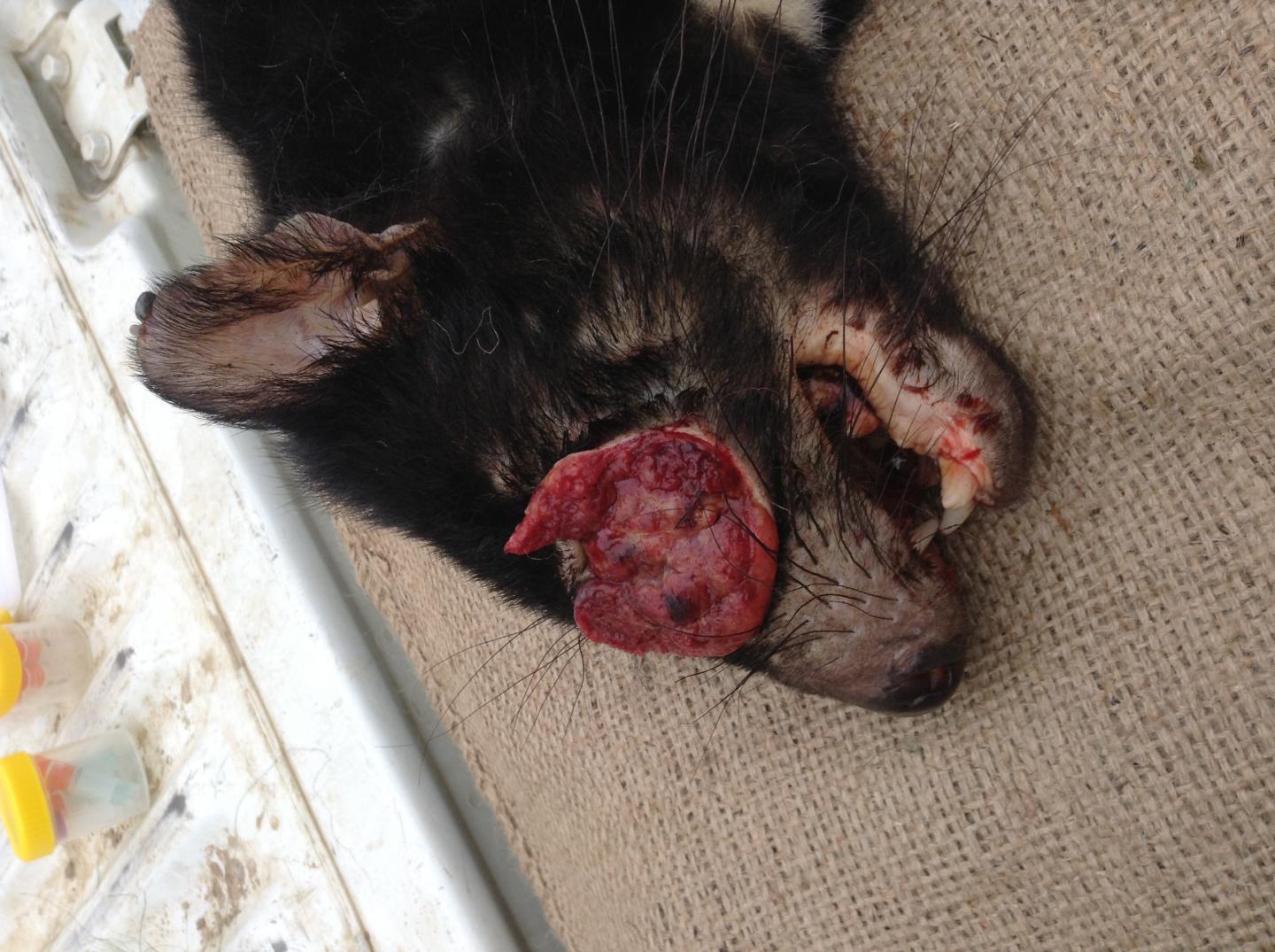
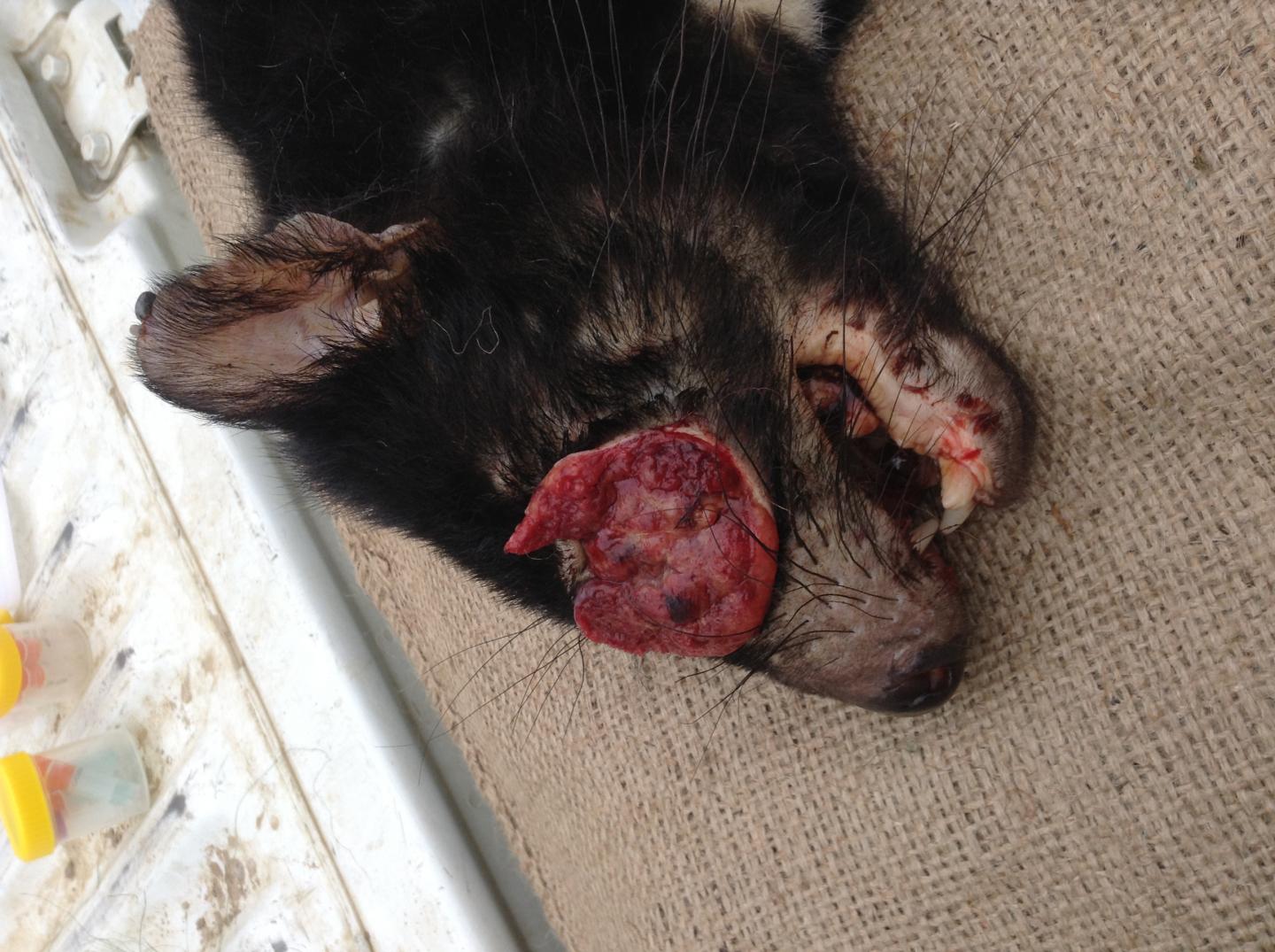
IMAGE: This is a photograph of a Tasmanian Devil with facial tumor.
Credit: Gregory Woods, Menzies Institute for Medical Research, University of Tasmania
Transmissible cancers — cancers which can spread between individuals by the transfer of living cancer cells — are believed to arise extremely rarely in nature. One of the few known transmissible cancers causes facial tumours in Tasmanian devils, and is threatening this species with extinction. Today, scientists report the discovery of a second transmissible cancer in Tasmanian devils. The discovery, published in the journal Proceedings of the National Academy of Science, calls into question our current understanding of the processes that drive cancers to become transmissible.
Tasmanian devils are iconic marsupial carnivores that are only found in the wild on the Australian island state of Tasmania. The size of a small dog, the animals have a reputation for ferocity as they frequently bite each other during mating and feeding interactions.
In 1996, researchers observed Tasmanian devils in the north-east of the island with tumours affecting the face and mouth; soon it was discovered that these tumours were contagious between devils, spread by biting. The cancer spreads rapidly throughout the animal's body and the disease usually causes the death of affected animals within months of the appearance of symptoms. The cancer has since spread through most of Tasmania and has triggered widespread devil population declines. The species was listed as endangered by the International Union for Conservation of Nature in 2008.
To date, only two other forms of transmissible cancer have been observed in nature: in dogs and in soft-shell clams. Cancer normally occurs when cells in the body start to proliferate uncontrollably; occasionally, cancers can spread and invade the body in a process known as 'metastasis'; however, cancers do not normally survive beyond the body of the host from whose cells they originally derived. Transmissible cancers, however, arise when cancer cells gain the ability to spread beyond the body of the host that first spawned them, by transmission of cancer cells to new hosts.
Now, a team led by researchers from the University of Tasmania, Australia, and the University of Cambridge, UK, has identified a second, genetically distinct transmissible cancer in Tasmania devils.
"The second cancer causes tumours on the face that are outwardly indistinguishable from the previously-discovered cancer," said first author Dr Ruth Pye from the Menzies Institute for Medical Research at the University of Tasmania. "So far it has been detected in eight devils in the south-east of Tasmania."
"Until now, we've always thought that transmissible cancers arise extremely rarely in nature," says Dr Elizabeth Murchison from the Department of Veterinary Medicine at the University of Cambridge, a senior author on the study, "but this new discovery makes us question this belief.
"Previously, we thought that Tasmanian devils were extremely unlucky to have fallen victim to a single runaway cancer that emerged from one individual devil and spread through the devil population by biting. However, now that we have discovered that this has happened a second time, it makes us wonder if Tasmanian devils might be particularly vulnerable to developing this type of disease, or that transmissible cancers may not be as rare in nature as we previously thought."
Professor Gregory Woods, joint senior author from the Menzies Institute for Medical Research at the University of Tasmania, adds: "It's possible that in the Tasmanian wilderness there are more transmissible cancers in Tasmanian devils that have not yet been discovered. The potential for new transmissible cancers to emerge in this species has important implications for Tasmanian devil conservation programmes."
The discovery of the second transmissible cancer began in 2014, when a devil with facial tumours was found in south-east Tasmania. Although this animal's tumours were outwardly very similar to those caused by the first-described Tasmanian devil transmissible cancer, the scientists found that this devil's cancer carried different chromosomal rearrangements and was genetically distinct. Since then, eight additional animals have been found with the new cancer in the same area of south-east Tasmania.
###
The research was primarily supported the Wellcome Trust and the Australian Research Council, with additional support provided by Dr Eric Guiler Tasmanian Devil Research Grants and by the Save the Tasmanian Devil Program.
For more information about the research into Tasmanian devils, see T is for Tasmanian Devil https://medium.com/cambridge-animal-alphabet/t-is-for-tasmanian-devil-812d680aece4#.3smab4q5i.
Reference
Pye, RJ et al. A second transmissible cancer in Tasmanian devils. PNAS; Dec. 28, 2015