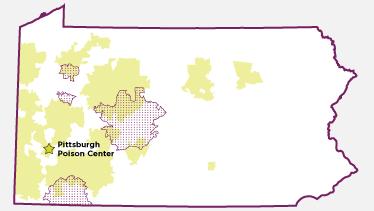
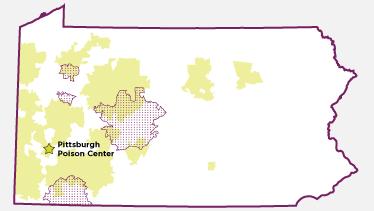
IMAGE: Children younger than 5 who live in economically disadvantaged areas had a greater risk of medication poisoning that resulted in referral to a health care facility, according to researchers.
Credit: (C) 2015 UPMC
PITTSBURGH, Dec. 22, 2015 – Children younger than 5 who live in economically disadvantaged areas had a greater risk of medication poisoning that resulted in referral to a health care facility, according to scientists at the University of Pittsburgh Graduate School of Public Health and the University of California, San Diego. These areas were rural and experienced high unemployment, along with lower rates of high school graduation and lower household income.
The analysis of Pittsburgh Poison Center data, published online and scheduled for print in the January issue of Clinical Toxicology, gives insight into potential geographic targets for poison prevention outreach.
"Understanding where there are geographic clusters of kids being exposed to medications that could hurt them gives us the opportunity to effectively intervene," said senior author Anthony Fabio, Ph.D., M.P.H., assistant professor of epidemiology at Pitt Public Health. "It also could help emergency clinicians to ask the right questions and perhaps zero in on a medication exposure when a child comes in with unexplained symptoms."
Dr. Fabio and his colleagues analyzed 26,685 Pittsburgh Poison Center records of pharmaceutical drug exposures–typically defined as ingesting a medication–in children under 5 years old from 2006 through 2010. They mapped the exposures based on whether there was simply a call to the center and advice given for treatment at home, if necessary, or if the center staff felt the exposure warranted medical evaluation and referred the child to a nearby health care facility.
By mapping the exposures in this way, the researchers revealed distinct "exposure" and "referral" locations, or geographic clusters, throughout western and central Pennsylvania. The exposure clusters generally encompass urban areas where people are perhaps more familiar with the Pittsburgh Poison Center's hotline and, therefore, more likely to call.
The referral clusters are generally in more rural areas characterized by high unemployment. The researchers found that in these areas, the likelihood of a child under 5 being referred to a health care facility for a medication exposure is 3.2 times greater than elsewhere.
"More study is needed to determine exactly why this is, but we believe it could be related to fewer resources for child supervision–whether at home or at daycare centers in the community–increasing the likelihood of a small child finding and swallowing medication," said Dr. Fabio.
The Pittsburgh Poison Center hotline, 1-800-222-1222, is staffed 24 hours a day and serves 44 Pennsylvania counties without charging a fee.
"These results have become a real eye-opener for us," said co-author Anthony F. Pizon, M.D., chief of the UPMC Division of Medical Toxicology and associate professor of emergency medicine at Pitt. "We now recognize the population of children most vulnerable to potentially harmful medication exposure. Our hope is that we can better tend to the needs of these children through Poison Center outreach efforts and more effectively prevent childhood poisonings."
###
The lead author on this study is Margaret B. Nguyen, M.D., of Rady Children's Hospital at the University of California, San Diego, who performed the majority of the research while at Pitt. Charles C. Branas, Ph.D., of the University of Pennsylvania, is an additional co-author.
This project was supported by the University of Pittsburgh Clinical and Translational Science Institute through National Institutes of Health grant UL1TR000005.
About the University of Pittsburgh Graduate School of Public Health
The University of Pittsburgh Graduate School of Public Health, founded in 1948 and now one of the top-ranked schools of public health in the United States, conducts research on public health and medical care that improves the lives of millions of people around the world. Pitt Public Health is a leader in devising new methods to prevent and treat cardiovascular diseases, HIV/AIDS, cancer and other important public health problems. For more information about Pitt Public Health, visit the school's Web site at http://www.publichealth.pitt.edu.
http://www.upmc.com/media
Contact: Allison Hydzik
Phone: 412-647-9975
E-mail: [email protected]
Contact: Rick Pietzak
Phone: 412-523-6922
E-mail: [email protected]