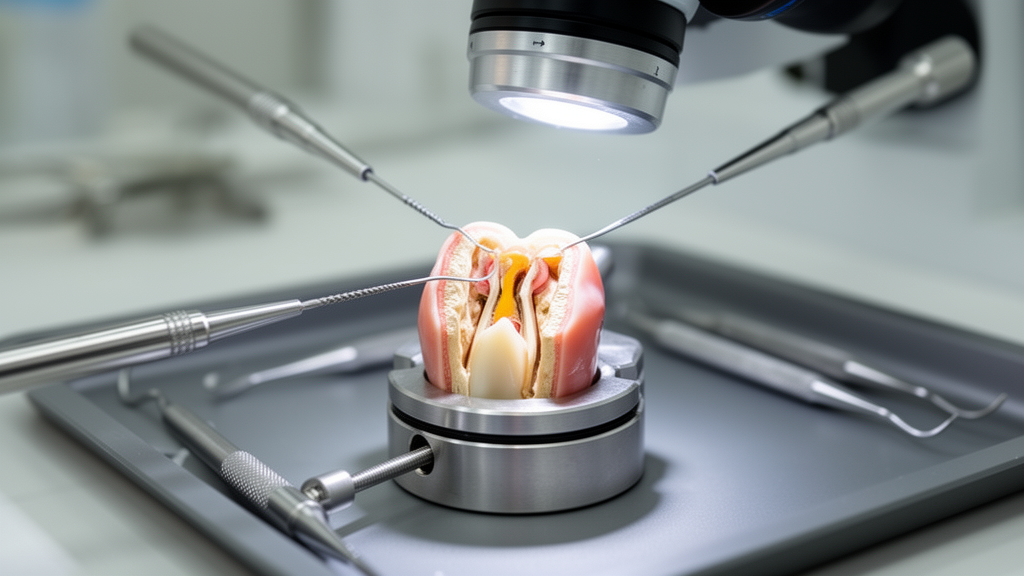
In an in vitro investigation evaluating methods for managing broken endodontic files, researchers found that three different instrument retrieval techniques left extracted human mandibular molar roots with comparable resistance to vertical root fractures. The laboratory study examined the structural integrity of roots after attempting to remove separated nickel-titanium fragments, assessing how continuous ultrasonic instrumentation, a combined ultrasonic and LeoPen loop approach, and an ultrasonic protocol combined with an XP-Endo Shaper affected post-retrieval vertical fracture resistance.
Separated endodontic instruments represent a frequent procedural challenge during root canal treatment that can compromise long-term procedural success. To evaluate these variables under controlled conditions, investigators Mariam Ahmed Mohamed, Nihal Nabil Roshdy, and Nermine Hassan structured a comparative evaluation examining vertical fracture resistance, procedure time, and overall retrieval success.
The experimental protocol utilized 27 extracted human mandibular molars displaying moderately curved mesial roots with curvature angles between 15 and 30 degrees. The samples were randomly allocated into three equal groups of nine teeth each. In every specimen, a 4-millimeter nickel-titanium instrument fragment was deliberately fractured within the middle third of the mesiobuccal canal. Each retrieval procedure was conducted under magnification, allowing researchers to record whether removal was achieved, the time required in minutes, and the mechanical fracture resistance in newtons.
Mechanical testing using a universal testing machine demonstrated that vertical fracture resistance did not significantly differ among the three experimental groups following retrieval procedures. The continuous ultrasonic control group exhibited a mean fracture resistance of 711.8 ± 230.1 newtons, while the XP-Endo Shaper combination group recorded 730.4 ± 241.0 newtons. The combined ultrasonic and LeoPen loop group showed a mean resistance of 710.0 ± 215.3 newtons. Statistical analysis revealed no significant variation in load capacity across these groups, yielding a p-value of 0.95.
Although vertical fracture resistance remained statistically equivalent, the retrieval success rates diverged sharply between protocols. The combined ultrasonic and LeoPen loop system successfully retrieved eight out of nine separated fragments, corresponding to an 88.9 percent success rate. This outcome was not significantly different from the continuous ultrasonic control group, which achieved retrieval in six of nine specimens, or 66.7 percent, yielding a p-value greater than 0.05.
In contrast, the protocol combining ultrasonic tips with the XP-Endo Shaper resulted in a significantly lower retrieval success rate than the other techniques. The XP-Endo Shaper group successfully retrieved only one fragment out of nine attempts, representing an 11.1 percent success rate. Fisher’s exact test confirmed that this difference was statistically significant compared to the alternatives, with a calculated p-value of 0.001.
The duration required to complete the retrieval procedures varied across the groups without reaching statistical significance. The LeoPen loop combination required an average retrieval time of 25.4 ± 8.8 minutes, while continuous ultrasonic retrieval averaged 24.0 ± 7.7 minutes, and the XP-Endo Shaper protocol averaged 19.8 ± 5.6 minutes, resulting in an overall p-value of 0.11. Furthermore, correlation analysis between total retrieval duration and post-retrieval fracture resistance revealed only a weak, non-significant inverse relationship, with a correlation coefficient of r = −0.13 and a p-value of 0.53.
Subject of Research: Comparison of vertical fracture resistance and retrieval success rates among endodontic instrument retrieval systems
Article Title: Comparative evaluation of vertical fracture resistance and retrieval outcomes using ultrasonic, LeoPen loop, and XP-Endo shaper systems: an in vitro study
Article References: Mohamed, M. A., Nabil Roshdy, N., & Hassan, N. (2026). Comparative evaluation of vertical fracture resistance and retrieval outcomes using ultrasonic, LeoPen loop, and XP-Endo shaper systems: an in vitro study. BMC Oral Health. https://doi.org/10.1186/s12903-026-10208-6
Image Credits: AI Generated
DOI: 10.1186/s12903-026-10208-6
Keywords: endodontics, separated instruments, instrument retrieval, vertical fracture resistance, ultrasonic tips, LeoPen loop, XP-Endo Shaper, nickel-titanium instruments, mandibular molars, mesiobuccal canal, root curvature, in vitro study, root fracture resistance, retrieval time, dental biomechanics, universal testing machine
News Source: Ophelia Keating. (November 20, 2026). Study Compares Root Fracture Resistance Across Three Broken Instrument Retrieval Techniques. Scienmag.