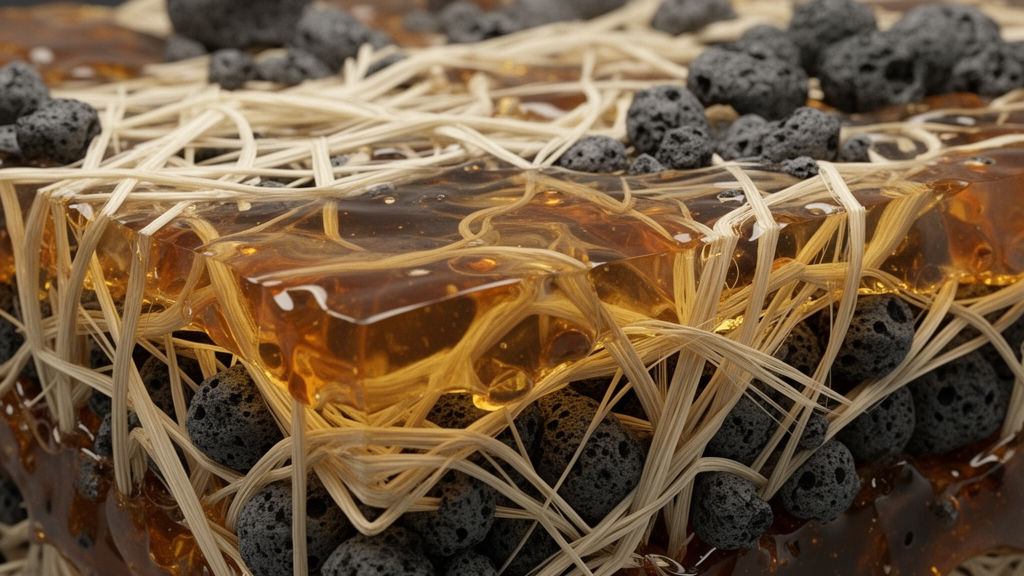
Researchers have shown that incorporating natural microfibers extracted from Allium hollandicum stems alongside activated biochar from macadamia nut shells substantially improves the mechanical, thermal, dielectric, and moisture barrier properties of vinyl ester composites. In laboratory evaluations testing hybrid formulations against neat thermoset resin, optimal mechanical performance occurred in composite laminates containing a constant 30 volume percent of Allium microfiber combined with 3 volume percent of activated biochar. Designated as formulation D3, this material achieved a tensile strength of 87 megapascals, a peak flexural load of 335 newtons, and an impact resistance of 11.3 kilojoules per square meter. These values represent improvements of 67.3 percent, 76.3 percent, and 85.2 percent over neat vinyl ester resin. Although higher biochar contents enhanced surface hardness, thermal conductivity, and dielectric permittivity, filler additions beyond three percent induced particulate agglomeration that restricted stress transfer across the polymer matrix.
Developing bio-based hybrid composites addresses pressing environmental concerns linked to non-renewable synthetic reinforcements, aligning with an expanding natural fiber composites market valued at over eight billion dollars and growing at more than ten percent annually. Agricultural residues from onion and garlic cultivation represent an abundant source of underutilized biomass, as global onion production exceeds 110 million tonnes and garlic harvests surpass 30 million tonnes annually. Between 15 and 25 percent of this harvested biomass becomes agricultural waste, despite containing valuable structural constituents such as 35 to 55 percent cellulose, 15 to 25 percent hemicellulose, and 10 to 20 percent lignin. Concurrently, commercial macadamia nut processing generates tough shells composed of 45 to 55 percent carbonaceous matter suited for thermal conversion. Vinyl ester resins are widely used in automotive, marine, aerospace, and structural settings for their chemical resistance, yet their deployment remains constrained by low thermal conductivity and moisture sensitivity.
To manufacture the hybrid materials, investigators harvested mature Allium hollandicum stems from Royal Flowers in Chennai, India, and obtained macadamia nut shell residues from Nuts N Beyond in Chennai. The continuous matrix consisted of commercial vinyl ester resin combined with an ambient curing package supplied by Sri Star India Resin and Fibre Glass Products. This crosslinking formulation included methyl ethyl ketone peroxide as the free-radical catalyst, cobalt naphthenate as the accelerator, and N,N-dimethylaniline as the chemical promoter to facilitate room-temperature polymerization. Potassium hydroxide was acquired from the same supplier to serve as the activation agent during the thermal treatment of the macadamia biochar. Sourcing both natural reinforcements from regional agricultural streams provided an accessible route to determine whether agro-industrial residues could serve as functional reinforcing fillers for structural thermosets without relying on synthetic inorganic additives.
The extraction of microfibers from Allium hollandicum stems followed a multistage processing sequence intended to optimize surface cleanliness, aspect ratio, and matrix wetting. Fresh stems were gathered, identified, and washed with water to dislodge surface dirt and biological debris. The cleaned stems underwent an eight-day water retting process, during which microbial activity degraded pectin, hemicellulose, and binding substances that hold fiber bundles together. After retting, the loosened fibers were manually separated from plant tissues, rinsed thoroughly, and dried in an oven at 100 degrees Celsius for two hours to eliminate residual moisture and enhance dimensional stability. Once dried, the cellulose-rich fibers were mechanically refined to microscale dimensions, producing high-aspect-ratio Allium microfibers with elevated surface-area-to-volume ratios suited for establishing physical contact and mechanical interlocking within the liquid vinyl ester matrix.
The functional carbon filler was produced from macadamia nut shells via a two-stage thermochemical activation process. Collected shells were sorted, cleaned, and pyrolyzed in a thermal reactor at 500 degrees Celsius for three hours, driving off volatile constituents to yield a carbon-rich primary biochar. This intermediate char was mixed with potassium hydroxide and subjected to chemical activation at 700 degrees Celsius for two hours. During thermal activation, reactions between potassium hydroxide and the carbon skeleton created extensive micropores and mesopores while modifying oxygen-containing surface groups. The activated biochar was repeatedly washed with purified water to remove residual potassium compounds and dried into a fine powder. Subsequent Brunauer-Emmett-Teller gas adsorption analysis showed that the activated biochar possessed a specific surface area of 16.73 square meters per gram, providing a porous architecture capable of facilitating polymer wetting and physical anchoring.
Composite laminates were produced using an open-mold hand lay-up technique followed by ambient curing. Both Allium microfibers and activated biochar were oven-dried prior to mixing to prevent moisture from hindering curing or generating interfacial voids. Liquid vinyl ester resin was mixed with catalyst, accelerator, and promoter under continuous stirring for ten minutes. Six distinct experimental formulations were prepared, designated D0 through D5. Formulation D0 comprised 100 volume percent neat resin, while D1 contained 30 volume percent microfibers and 70 volume percent resin without biochar. Formulations D2, D3, D4, and D5 maintained 30 volume percent microfibers while incorporating 1, 3, 5, and 7 volume percent activated biochar, respectively, with resin content adjusted accordingly. The blends were poured into wax-coated flat molds, cured at room temperature for 24 hours, and machined into ASTM test specimens using abrasive water jet cutting.
Mechanical characterization revealed that tensile strength and flexural load peaked at intermediate biochar loadings. Neat resin D0 exhibited a tensile strength of 52 megapascals, increasing to 71 megapascals in D1, 78 megapascals in D2, and peaking at 87 megapascals in D3, representing a 67.3 percent enhancement over neat resin. Further biochar additions reduced tensile strength to 83 megapascals in D4 and 77 megapascals in D5. Flexural load displayed a parallel trend, rising from 190 newtons in D0 to 245 newtons in D1, 290 newtons in D2, and peaking at 335 newtons in D3, before falling to 305 newtons and 270 newtons in D4 and D5. A one-way analysis of variance confirmed statistically significant tensile strength differences across formulations, yielding an F-statistic of 41.3694 and a p-value of 4.971 times 10 to the negative eleventh power against a critical F-value of 2.6207. Residual testing validated normality with a Shapiro-Wilk p-value of 0.07727 and variance homogeneity via Levene’s test at p equals 0.9672, though Tukey’s fence identified six outliers representing 20 percent of observations, and a low statistical power of 0.1275 suggested that pairwise differences warrant cautious interpretation.
Impact testing and surface indentation measurements provided further insight into dynamic energy absorption and composite rigidity. Unnotched impact strength climbed from 6.1 kilojoules per square meter in neat resin D0 to 8.2 kilojoules per square meter in D1, 9.7 kilojoules per square meter in D2, and reached a peak of 11.3 kilojoules per square meter in D3, reflecting an 85.2 percent improvement attributable to crack deflection and fiber pull-out. Impact resistance subsequently declined to 10.9 kilojoules per square meter in D4 and 10.2 kilojoules per square meter in D5. Conversely, surface hardness increased monotonically from 68 Shore D in D0 to 72 in D1, 74 in D2, 76 in D3, 78 in D4, and 80 Shore D in D5, representing a 17.6 percent overall gain. Fractographic examinations corroborated these trends: neat resin D0 exhibited smooth brittle fracture surfaces, D1 displayed matrix-controlled failure with visible voids, and D2 showed fiber breakage. Optimum formulation D3 demonstrated uniform filler dispersion and strong interfacial bonding, whereas D4 and D5 revealed biochar agglomeration and pull-out cavities, although researchers noted that confirming true synergy requires comparisons with biochar-only controls.
Thermal and dielectric measurements demonstrated substantial functional gains imparted by the conductive carbon filler. Thermal conductivity increased continuously with biochar loading, measuring 0.23 watts per meter-kelvin in D0, 0.31 in D1, 0.36 in D2, 0.43 in D3, 0.50 in D4, and reaching 0.56 watts per meter-kelvin in D5, representing a 143.5 percent enhancement over neat resin due to conductive carbon pathways. Broadband dielectric testing between 100 hertz and 1 megahertz showed that dielectric constant and dielectric loss scaled with biochar concentration while decreasing at higher frequencies. At 100 hertz, the dielectric constant rose from 1.95 in D0 to 2.32 in D1, 2.78 in D2, 3.12 in D3, 3.48 in D4, and 3.78 in D5, marking a 93.8 percent improvement. Simultaneously, dielectric loss at 100 hertz increased from 0.006 in D0 to 0.014 in D1, 0.031 in D2, 0.062 in D3, 0.135 in D4, and 0.320 in D5, representing an increase of roughly 5,230 percent linked to interfacial polarization. At 1 megahertz, dielectric constants dropped across all samples to values between 1.20 and 2.35, while dielectric loss decreased to between 0.00035 and 0.00800 because dipoles could no longer track the rapidly alternating electric field.
Water immersion testing over 168 hours showed that activated biochar markedly reduced moisture uptake despite the presence of hydrophilic plant fibers. All formulations exhibited rapid water absorption during the initial 48 hours before approaching equilibrium, consistent with diffusion-controlled transport. Neat vinyl ester resin absorbed 5.2 percent water, whereas moisture uptake decreased progressively to 3.9 percent in D1, 3.05 percent in D2, 2.45 percent in D3, 1.95 percent in D4, and 1.50 percent in D5. This represents a 71.2 percent total reduction in water uptake compared with neat resin, indicating that porous biochar particles filled accessible voids and restricted interconnected diffusion channels. Although absorption trends conformed to Fickian diffusion characteristics, the authors noted that mathematical model fitting is necessary to confirm transport kinetics. Overall, the simultaneous improvements in mechanical strength, thermal dissipation, dielectric storage, and moisture resistance indicate that these hybrid composites hold promise for lightweight structural panels, automotive interiors, thermal management systems, and electrical insulation components.
Subject of Research: Mechanical and functional evaluation of Allium microfiber and macadamia biochar vinyl ester composites
Article Title: Mechanical, thermal conductivity, dielectric, and water absorption performance of vinyl ester composites reinforced with Allium microfibre and activated macadamia nut biochar
Article References: Kilari, N., Kumar, S. L., Kaliappan, S., & Ravi, D. (2026). Mechanical, thermal conductivity, dielectric, and water absorption performance of vinyl ester composites reinforced with Allium microfibre and activated macadamia nut biochar. Journal of Engineering and Applied Science, 73(1), Article 442. https://doi.org/10.1186/s44147-026-01303-0
Image Credits: AI Generated
DOI: 10.1186/s44147-026-01303-0
Keywords: vinyl ester resin, Allium hollandicum, macadamia nut shell, activated biochar, natural fiber composites, tensile strength, flexural load, impact resistance, Shore D hardness, thermal conductivity, dielectric constant, dielectric loss, water absorption, potassium hydroxide activation, retting process, hand lay-up fabrication, fractography, agricultural residue valorization
News Source: Denise Maddox. (November 20, 2026). Allium Microfiber and Macadamia Biochar Enhance Vinyl Ester Composite Mechanical Performance. Scienmag.