Credit: Jan-Peter Kasper/FSU
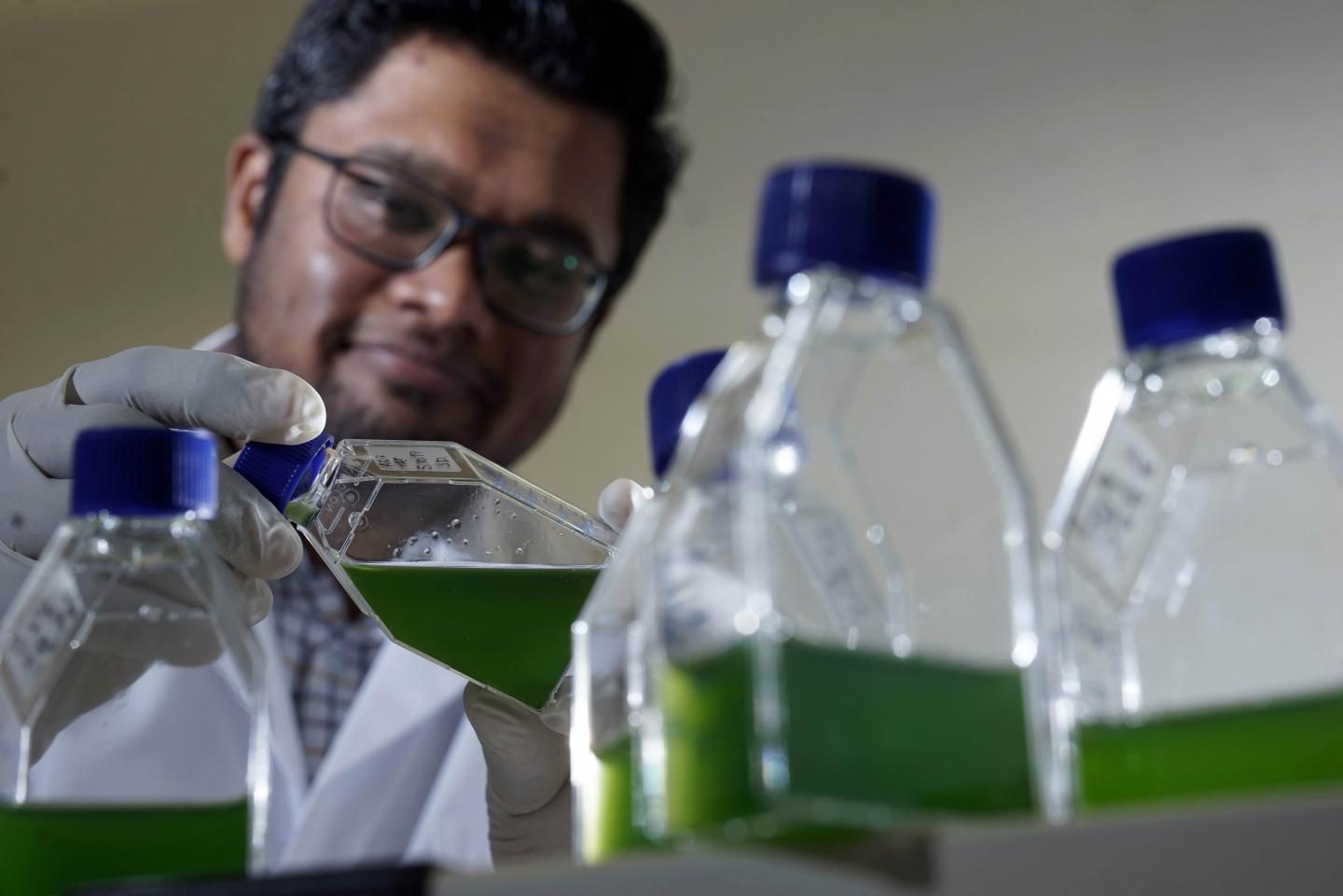
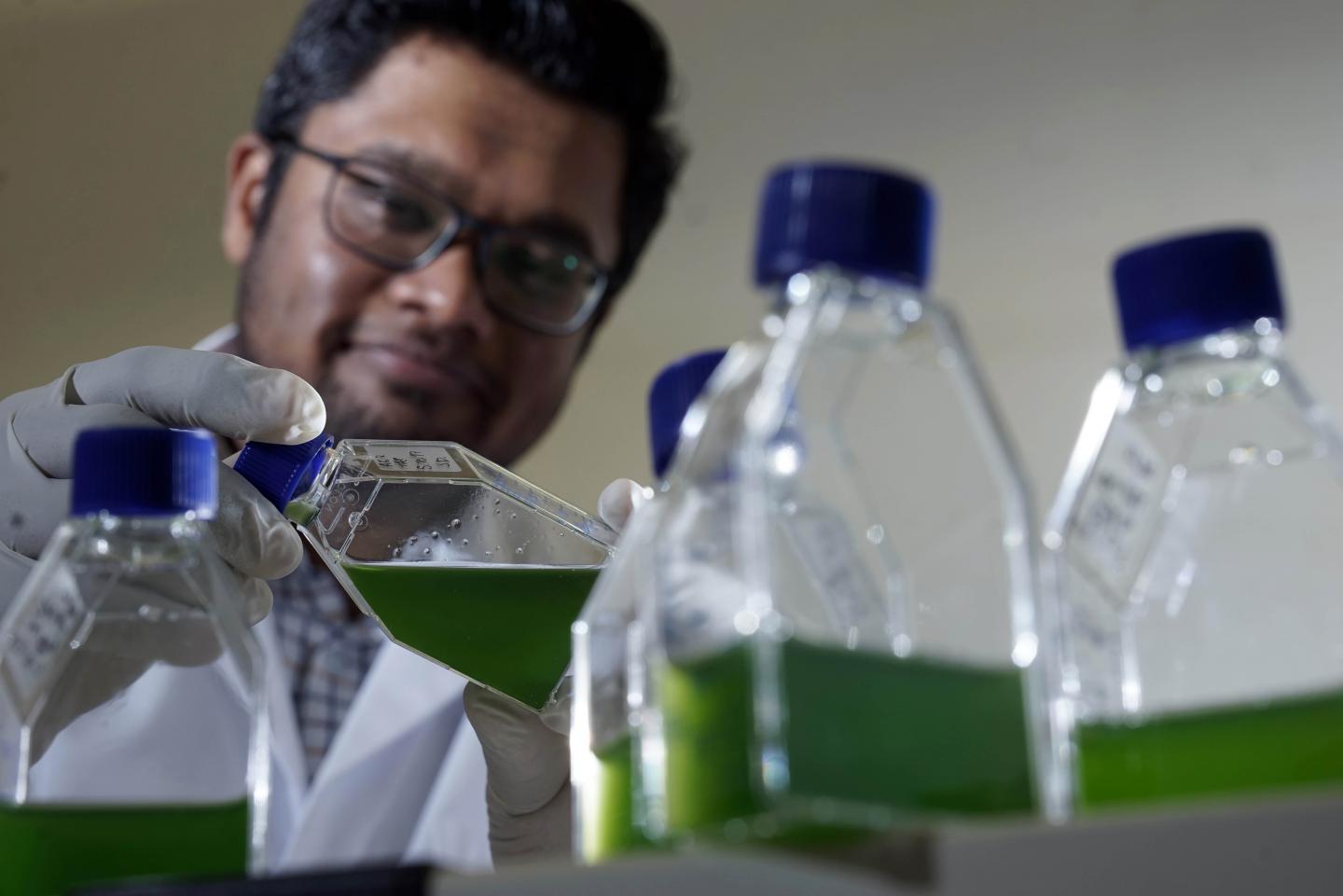
It is a gruesome spectacle that meets the eyes of Prasad Aiyar as he looks down the microscope. The doctoral candidate from India, who came to Jena to do his Master's degree in Molecular Life Sciences, examines the species Chlamydomonas reinhardtii on a microscope slide. The oval-shaped microalgae, a good 10 micrometres in size, have two flagella with which they busily swim around – that is, until Prasad Aiyar uses a pipette to add a drop of a bacterial solution. The even smaller bacteria gather together into swarms, which surround the algae. Just 90 seconds later, the algae are motionless and when one looks more closely, one can see that their flagella have fallen off.
The Jena researchers have discovered why these bacteria have such a devastating effect on the green algae. It seems that a chemical substance plays a central role in the process, as the teams under Prof. Maria Mittag and Dr Severin Sasso of the FSU, and Prof. Christian Hertweck of the Leibniz Institute for Natural Product Research and Infection Biology – Hans Knöll Institute (HKI) – report in the scientific journal Nature Communications (DOI: 10.1038/s41467-017-01547-8).
Orfamide A, as the substance is called, is a cyclical lipopeptide which the bacteria release, together with other chemical compounds. "Our results indicate that orfamide A affects channels in the cell membrane, which leads to these channels opening," explains Dr Severin Sasso. "This leads to an influx of calcium ions from the environment into the cell interior of the algae," adds the head of the Research Group Molecular Botany. A rapid change in the concentration of calcium ions is a common alarm signal for many cell types, which regulates a large number of metabolic pathways. "To be able to observe the change in the level of calcium in the cell, we introduced the gene for a photoprotein into the green algae, which causes bioluminescence if the calcium level increases. This enables us to measure the amount of calcium with the help of the luminescence," explains Prof. Mittag, Professor for General Botany. In some cases, the changes in the calcium lead to changes in the direction of movement, for example after light perception. In other cases, for example after the bacterial attack, they cause the loss of the flagella.
Researching the "chemical language"
In addition, the teams were able to show that the bacteria can tap the algae and use them as a nutrient source if they are lacking in nutrients. "We have evidence that other substances from the toxic cocktail released by the bacteria also play a role in this," says Maria Mittag. Her team, once again in cooperation with the teams of Prof. Hertweck und Dr Sasso, now also wants to track down these substances, in order to gain a precise understanding of this chemical communication between algae and bacteria.
Numerous research groups have dedicated their efforts to studying the "chemical language" between microorganisms and their environment as part of the Collaborative Research Centre "ChemBioSys". Microbial species communities occur in virtually every habitat on Earth. "In these communities, both the species composition and the interrelations between individual organisms of one or more species are regulated by chemical mediators," says Prof. Hertweck, who is the speaker for the Collaborative Research Centre and head of the Biomolecular Chemistry department at HKI.
The aim of the interdisciplinary research partnership is to explain the fundamental control mechanisms in complex biosystems, which affect the whole of life on Earth. "We want to understand the mechanisms through which the microbial community structures are formed and their diversity maintained." They are important, because essentials of life – not least for human beings – depend on them, for example food or air.
This is also true of microalgae such as Chlamydomonas reinhardtii. Such photosynthetic microorganisms (phytoplankton) make a contribution of about 50 per cent towards fixing the greenhouse gas carbon dioxide and, as a by-product of photosynthesis, they supply the oxygen that is essential for our survival. In addition, microalgae, which are found in fresh water, wet soils or the world's seas and oceans, represent an important base for food chains, especially in aquatic systems. For example, zooplankton in the oceans feed on the algae and together they provide food for crustaceans, which in turn are eaten by fish, before these are eaten by bigger fish or caught by humans. "In view of the huge significance of microalgae for human life, we still know astonishingly little about the fundamental elements and the interactions in their microscopic world," says Prof. Mittag.
###
Original publication:
Prasad Aiyar et al. Antagonistic bacteria disrupt calcium homeostasis and immobilize algal cells, Nature Communications (2017), DOI: 10.1038/s41467-017-01547-8
Contact:
Prof. Maria Mittag, Dr Severin Sasso
Faculty of Biology and Pharmacy of Friedrich Schiller University, Jena
Am Planetarium 1, 07743 Jena, Germany
49-3641-949201, 49-3641-949475
[email protected]
[email protected]
Media Contact
Ute Schoenfelder
[email protected]
http://www.uni-jena.de
Original Source
http://www.uni-jena.de/en/Research+News/FM171124_chemical+communication_Chlamydomonas+reinhardtii+.html http://dx.doi.org/10.1038/s41467-017-01547-8