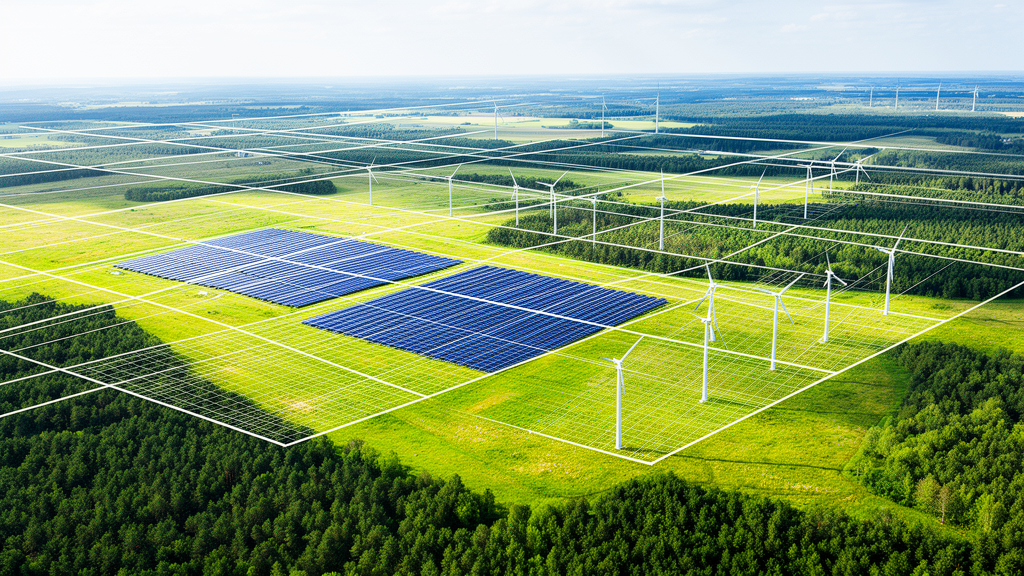
The rapid acceleration of renewable energy infrastructure worldwide requires moving beyond purely technical and cost-driven siting models to address intensifying land-use conflicts, ecological impacts, and place-based community values. In a perspective published in the journal Landscape Ecology, researchers outline a structured spatial framework grounded in the Integrated Landscape Approach (ILA) and Landscape Sustainability Science (LSS). As utility-scale solar arrays, wind installations, battery storage complexes, and high-voltage transmission networks expand across diverse geographies, energy systems increasingly form distinct physical patterns that alter viewsheds, ecosystems, and everyday environments. The review emphasizes that renewable transitions differ fundamentally from conventional fossil fuels because of their extensive spatial diffuseness, reliance on local resource availability, and frequent co-location with existing agricultural, urban, and ecological land uses.
To navigate these complex spatial demands, the framework integrates two foundational spatial planning instruments: the landscape transect and the energyshed. Grounded in planning traditions ranging from Patrick Geddes’s valley section and Ian McHarg’s layer-cake analysis to New Urbanism and landscape urbanism, the landscape transect organizes spatial design choices along continuous gradients of settlement density, ecological sensitivity, and cultural values. This enables planners and municipal authorities to calibrate appropriate energy generation technologies, physical design forms, and regulatory controls across urban, suburban, rural, and coastal zones. Complementing this local granularity, the energyshed borrows analytical logic from hydrological watershed modeling to delineate the entire geographic footprint of generation, transmission, storage, and consumption associated with end-use energy demand.
By tracing power flows from primary source to ultimate sink, energyshed analysis directly links localized design interventions with regional infrastructure networks and highlights spatial interdependencies. The energyshed conceptualizes energy systems across nested operational scales, spanning from distributed rooftop photovoltaic panels to cross-jurisdictional regional power corridors. Crucially, mapping these connections exposes the extended environmental footprint of major urban consumption centers and the distal burdens transferred onto rural and coastal host landscapes. Making these regional relationships explicit provides a concrete analytical foundation for spatial equity analysis, enabling transparent negotiations around local stewardship, community ownership models, and regional benefit-sharing mechanisms that are routinely overlooked in conventional, centralized utility planning.
The framework operationalizes five core principles derived from the Integrated Landscape Approach: multifunctionality, transdisciplinarity, stakeholder participation, complexity, and long-term sustainability. Multifunctionality reframes renewable installations not as single-purpose industrial facilities, but as composite elements of working landscapes capable of sustaining ecosystem services. Documented field configurations illustrate this capacity, including agrivoltaic systems that co-locate crop production with elevated solar panels, pollinator-friendly vegetative ground covers beneath solar arrays, floating photovoltaics on water reservoirs that mitigate harmful algal blooms, and transmission right-of-ways co-managed with recreational trail networks through integrated vegetation management protocols.
Transdisciplinarity addresses the historical fragmentation of renewable planning, where techno-economic feasibility studies, ecological impact reviews, and social acceptability research are conducted in isolated institutional silos. By deliberately synthesizing landscape ecological metrics with power system engineering, the framework identifies spatial configurations that sustain grid performance while minimizing habitat degradation. Landscape pattern indices—such as patch size and density, structural edge effects, matrix quality, the Shannon Diversity Index, and habitat connectivity corridors—provide empirical measures of fragmentation and cumulative ecological stress. These ecological indicators are paired with socioeconomic metrics, including local employment creation, household energy burdens, public acceptance rates, and distributional equity, ensuring multi-criteria assessment throughout project lifecycles.
Within urban environments, which operate as dense energy sinks drawing power from distant production regions, the framework emphasizes maximizing distributed generation within tight physical constraints. Urban strategies include building-integrated photovoltaics, rooftop and façade solar installations, parking canopy arrays, and decentralized district storage. Pairing green roofs with solar panels delivers secondary environmental dividends by moderating urban microclimates, reducing stormwater runoff, and curtailing building cooling loads. However, dense urban deployment faces obstacles such as structural roof limitations, architectural heritage protections, shading from adjacent structures, fragmented real estate ownership, and congested grid interconnection points, necessitating adaptive zoning codes and equitable community financing programs for lower-income households.
Suburban environments occupy an intermediate operational niche along the transect-energyshed gradient, characterized by high per-capita residential electricity consumption alongside expansive surface areas suitable for microgrids and feeder-level storage. Extensive commercial rooftops on big-box retailers, corporate office parks, and industrial warehouses offer significant potential for peak-demand generation that relieves regional transmission stress. Overcoming suburban planning hurdles—including restrictive homeowner association covenants, aesthetic concerns, and fragmented municipal jurisdictions—relies on model zoning ordinances and form-based design guidelines. Additionally, suburban powerline rights-of-way maintained as unmowed, shrub-scrub habitats can enhance regional ecological connectivity across fragmented metropolitan landscapes.
Rural landscapes bear the primary production burdens of clean energy transitions, hosting utility-scale wind farms, vast photovoltaic plants, regional substations, and interstate transmission corridors. These hosting burdens are compounded by the rapid expansion of hyperscale data centers seeking inexpensive rural acreage and direct access to high-capacity power lines. The framework addresses rural land-use tensions through agrivoltaic deployment, solar installations along irrigation canals, and prioritizing renewable development on degraded or brownfield sites rather than prime agricultural soils or ecologically sensitive wildlife corridors. Empirical research indicates that rural landowner decisions to host infrastructure depend heavily on water scarcity, agricultural ethics, and income diversification, making early and sustained participatory mapping essential for establishing social legitimacy.
Coastal environments represent complex junctions connecting terrestrial power grids with marine energy resources. Coastal planning must accommodate port electrification, offshore wind interconnection nodes, aquaculture-energy co-location, and experimental ocean thermal or wave energy installations. These maritime systems intersect sensitive nearshore ecosystems, commercial fisheries, visual scenic corridors, and heightened exposure to storm surge and saltwater corrosion. Implementing habitat-sensitive subsea cable routing, nature-based living shorelines, and resilient port infrastructure embeds ecological protection directly into coastal energy development, reinforcing the adaptive governance mechanisms prioritized by the Integrated Landscape Approach.
Ultimately, the perspective demonstrates that technical participation alone cannot resolve structural tensions between state-level decarbonization mandates and localized community opposition. By linking the transect with the energyshed, the framework provides an explicit spatial accounting of non-negotiable ecological constraints, cumulative landscape impacts, and spatial trade-offs across nested jurisdictions. Applying adaptive management protocols allows planners to deploy phased infrastructure pilots, monitor empirical ecological thresholds, and iteratively adjust site management practices over time. This systems-oriented paradigm positions ecologists, planners, landscape architects, and host communities as collaborative stewards capable of delivering energy transitions that are spatially grounded, socially legitimate, and ecologically durable.
The conceptual architecture linking Landscape Sustainability Science with the Integrated Landscape Approach functions as a symbiotic partnership between empirical observation and practical implementation. Landscape Sustainability Science provides the ecological foundation, analyzing how spatial heterogeneity and landscape configurations influence the dynamic relationships between ecosystem services and human well-being. In parallel, the Integrated Landscape Approach provides the collaborative governance frameworks necessary to translate that ecological science into field-level planning. This joint foundation acknowledges that energy systems are embedded within dynamic social-ecological systems subject to volatile market conditions, evolving public policies, and shifting climate patterns. Rather than treating regional landscapes as static backdrops for power plants, the framework establishes adaptive management pathways where carrying capacities and cumulative ecological thresholds guide development limits. Designers and planners can thus translate complex scientific uncertainty into concrete, place-based scenarios that can be evaluated collaboratively prior to committing capital or altering sensitive land systems.
Historically, regional energy infrastructure shaped landscapes through centralized, top-down institutions like the Tennessee Valley Authority and the Bonneville Power Administration. Contemporary decarbonization differs markedly because distributed renewable installations directly alter existing land uses, viewsheds, and parcel-level property relationships. To navigate these physical interactions, the framework moves beyond single-sector planning approaches that prioritize output maximization and least-cost siting while isolating power generation from agriculture, conservation, and cultural heritage. It also integrates complementary energy technologies such as bioenergy, which can provide dispatchable electricity supply and low-carbon transport fuels to balance intermittent solar and wind resources. Incorporating bioenergy into landscape-scale planning requires evaluating feedstock production, supply chains, and localized land-use trade-offs to ensure biomass cultivation does not degrade ecosystem services or undermine regional food security.
To institutionalize these integrated concepts, the framework outlines practical governance mechanisms that replace conventional compensatory models with collaborative project design. Upfront co-creation agreements allow host communities, developers, and regional agencies to embed shared value streams directly into project plans, including local community ownership, energy affordability programs, and long-term habitat stewardship. At municipal levels, transect-sensitive form-based codes offer enforceable design standards that govern equipment typologies, setback distances, visual screening, adjacency considerations, and eventual decommissioning according to landscape context. Delineating energyshed boundaries further enables regional utility planners and conservation bodies to align transmission corridors with transect gradients, directing installations toward already degraded or developed sites to reduce cumulative habitat fragmentation.
The framework’s practical utility was demonstrated through an illustrative application in the State of Oregon, where researchers synthesized spatial datasets encompassing settlement densities, land-use classifications, ecological corridors, and existing electrical infrastructure. By linking localized design considerations to regional power flows, this visualization serves as an iterative working tool for scenario development and public dialogue. While the model emphasizes inclusive engagement, it explicitly recognizes that public consultation alone cannot dissolve foundational tensions between national decarbonization mandates and localized community opposition. Instead of presuming inevitable consensus, the framework clarifies jurisdictional decision authority and identifies non-negotiable ecological constraints, creating transparent foundations for structured negotiation, impact mitigation, and durable regional benefit-sharing.
Subject of Research: Integrated landscape approaches and spatial planning frameworks for renewable energy infrastructure
Article Title: The integrated landscape approach for renewable energy planning: a spatial framework through the energyshed and landscape transect
Article References: Ko, Y. (2026). The integrated landscape approach for renewable energy planning: a spatial framework through the energyshed and landscape transect. Landscape Ecology, 41(11), Article 196. https://doi.org/10.1007/s10980-026-02434-8
Image Credits: AI Generated
DOI: 10.1007/s10980-026-02434-8
Keywords: Renewable Energy Planning, Integrated Landscape Approach, Energyshed Analysis, Landscape Transect, Landscape Sustainability Science, Agrivoltaics, Ecosystem Services, Multifunctionality, Spatial Ecology, Habitat Connectivity, Energy Justice, Distributed Generation, Land-Use Conflicts, Transmission Corridors, Decarbonization Infrastructure, Spatial Planning Frameworks, Coastal Renewable Energy
News Source: Gavin Prescott. (November 20, 2026). Integrated Spatial Planning Couples Landscape Transects With Energysheds for Renewable Infrastructure. Scienmag.