• HOME
  • NEWS
  • EXPLORE
    • CAREER
      • Companies
      • Jobs
    • EVENTS
    • iGEM
      • News
      • Team
    • PHOTOS
    • VIDEO
    • WIKI
  • BLOG
  • COMMUNITY
    • FACEBOOK
    • INSTAGRAM
    • TWITTER
Friday, November 20, 2026
BIOENGINEER.ORG
No Result
View All Result
  • Login
  • HOME
  • NEWS
  • EXPLORE
    • CAREER
      • Companies
      • Jobs
        • Lecturer
        • PhD Studentship
        • Postdoc
        • Research Assistant
    • EVENTS
    • iGEM
      • News
      • Team
    • PHOTOS
    • VIDEO
    • WIKI
  • BLOG
  • COMMUNITY
    • FACEBOOK
    • INSTAGRAM
    • TWITTER
  • HOME
  • NEWS
  • EXPLORE
    • CAREER
      • Companies
      • Jobs
        • Lecturer
        • PhD Studentship
        • Postdoc
        • Research Assistant
    • EVENTS
    • iGEM
      • News
      • Team
    • PHOTOS
    • VIDEO
    • WIKI
  • BLOG
  • COMMUNITY
    • FACEBOOK
    • INSTAGRAM
    • TWITTER
No Result
View All Result
Bioengineer.org
No Result
View All Result
Home NEWS Science News Technology

Virtual-Center Spherical Joint Enables Large Shape Changes in Truss Robots

by
November 20, 2026
in Technology
Reading Time: 2 mins read
0
Virtual-Center Spherical Joint Enables Large Shape Changes in Truss Robots

Virtual-Center Spherical Joint Enables Large Shape Changes in Truss Robots

Share on FacebookShare on TwitterShare on LinkedinShare on RedditShare on Telegram

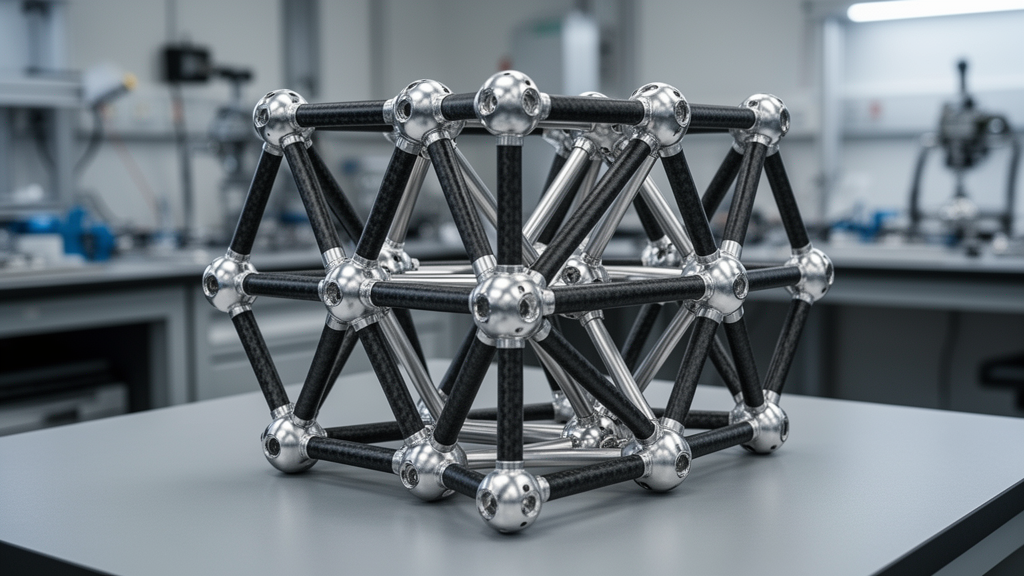
Researchers at Brigham Young University have introduced and modeled the Virtual-Center Serial Linkage Spherical Joint, a modular joint mechanism developed for reconfigurable truss robots. The design facilitates substantial three-dimensional changes in shape while simultaneously permitting robotic systems to be dismantled and reassembled into entirely different structural configurations.

Structurally, the mechanism operates as a passive linkage constructed from serially pinned panels. The physical axis of every pin joint is arranged to intersect at a single virtual center of rotation regardless of how the panels are oriented, delivering all degrees of freedom typical of a spherical joint while preserving the structural and kinematic simplicity of the underlying truss.

To enable rapid reconfiguration, the joint arm connects to standard truss elements using clevis-pin attachments that support straightforward assembly and disassembly. At its opposite end, the arm attaches directly to a central spherical node, which unifies all incoming joint arms and enforces a single shared virtual center of rotation across the junction.

This nodal architecture allows multiple passive spherical joints to converge at the same central spherical node.

To evaluate the motion limits of the mechanism, the investigators established complementary forward and inverse kinematic formulations based on geometric design parameters. The forward kinematic model applies these geometric parameters to generate a three-dimensional representation of the reachable joint workspace, whereas the inverse kinematic model uses the same parameters to calculate allowable axial rotation at each joint endpoint across that workspace.

Experimental validation confirmed that the kinematic models reasonably reflect physical joint behavior. During motion capture testing of a prototype configuration, the forward model predicted 38.68 percent spherical-surface coverage compared with 33.38 percent measured experimentally, while the inverse model characterized the available axial rotation throughout the workspace; the joint was subsequently integrated into an operational six-unit inflatable truss robot.

The investigation was reported by Adam Rose, Ivyann O. Running, Eli Francom, Simon Charles, Bryce Parkinson, Larry Howell, and Nathan Usevitch in the Robot Design section of Frontiers in Robotics and AI.

Subject of Research: Modular virtual-center serial linkage spherical joint for reconfigurable truss robots

Article Title: A virtual-center spherical joint for reconfigurable truss robot systems

Article References: Rose, A., Running, I. O., Francom, E., Charles, S., Parkinson, B., Howell, L. L., & Usevitch, N. (2026). A virtual-center spherical joint for reconfigurable truss robot systems. Frontiers in Robotics and AI, 13, 1968425. https://doi.org/10.3389/frobt.2026.1968425

Image Credits: AI Generated

DOI: 10.3389/frobt.2026.1968425

Keywords: reconfigurable truss robots, virtual-center serial linkage, passive spherical joint, joint kinematics, forward kinematic model, inverse kinematic model, spherical node, serially pinned panels, virtual center of rotation, clevis-pin connection, motion capture validation, inflatable truss robot, axial rotation, spherical-surface coverage, three-dimensional joint workspace, space robotics, modular joint design

News Source: Denise Maddox. (November 20, 2026). Virtual-Center Spherical Joint Enables Large Shape Changes in Truss Robots. Scienmag.


Tags: axial rotationclevis-pin connectionforward kinematic modelinflatable truss robotinverse kinematic modeljoint kinematicsmodular joint designmotion capture validationpassive spherical jointreconfigurable truss robotsserially pinned panelsspace roboticsspherical nodespherical-surface coveragethree-dimensional joint workspacevirtual center of rotationvirtual-center serial linkage
Share12Tweet7Share2ShareShareShare1

Related Posts

Vapor Sulfurization Narrows Bismuth Ferrite Bandgap While Compromising Film Epitaxy

Vapor Sulfurization Narrows Bismuth Ferrite Bandgap While Compromising Film Epitaxy

November 20, 2026
Review Finds Clinical AI Safeguards Lack Evidence of Reduced Patient Harm

Review Finds Clinical AI Safeguards Lack Evidence of Reduced Patient Harm

November 20, 2026

AI Models Predict Stabilized Road Soil Strength but Face Validation Gaps

November 20, 2026

Cross-Attention Multimodal Framework Halves Climate Prediction Error Across Ukrainian Data

November 20, 2026

POPULAR NEWS

  • Biased Bubble Chain Navigation Helps Indoor Mobile Robots Accommodate Approaching Pedestrians

    Biased Bubble Chain Navigation Helps Indoor Mobile Robots Accommodate Approaching Pedestrians

    29 shares
    Share 12 Tweet 7
  • Thermophilic Fungus Engineered for High-Yield Bacterial Dipeptidyl Peptidase 4 Secretion

    29 shares
    Share 12 Tweet 7
  • Anterior Talar Osteotomy Corrects Equinus Deformity While Preserving Joint Congruence

    29 shares
    Share 12 Tweet 7
  • Biosensor Mouse Shows Mammary Defects Reversed by Estrogen and Genetic Crossing

    29 shares
    Share 12 Tweet 7

About

We bring you the latest biotechnology news from best research centers and universities around the world. Check our website.

Follow us

Recent News

Youth With 22q11.2 Deletion Show Olfactory Loss Without Substantia Nigra Enlargement

RNA Regulatory Loop Discovered Controlling Peach Branch Architecture and Hormone Levels

RNA Acetylation Stabilizes Heat-Responsive Transcripts in Tomato Plants Under Thermal Stress

Subscribe to Blog via Email

Enter your email address to subscribe to this blog and receive notifications of new posts by email.

Join 89 other subscribers
  • Contact Us

Bioengineer.org © Copyright 2023 All Rights Reserved.

Welcome Back!

Login to your account below

Forgotten Password?

Retrieve your password

Please enter your username or email address to reset your password.

Log In
No Result
View All Result
  • Homepages
    • Home Page 1
    • Home Page 2
  • News
  • National
  • Business
  • Health
  • Lifestyle
  • Science

Bioengineer.org © Copyright 2023 All Rights Reserved.