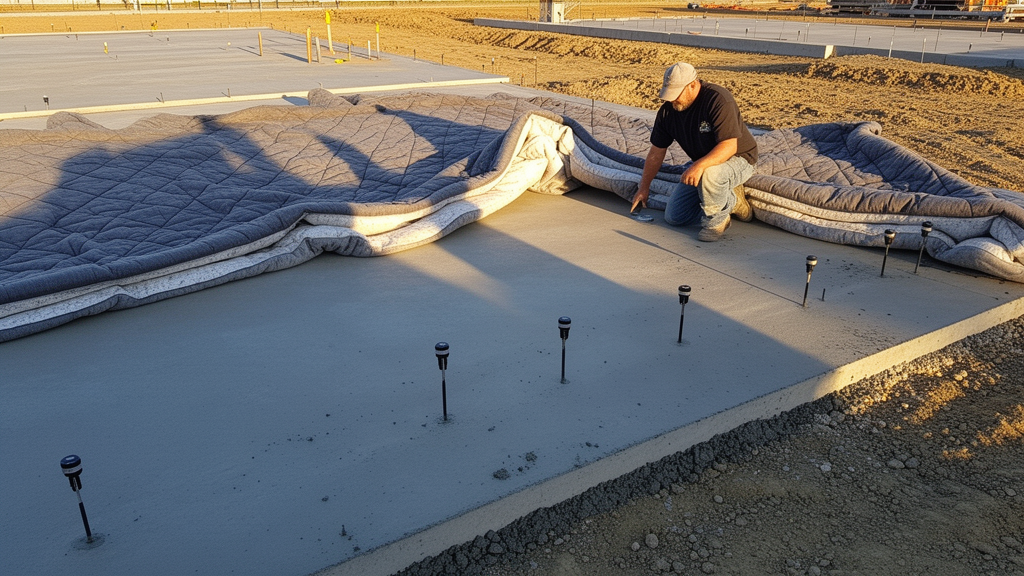
In an outdoor field evaluation conducted on an access driveway slab at a fire station in Kyle, Texas, researchers demonstrated that integrating carbon nanotube cementitious strain sensors and deploying external bio-based phase change material covers can effectively monitor structural behavior and dampen thermal gradients associated with early-age cracking. Early-age concrete remains particularly sensitive to environmental fluctuations in temperature and moisture, which generate internal tensile stresses during cement hydration and subsequent cooling. When these induced stresses exceed the relatively low tensile strength of immature concrete, premature cracking develops, often compromising the long-term serviceability and structural integrity of the pavement. The study placed both advanced technologies simultaneously into a full-scale pavement placement on December 10, 2024, assessing their real-world capabilities under continuous exposure to natural climatic shifts over a monitoring span reaching up to 160 days.
To mitigate the thermal spikes that drive early stress development, the investigation examined external blankets fabricated from a commercially available bio-based phase change material supplied in powder form by PureTemp LLC. Rather than admixing the material directly into the concrete mixture, where microencapsulation or aggregate impregnation has historically caused compressive strength loss, leakage risks, and constructability hurdles, the team pre-melted and solidified the substance into sealed sheets measuring 610.0 millimeters by 610.0 millimeters with a thickness of 12.0 millimeters. Positioned directly atop the finished slab following curing compound application and surface texturing, these external covers operated without modifying the internal mechanical properties of the concrete matrix. The installation aimed to intercept incoming solar radiation and regulate thermal exchanges during the initial ten days of curing, establishing an altered early thermal history before physical removal.
Alongside the thermal management trial, the researchers validated internal structural health monitoring using piezoresistive carbon nanotube cementitious strain sensors fabricated in the laboratory. The sensor mortar was formulated using multi-walled carbon nanotubes with diameters between 10 and 20 nanometers, Portland Type I cement, fine river sand, a water-to-cement ratio of 0.45, and a polycarboxylate-based superplasticizer. Electrical percolation trials on mortar cubes identified an optimal filler concentration of 0.7 percent carbon nanotubes by cement mass, establishing a continuous conductive network while maintaining standard mortar workability verified through ASTM flow tests. Prior to field placement, the sensors underwent approximately 120 days of laboratory curing to minimize baseline microstructural evolution and moisture fluctuations, after which they were embedded with circular copper plate electrodes spaced 19.0 millimeters from each end to continuously track electrical resistance changes under field mechanical strains.
Isolating the distinct components of early volume change required specialized instrumentation known as non-stress cylinders, originally developed by Choi and Won, installed within the 165.0 to 178.0 millimeter thick reinforced slab. Impervious non-stress cylinders shielded internal mortar from moisture movement while permitting heat conduction, effectively capturing purely thermal strain. Concurrently, porous non-stress cylinders equipped with wall perforations allowed both heat and moisture exchange with the surrounding concrete matrix, measuring combined thermal and moisture-induced deformations. Vibrating-wire strain gages installed within these cylinders recorded dimensional shifts, while embedded T-type thermocouples monitored temperature distributions across depths of 76.0, 114.0, and 152.0 millimeters from the pavement surface, allowing direct cross-referencing between mechanical strain, thermal gradients, and electrical signal responses.
Pavement placement occurred during winter under ambient temperatures ranging from approximately 9 degrees Celsius at early morning pouring to 21 degrees Celsius in the afternoon. Sensor data indicated that the concrete reached final set roughly 7.51 hours after placement, as marked by the divergence of internal strain from the temperature curve. Because winter ambient temperatures and hydration heat kept peak concrete temperatures within the control section between 24 and 25 degrees Celsius, the phase change material did not reach its 29 degrees Celsius melting threshold to trigger latent heat absorption. Nevertheless, the external cover acted as a beneficial thermal barrier, reflecting and absorbing solar radiation to reduce peak slab temperatures by approximately 1.5 degrees Celsius during the covered monitoring window.
This surface moderation yielded a substantial dampening of internal slab thermal gradients between the upper and lower concrete layers. In winter, the control section exhibited a maximum temperature differential of roughly 5.6 degrees Celsius, whereas the section protected by the phase change material maintained a peak differential of approximately 3.0 degrees Celsius. This reduction of roughly 46 percent in maximum cycle-level temperature differential effectively suppressed the nonlinear temperature profiles that frequently generate excessive internal restraint stresses. Furthermore, the thermal buffering persisted into the spring monitoring period, where the protected area consistently maintained slab temperature differentials that were 1.0 to 2.0 degrees Celsius lower than those observed in the bare control slab.
Mechanical measurements recorded by the non-stress cylinders corroborated the protective influence of the altered thermal history. During the initial ten-day period, the control section generated roughly 30 percent more peak thermal strain than the section sheltered by the cover. Following the removal of the protective blankets, the difference in thermal strain gradually narrowed to approximately 15 percent and dropped below 9 percent by day 30. Porous non-stress cylinder readings also revealed that the control section experienced pronounced early expansion, driven by surface evaporation and upward moisture migration from the moist clay-rich subgrade. In contrast, the covered slab retained a more stable moisture profile, reducing early strain discrepancies by up to 60 percent during the coverage period and maintaining 20 to 30 percent lower strain amplitudes into spring.
Long-term shrinkage strain data collected over 160 days demonstrated that the covered region experienced 50 to 70 percent lower and noticeably more stable shrinkage values than the uncovered pavement. Total strain measurements during the initial ten days similarly exhibited a 10 to 15 percent reduction under the cover. While overall strain responses converged toward comparable cyclic patterns after day 30 as environmental exposure equalized, the early-age moderation imparted a persistent benefit, keeping peak spring strain amplitudes 15 to 25 percent lower in the previously covered slab. The authors emphasized, however, that field shrinkage evaluations naturally encompass sensor noise and environmental redistributions that require careful contextual interpretation.
Meanwhile, the carbon nanotube cementitious sensors exhibited robust operational performance, demonstrating clear linear correlations between electrical resistance and mechanical strain with determination coefficients exceeding 0.8 across field temperature cycles. Within the impervious non-stress cylinders, sensor electrical resistance decreased consistently as temperatures rose, primarily governed by differential thermal expansion that shortens inter-particle distances and enhances electron tunneling across the conductive network. An overall field resistance-strain correlation yielded an R-squared value of 0.8528. The absence of electrical hysteresis in field sensors, compared to earlier laboratory trials, was attributed to advanced sensor age and extensive internal moisture depletion achieved during the 120-day pre-curing period.
Segmenting the sensor resistance data into 20-day monitoring intervals revealed that the strong negative linear relationship between resistance and strain remained consistent over time, with correlation values ranging from 0.72 to 0.93. The highest strain sensitivity appeared during the 10-to-30-day window, followed by a gradual reduction in slope steepness at later ages as continuous hydration, matrix densification, and network stabilization matured the composite microstructure. Because field resistance reflects combined thermo-mechanical phenomena, complete analytical decoupling of thermal and mechanical signal components will require additional calibration models. Ultimately, the trial confirms that externally applied phase change covers and embedded nanotube sensors offer viable, scalable pathways for suppressing thermal cracking risks and monitoring smart infrastructure under demanding field conditions.
Subject of Research: Field evaluation of carbon nanotube cementitious strain sensors and phase change material covers for concrete pavements
Article Title: Field Performance of Emerging Concrete Technologies: CNT-Based Cementitious Strain Sensors and PCM Covers for Reducing Early-Age Cracking Potential
Article References: Hussain, A. B., Chakraborty, R., Choi, J., & Yeon, J. H. (2026). Field Performance of Emerging Concrete Technologies: CNT-Based Cementitious Strain Sensors and PCM Covers for Reducing Early-Age Cracking Potential. International Journal of Concrete Structures and Materials, 20(1), Article 75. https://doi.org/10.1186/s40069-026-00957-7
Image Credits: AI Generated
DOI: 10.1186/s40069-026-00957-7
Keywords: concrete pavement, smart concrete, carbon nanotubes, cementitious sensors, phase change materials, thermal cracking, strain monitoring, structural health monitoring, early-age concrete, percolation threshold, non-stress cylinders, temperature differential, hydration heat, pavement engineering, civil engineering, Kyle Texas, piezoresistive sensing
News Source: Denise Maddox. (November 20, 2026). Smart Sensors and External Phase Change Covers Reduce Concrete Cracking Risks. Scienmag.