• HOME
  • NEWS
  • EXPLORE
    • CAREER
      • Companies
      • Jobs
    • EVENTS
    • iGEM
      • News
      • Team
    • PHOTOS
    • VIDEO
    • WIKI
  • BLOG
  • COMMUNITY
    • FACEBOOK
    • INSTAGRAM
    • TWITTER
Friday, November 20, 2026
BIOENGINEER.ORG
No Result
View All Result
  • Login
  • HOME
  • NEWS
  • EXPLORE
    • CAREER
      • Companies
      • Jobs
        • Lecturer
        • PhD Studentship
        • Postdoc
        • Research Assistant
    • EVENTS
    • iGEM
      • News
      • Team
    • PHOTOS
    • VIDEO
    • WIKI
  • BLOG
  • COMMUNITY
    • FACEBOOK
    • INSTAGRAM
    • TWITTER
No Result
View All Result
Bioengineer.org
No Result
View All Result
Home NEWS Science News Technology

Flight Tests Validate Control Barrier Functions for Drone Collision Avoidance

by
November 20, 2026
in Technology
Reading Time: 2 mins read
0
Flight Tests Validate Control Barrier Functions for Drone Collision Avoidance

Flight Tests Validate Control Barrier Functions for Drone Collision Avoidance

Share on FacebookShare on TwitterShare on LinkedinShare on RedditShare on Telegram

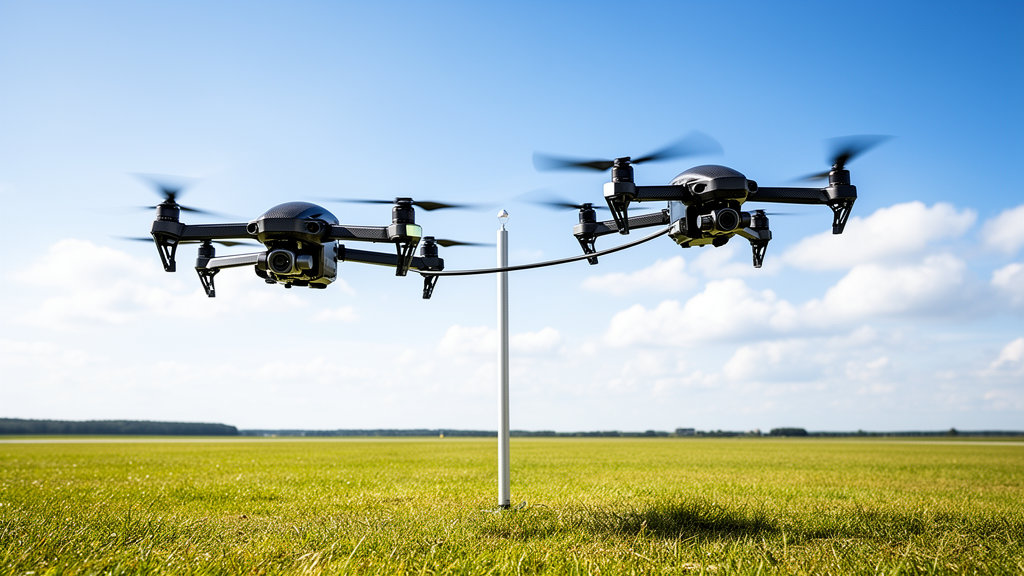
Researchers have conducted the first documented flight-test validation of a higher-order control barrier function quadratic program safety filter designed for collision avoidance in fixed-wing uncrewed aircraft systems. Urban air mobility operations within dense, obstacle-rich airspace require robust collision-avoidance mechanisms that guarantee safety under tight trajectory constraints and atmospheric disturbances. While control barrier functions provide a principled mathematical framework for safety-critical control, prior fixed-wing implementations remained confined to numerical simulations without physical verification.

The absence of real-world trials left theoretical safety guarantees unverified against physical actuator limits, onboard hardware constraints, sensor noise, and atmospheric turbulence. To evaluate the algorithm under operational conditions, the research team implemented the higher-order control barrier function quadratic program filter directly onto an uncrewed aerial vehicle to govern collision-avoidance maneuvers.

Flight trials were carried out using a SkyHunter aircraft tasked with tracking a complex figure-eight flight path in the presence of static obstacles. Testing was conducted across distinct environmental profiles, specifically comparing navigation behavior under low-wind scenarios against high-wind conditions.

To overcome computational bottlenecks and allow real-time onboard execution, the investigators implemented a three-dimensional engagement-dynamics formulation that reduces the problem to one-dimensional range dynamics.

During the low-wind trials, both the two-dimensional and three-dimensional formulations successfully preserved the required separation distances throughout every avoidance maneuver.

In high-wind conditions featuring sustained wind speeds exceeding 40 percent of the aircraft’s cruise speed, the system encountered significant performance limits. Wind gusts triggered two safety-boundary violations during the maneuvers, demonstrating precisely where nominal theoretical guarantees fail during physical atmospheric disturbances. The flight-test results provide an experimental pathway for deploying barrier-function safety filters while underscoring the necessity of real-world validation in safety-critical autonomy.

Subject of Research: Flight-test validation of control barrier function algorithms for fixed-wing collision avoidance

Article Title: Real World Flight Test of a Three-Dimensional Collision Avoidance Control Barrier Function Algorithm

Article References: Xu, J., Marshall, J., Powers, M., & Keshmiri, S. (2026). Real World Flight Test of a Three-Dimensional Collision Avoidance Control Barrier Function Algorithm. Journal of Intelligent & Robotic Systems, 112(4), Article 113. https://doi.org/10.1007/s10846-026-02440-7

Image Credits: AI Generated

DOI: 10.1007/s10846-026-02440-7

Keywords: Control Barrier Functions, Collision Avoidance, Flight Test, Fixed-Wing UAS, SkyHunter Aircraft, Urban Air Mobility, Quadratic Program, Safety Filter, Engagement Dynamics, Obstacle Avoidance, Wind Disturbance, Autonomous Flight, Safety-Critical Control, Sensor Noise, Actuator Limits, Uncrewed Aircraft Systems

News Source: Denise Maddox. (November 20, 2026). Flight Tests Validate Control Barrier Functions for Drone Collision Avoidance. Scienmag.


Tags: Actuator LimitsAutonomous Flightcollision avoidanceControl barrier functionsEngagement DynamicsFixed-Wing UASFlight Testobstacle avoidanceQuadratic Programsafety filterSafety-Critical Controlsensor noiseSkyHunter AircraftUncrewed aircraft systemsUrban Air MobilityWind Disturbance
Share12Tweet7Share2ShareShareShare1

Related Posts

Random Forest Model Predicts Gold Prospectivity Across Northern Peru Exploration Zones

Random Forest Model Predicts Gold Prospectivity Across Northern Peru Exploration Zones

November 20, 2026
Recycled Carbon Fibers Boost Concrete Axial Compressive Strength by 18.8 Percent

Recycled Carbon Fibers Boost Concrete Axial Compressive Strength by 18.8 Percent

November 20, 2026

Graph Neural Network Framework Detects Cyberattacks in Connected Hospital Networks

November 20, 2026

Hybrid Signal Decomposition and Denoising Accurately Forecasts Weekly Nature Tourism Demand

November 20, 2026

POPULAR NEWS

  • Astrocytic GFAP Upregulation Reduces Tau Pathology in Mouse Model of Tauopathy

    Astrocytic GFAP Upregulation Reduces Tau Pathology in Mouse Model of Tauopathy

    29 shares
    Share 12 Tweet 7
  • Acidic Ponds Link to Lower Pathogen Prevalence in Palmate Newts

    29 shares
    Share 12 Tweet 7
  • Early YAP and Beta-Catenin Signaling Links Stomach Infection to Liver Colonization

    29 shares
    Share 12 Tweet 7
  • Cold Storage Preserves Peach Firmness by Triggering RNA Degradation of Expansin Transcripts

    29 shares
    Share 12 Tweet 7

About

We bring you the latest biotechnology news from best research centers and universities around the world. Check our website.

Follow us

Recent News

Parole Study Finds Age Does Not Determine Stigma or Reintegration Perceptions

Random Forest Model Predicts Gold Prospectivity Across Northern Peru Exploration Zones

Y-Chromosome Markers Reveal High Diversity and Shared Paternal Ancestry in Western Iranian Kurds

Subscribe to Blog via Email

Enter your email address to subscribe to this blog and receive notifications of new posts by email.

Join 89 other subscribers
  • Contact Us

Bioengineer.org © Copyright 2023 All Rights Reserved.

Welcome Back!

Login to your account below

Forgotten Password?

Retrieve your password

Please enter your username or email address to reset your password.

Log In
No Result
View All Result
  • Homepages
    • Home Page 1
    • Home Page 2
  • News
  • National
  • Business
  • Health
  • Lifestyle
  • Science

Bioengineer.org © Copyright 2023 All Rights Reserved.