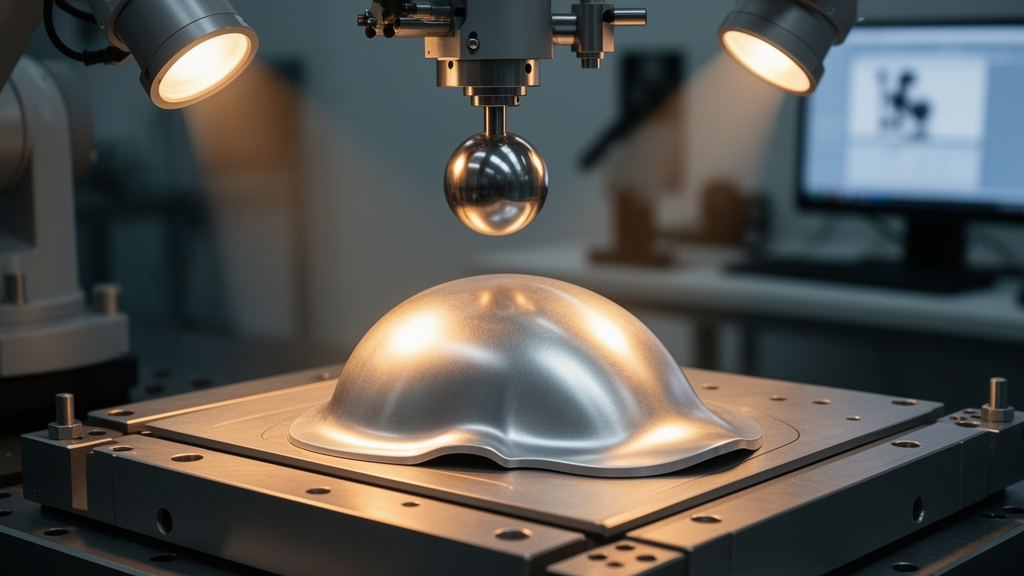
A hybrid experimental and numerical investigation has established an advanced warm single point incremental forming framework capable of shaping perforated AZ31B magnesium alloy sheets into high-precision, patient-specific cranial implants. The study demonstrates that performing incremental sheet forming at an elevated temperature of 400 °C effectively overcomes the severe room-temperature formability constraints typical of magnesium alloys, enabling deep plastic deformation without premature material failure. Through systematic parameter selection, the researchers identified that combining a 12 mm tool diameter with a 3.5 mm sheet perforation diameter yields an optimal balance of maximum fracture depth and superior surface smoothness. When applied to real-world anatomical profiles derived from clinical cranial scans, an optimized zig-zag toolpath strategy produced skull rebuilding plates exhibiting minimal dimensional deviation and refined surface topography, establishing a reliable pathway for manufacturing customized biodegradable implants.
Biodegradable magnesium alloys such as AZ31B have garnered substantial interest in cranial reconstruction and neurosurgery because of their favorable specific strength-to-weight ratio and ability to gradually degrade within the biological environment. Moreover, traditional sheet forming techniques such as stretch forming require expensive, part-specific solid dies that are economically impractical for customized, patient-specific geometries needed after craniotomy. Single point incremental forming provides a die-less alternative that deforms sheets progressively using a simple spherical forming tool, but forming perforated magnesium sheets reliably requires rigorous thermal management and process parameter control.
To rigorously evaluate the baseline properties of the incoming material, the investigators conducted uniaxial tensile testing on 1 mm thick AZ31B sheets according to ASTM E8 sub-sized standards. Because rolling processes induce distinct crystallographic textures and grain elongation, tensile test specimens were cut along three primary orientations: 0°, 45°, and 90° relative to the rolling direction. The resulting engineering stress-strain data confirmed substantial in-plane mechanical anisotropy, which directly governs how slip systems and twinning mechanisms activate under multiaxial tension. Optical microscopy of the as-received alloy revealed a uniform microstructure composed of equiaxed grains and established a baseline Vickers microhardness of 64.66 N/mm².
The initial stage of optimization examined formability and surface quality using a varying wall angle conical frustum geometry mapped across a response surface methodology D-optimal design matrix. Testing twelve distinct parametric runs at 400 °C revealed that both the tool diameter and hole diameter strongly govern forming performance. Specifically, increasing the hole diameter from 2.5 mm to 3.5 mm while operating with a 12 mm tool allowed the sheet to reach a maximum fracture depth of 11.2 mm and an ultimate wall angle of failure of 57.9°. In sharp contrast, decreasing the tool diameter to 8 mm alongside smaller 2.5 mm perforations caused early failure at a shallow depth of 7.2 mm and a wall angle of 52.41°. The mechanical cause was traced to the contact dynamics: smaller spherical tools generate concentrated local indentation and higher friction against smaller holes, increasing resistance to deformation. Larger tools, conversely, produce smaller peak-and-valley cusps across the formed sheet, lowering the arithmetical mean surface roughness to 0.948 µm compared to 4.982 µm recorded under smaller tool configurations.
To uncover the internal mechanics governing sheet behavior during forming, the researchers constructed a high-fidelity finite element simulation utilizing the commercial Abaqus solver. The numerical model incorporated the Johnson-Cook plasticity formulation to capture strain, strain rate, and temperature dependencies, paired with a Johnson-Cook progressive damage model to trace stiffness degradation toward fracture. In the simulations, the sheet was meshed with solid continuum elements while the hemispherical forming tool was represented as a rigid body following helical coordinates generated in computer-aided manufacturing software. The numerical model accurately reproduced the experimentally observed trends, predicting an 11 mm fracture depth for the optimal 12 mm tool and 3.5 mm hole combination.
The numerical stress and strain analysis illuminated why larger tools improve forming stability across perforated magnesium sheets. Von Mises stress evaluations demonstrated that increasing tool diameter from 8 mm to 12 mm consistently decreased localized stress peaks across the frustum wall, because the broader tool surface area distributes deformation forces over a wider contact zone, mitigating extreme localized stress concentrations. While widening the perforation diameter from 3 mm to 3.5 mm produced a minor increase in von Mises stress due to altered contact interactions at the hole edges, it enabled the material to accommodate plastic strain through enhanced dislocation glide along crystallographic planes, preventing premature localized necking and enabling higher overall forming depths.
Thermal and microstructural analyses revealed that warm forming at 400 °C fundamentally alters the internal crystalline structure of the AZ31B alloy. In contrast to the initial equiaxed grains of the base material, optical micrographs from the deformed zones demonstrated pronounced grain elongation along with localized grain coarsening. Crucially, the combination of elevated thermal exposure and severe plastic straining triggered dynamic recrystallization, wherein new, refined grains nucleated and grain boundary mobility increased. As dynamic recrystallization progressed, newly formed grain boundaries absorbed moving dislocations, facilitating sustained plastic flow while alleviating excessive internal stresses. Following warm forming, the Vickers microhardness rose to an average of 81 N/mm², representing a 20.17% increase relative to the unformed base material. This strengthening was attributed to the combined effects of grain boundary modification, dislocation interactions, and residual strain hardening that survived thermal exposure.
Translating these findings to surgical geometry, the investigators utilized patient-specific cranial defect models acquired from hospital computed tomography scans stored in digital imaging and communication in medicine format. After reconstructing the anatomical cranial contour into standard triangle language and parametric computer-aided design models, experimental trials were conducted on perforated AZ31B blanks using an L9 orthogonal array. The team compared three distinct toolpath strategies: follow-part, follow-periphery, and zig-zag passes across varying step depths and feed rates. Both the follow-part and follow-periphery paths, which traverse full contours in single passes, caused abrupt localized stretching, severe elastic springback, and noticeable dimensional errors. In contrast, the zig-zag toolpath, which deforms the sheet progressively layer-by-layer along back-and-forth contour lines before descending in depth, distributed strains evenly and controlled material flow effectively.
Dimensional accuracy and surface integrity evaluations of the fabricated cranial plates confirmed the superiority of the optimized incremental forming parameters. Three-dimensional non-contact optical scanning matched the formed implant profiles against nominal design models, revealing that Run 8, executed with a zig-zag toolpath, a 0.2 mm step depth, and a 250 mm/min feed rate, achieved the highest geometrical accuracy with a minimum dimensional error of 5.41%. The physical implants reached a forming depth of 6 mm, closely mirroring the 6.2 mm depth predicted by finite element simulations. Surface roughness measurements recorded an arithmetical mean roughness as low as 1.14 µm under mild forming conditions, whereas aggressive step depths of 0.6 mm produced elevated roughness reaching 2.95 µm due to tool deflection and chatter. By integrating controlled localized heating, numerical damage modeling, and toolpath refinement, the study provides a robust manufacturing methodology for producing patient-matched, biodegradable cranial implants.
Subject of Research: Heat-assisted single point incremental forming of perforated biodegradable magnesium alloy cranial implants
Article Title: Advanced heat-assisted flexible forming of perforated AZ31B magnesium alloy: a hybrid experimental–numerical study for high-precision biocompatible cranial implant fabrication
Article References: Choudhary, S., Gurpude, R., & Mulay, A. (2026). Advanced heat-assisted flexible forming of perforated AZ31B magnesium alloy: a hybrid experimental–numerical study for high-precision biocompatible cranial implant fabrication. Journal of Materials Science: Materials in Medicine, 37(1), Article 81. https://doi.org/10.1007/s10856-026-07044-z
Image Credits: AI Generated
DOI: 10.1007/s10856-026-07044-z
Keywords: AZ31B magnesium alloy, single point incremental forming, cranial implants, biomaterials, biodegradable metals, warm sheet forming, finite element analysis, Johnson-Cook model, surface roughness, dimensional accuracy, dynamic recrystallization, microstructure, Vickers microhardness, plastic equivalent strain, von Mises stress, sheet metal forming, biomedical engineering
News Source: Ophelia Keating. (November 20, 2026). Warm Incremental Sheet Forming Produces Accurate Biodegradable Cranial Implants from Magnesium. Scienmag.