A research team led by scientists from Nanjing University, The Hong Kong Polytechnic University, and Shaoxing University has engineered a ferroelectric vertical organic field-effect transistor that integrates an optical reservoir and an electrical readout into a single physical platform. Reported in Light: Science & Applications, the device architecture addresses a long-standing physical conflict in neuromorphic hardware by combining volatile, multi-timescale temporal mapping with linear, nonvolatile conductance programming. In experimental demonstrations, the dual-mode platform successfully compressed dynamic motion data to achieve 97.2 percent accuracy in traffic trajectory recognition and exceeded 90 percent accuracy in human action classification.
Dynamic visual computing tasks, such as tracking moving vehicles or interpreting complex human motion, present severe computational challenges for conventional machine vision architectures. Standard deep neural networks process temporal sequences through massive arrays of trainable parameters, resulting in elevated energy consumption and computational latency that limit their deployment on compact edge hardware. Reservoir computing offers a lower-complexity alternative by projecting time-dependent signals into high-dimensional dynamic state spaces using a fixed reservoir, leaving only a simple linear readout layer to be trained for final classification.
Direct hardware realization of reservoir computing has historically been constrained by diametrically opposed physical requirements between the system components. A functional reservoir requires volatile, nonlinear responses capable of sustaining a fading physical memory of incoming temporal sequences. Conversely, the classification readout demands highly linear, symmetric, and nonvolatile memory states to retain synaptic weight programming accurately over time without drift.
To overcome this trade-off, the researchers designed a ferroelectric vertical organic field-effect transistor, designated as Fe-vOFET, that operates under two orthogonally regulated functional modes. The platform incorporates a vertical transistor geometry coupled with a specialized ferroelectric gate stack. Optically driven inputs utilize photocarrier dynamics across an organic heterojunction to emulate transient reservoir behavior, while electrically driven inputs manipulate ferroelectric polarization to establish nonvolatile conductance states, allowing both operations to be optimized independently within the same nanoscale device footprint.
In the optical reservoir operating mode, the device utilizes a Rubrene/F16CuPc organic heterojunction that exhibits wavelength-dependent relaxation dynamics upon exposure to optical pulses. Because different optical wavelengths produce distinct photocarrier recombination rates and fading-memory timescales, a single physical transistor can generate multi-timescale sub-reservoirs. This wavelength-multiplexed configuration enriches the temporal feature space, substantially improving the system’s capacity to separate and categorize complex sequential optical inputs without requiring additional physical hardware nodes.
In the electrical readout mode, the device employs a metal-ferroelectric-metal-insulator-semiconductor gate stack to translate reversible ferroelectric polarization into precise conductance adjustments. The gate architecture yields linear, symmetric, and nonvolatile conductance updates essential for stable artificial neural network training. Furthermore, the short channel inherent to the vertical transistor structure provides a high electrical on/off ratio of approximately ten million, establishing a wide conductance window that ensures accurate weight programming and reliable inferencing.
Material characterization confirmed robust nonvolatile memory endurance and data retention in the vertical platform. The device demonstrated retention stability exceeding 3,000 seconds alongside continuous switching endurance across more than one million electrical cycles. Simultaneously, the vertical geometry amplified transient photoresponses by enhancing optical feedback within the compact channel, sustaining the sensitivity required for rapid front-end temporal processing.
The researchers verified the practical utility of the dual-mode architecture across two standard visual benchmark tasks. In a traffic-trajectory recognition evaluation, the bio-inspired vision platform compressed incoming motion trajectories into a single spatiotemporal frame, delivering a 97.2 percent recognition accuracy that outperformed traditional frame-by-frame visual sensing. Additionally, when evaluated on human action recognition using the Weizmann benchmark dataset, the multi-wavelength grouped reservoir computing framework achieved an accuracy surpassing 90 percent, demonstrating the functional advantage of multi-timescale physical reservoir dynamics for motion interpretation.
By unifying volatile multi-timescale optical dynamics and nonvolatile electrical weight storage in a single vertical transistor, the platform provides a device-level pathway to bypass the trade-offs inherent to conventional reservoir computing hardware. The authors forecast that this orthogonally regulated strategy could accelerate the development of compact, energy-efficient, and adaptive dynamic machine vision systems for edge artificial intelligence and autonomous monitoring applications.
The research was directed by Professor Yun Li and Professor Yi Shi of Nanjing University, Dr. Mengjiao Pei from The Hong Kong Polytechnic University, and Professor Bo Yao from Shaoxing University. In their experimental design, the reconfigurable photoelectric platform coordinates a front-end optical reservoir for nonlinear temporal mapping with a back-end artificial neural network readout for classification. During optical operation, broadband light excitation stimulates wavelength-dependent relaxation across the device, establishing enriched dynamic states that enable multi-wavelength grouped reservoir computing to separate complex input sequences.
The scientists explained that utilizing photocarrier dynamics creates a volatile optical reservoir, whereas reversible ferroelectric polarization independently programs the nonvolatile electrical readout. By separating these mechanisms within a single vertical geometry, the opposing device requirements of reservoir computing can be individually tuned. The team noted that this architecture provides a practical framework for robotics, autonomous driving, and intelligent surveillance, where recognizing dynamic visual information has traditionally overwhelmed compact hardware.
Subject of Research: Neuromorphic ferroelectric vertical organic transistor for dynamic machine vision
Article Title: A vertical transistor for compact dynamic machine vision
Article References: A vertical transistor for compact dynamic machine vision. Original publication (Bibliographic details unavailable.)
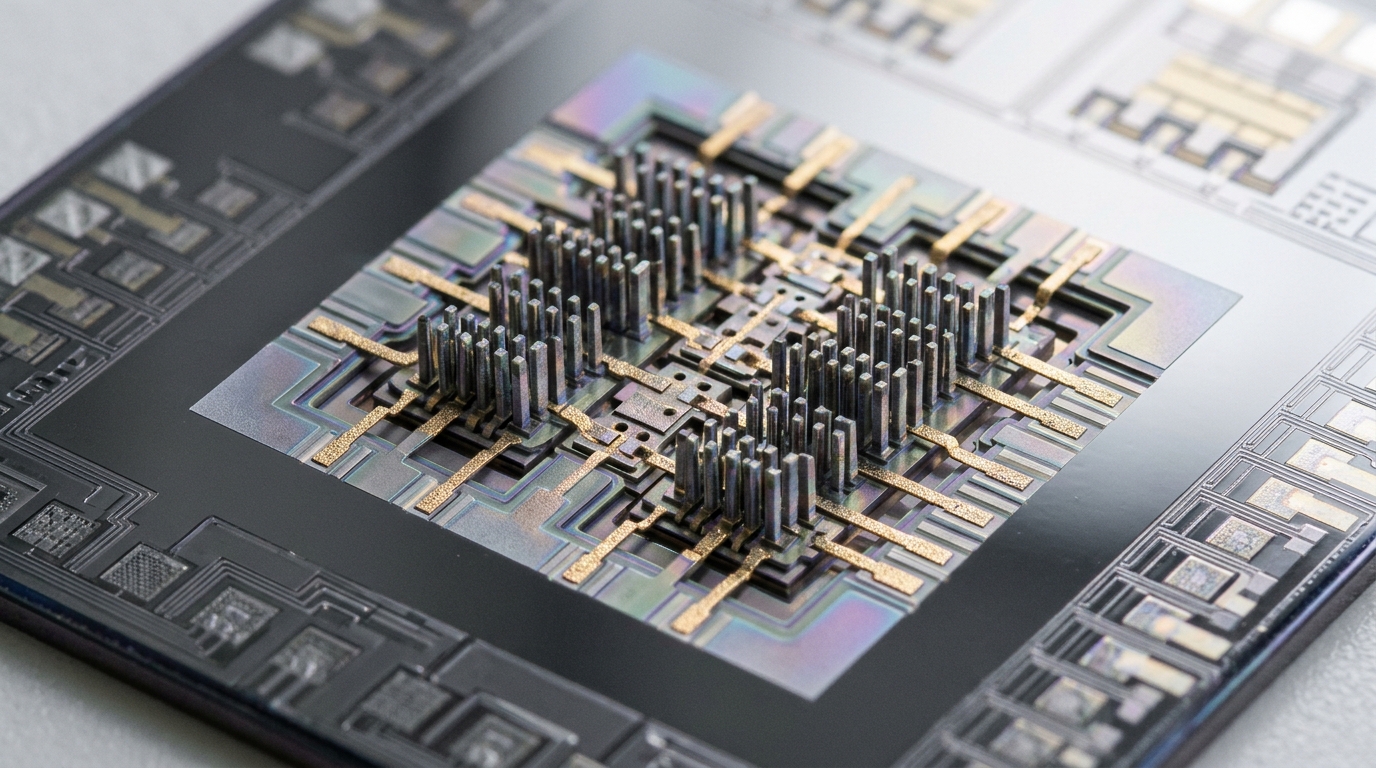
Image Credits: AI Generated
DOI: Not provided
Keywords: reservoir computing, organic transistors, ferroelectric memory, machine vision, neuromorphic computing, edge computing, photocarrier dynamics, optical computing, spatiotemporal processing, action recognition, vertical field-effect transistor, heterojunction, Fe-vOFET, Weizmann dataset, traffic trajectory recognition, analog computing
News Source: Elena Sutton. (November 20, 2026). Dual-Mode Ferroelectric Vertical Transistor Boosts Dynamic Machine Vision Processing. Scienmag.