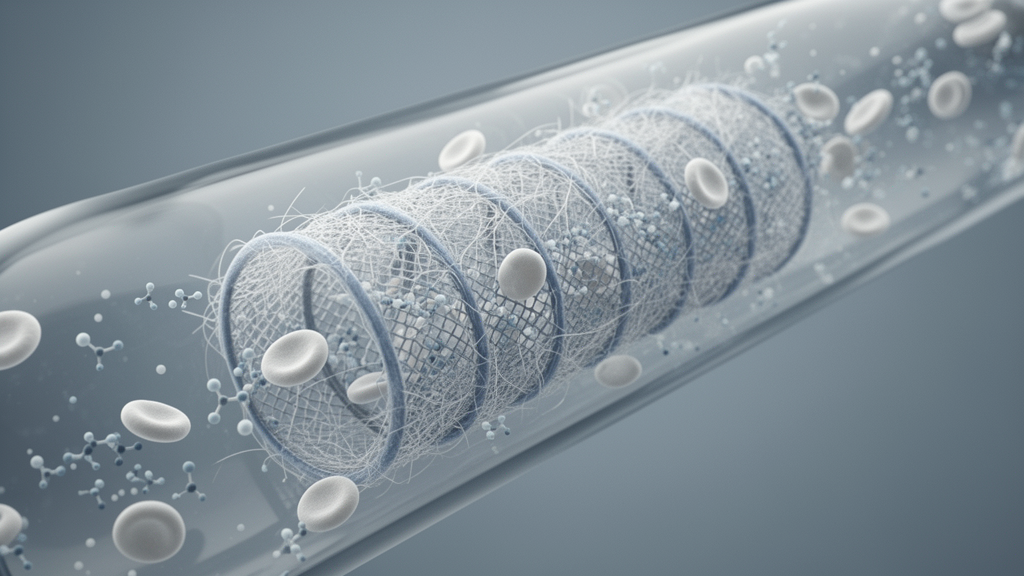
An in vitro investigation in the Journal of Materials Science: Materials in Medicine reveals that flow diverters coated with a natural fibrin and heparin matrix elicit significantly less leukocyte and complement activation than devices bearing synthetic poly(2-methoxyethyl acrylate) nanocoatings, while matching their capacity to suppress thrombotic reactions. The study evaluated neurovascular flow diverters using a dynamic Chandler loop model to examine biological responses when fresh human whole blood contacts engineered surfaces. Flow diverters represent an essential endovascular therapy for intracranial aneurysms by bridging the arterial defect, modifying hemodynamics, and inducing thrombosis within the aneurysm sac. However, because their densely braided wire mesh introduces substantial foreign material into the cerebral circulation, these permanent implants can provoke adverse thromboembolic complications and acute inflammatory reactions. To mitigate these clinical risks, engineers have developed specialized surface coatings to shield struts from circulating blood, making comparative biocompatibility evaluations vital for patient care.
Intracranial aneurysms represent localized dilations of cerebral vessels that remain primarily asymptomatic until instability causes rupture. Rupture precipitates subarachnoid hemorrhage, a severe stroke accounting for approximately five percent of all strokes worldwide. Epidemiological assessments estimate an overall aneurysmal subarachnoid hemorrhage incidence of roughly 6.67 cases per 100,000 person-years, with heightened prevalence among older women in Europe and Japan. Surveillance data from 1990 to 2021 show that although recorded subarachnoid hemorrhage incidence rose over recent decades, age-standardized mortality and disability-adjusted life-year rates declined, reflecting interventional advances. Following the introduction of surgical clipping in 1937, neurovascular practice shifted toward endovascular therapies guided by international trials. Endovascular flow diverters utilize high-density mesh scaffolds placed across the parent artery to alter inflow and outflow hemodynamics, promoting thrombosis in the aneurysm sac while parent artery architecture is reconstructed through neointimal tissue overgrowth.
Because flow diverters require a remarkably dense metal braid to disrupt arterial inflow, they introduce substantially greater foreign surface area into the vessel lumen than traditional laser-cut neurovascular stents. This prominent blood-material contact zone can provoke a foreign body response, initiating platelet activation, contact pathway triggering, and inflammatory leukocyte recruitment that may lead to device occlusion or ischemic stroke. Device manufacturers have therefore developed diverse surface functionalization strategies to enhance device hemocompatibility. For example, Medtronic employs a cell membrane-mimicking phosphorylcholine coating on the Pipeline Flex Shield, while Phenox GmbH applies a hydrophilic polymer coating to mimic endothelial glycocalyx on its p48 MW and p64 MW devices. In another approach, Terumo Neuro utilizes X-technology based on a covalently bound nanoscale layer of poly(2-methoxyethyl acrylate), or PMEA, creating a hydrated interface that limits protein adsorption. In contrast, Acandis GmbH introduced HEAL technology on the DERIVO 2heal, utilizing a fully polymerized fibrin network with covalently bound heparin to suppress thrombosis and inflammation while promoting endothelialization.
To evaluate these surface modification technologies, researchers conducted an in vitro study using a dynamic Chandler loop model in accordance with ISO 10993-4 standards for medical device hemocompatibility. Whole human blood was drawn via venipuncture from five healthy, non-medicated donors under an ethics protocol approved by the University of Tuebingen, with written informed consent obtained from all subjects. Blood samples were collected into tubes containing 1.5 international units per milliliter of sodium heparin, a low anticoagulant concentration chosen to prevent spontaneous coagulation while preserving sensitive cellular and biochemical activation cascades. The investigation tested three commercial flow diverter configurations: the FRED X 27 measuring 4.5 by 25 millimeters from Terumo Neuro, the uncoated DERIVO 2 measuring 4.5 by 20 millimeters from Acandis GmbH, and the fibrin/heparin-coated DERIVO 2heal measuring 4.5 by 20 millimeters from Acandis GmbH. Individual flow diverters were deployed into 50-centimeter polyvinyl chloride tubes, anchored securely with proximal cable ties, filled with 12 milliliters of fresh whole blood, closed into continuous loops, and rotated dynamically at 30 revolutions per minute at 37 degrees Celsius for 60 minutes.
Baseline blood measurements were gathered immediately following venipuncture without loop incubation, while identical empty polyvinyl chloride loops carrying 12 milliliters of blood served as negative controls. After dynamic rotation, blood plasma was isolated via centrifugation, shock-frozen in liquid nitrogen, and stored at minus 80 degrees Celsius. Hematological parameters, including platelet, erythrocyte, and leukocyte counts, as well as hematocrit and hemoglobin concentrations, were quantified on an automated Micros 60 hematology analyzer. Erythrocyte membrane disruption was evaluated through cyanmethemoglobin spectrophotometry, measuring plasma optical absorption at 540 and 680 nanometers to determine free hemoglobin. Specific enzyme-linked immunosorbent assay kits were utilized to measure biochemical activation markers: thrombin-antithrombin III complexes for coagulation cascade activation, beta-thromboglobulin for platelet granule secretion, terminal SC5b-9 complex for complement activation, and PMN-elastase-alpha1-proteinase inhibitor complexes for leukocyte activation. Following incubation, stents were fixed in glutaraldehyde, dehydrated in graded ethanol, critical-point dried, gold-sputtered, and imaged with scanning electron microscopy. Statistical evaluations were performed using one-way repeated measures analysis of variance with Tukey post-hoc tests after outlier screening.
Analysis of hematological parameters showed that leukocyte counts, erythrocyte counts, hemoglobin levels, and hematocrit percentages remained unchanged across all flow diverter groups and control conditions. Free hemoglobin measurements indicated a slight increase in hemolysis for blood exposed to DERIVO 2heal and FRED X devices compared with baseline, but levels did not differ significantly from the empty control tube, confirming erythrocyte compatibility. In contrast, platelet measurements revealed marked differences. The uncoated DERIVO 2 flow diverter caused a statistically significant drop in platelet counts compared with baseline and empty control loops, indicating substantial platelet adhesion to the bare metal struts. Blood incubated with the FRED X flow diverter also exhibited a significant platelet reduction relative to baseline, but showed no statistically significant difference compared with the control tube. Scanning electron microscopy confirmed these patterns: uncoated DERIVO 2 devices displayed widespread platelet adhesion and dense fibrin networks across their struts, whereas DERIVO 2heal and FRED X surfaces exhibited only isolated, minor deposits, leaving the majority of the stent surface free from material adhesion.
Enzyme-linked immunosorbent assays tracking thrombotic pathways demonstrated robust anti-thrombogenic performance for both surface coatings. When blood encounters artificial biomaterials, Factor XII undergoes autoactivation into Factor XIIa, triggering the intrinsic coagulation cascade and stimulating prothrombinase assembly, which generates active thrombin. Active thrombin induces platelet secretion of beta-thromboglobulin and forms thrombin-antithrombin III complexes upon neutralization by circulating serpins. In this study, the uncoated DERIVO 2 flow diverter provoked significant elevations in both beta-thromboglobulin and thrombin-antithrombin levels compared with baseline, empty control loops, and both coated devices, indicating marked activation of platelets and the coagulation cascade. In sharp contrast, both the fibrin/heparin-coated DERIVO 2heal and the PMEA-coated FRED X flow diverters effectively suppressed thrombin generation and platelet degranulation. Both coated implants maintained beta-thromboglobulin and thrombin-antithrombin concentrations comparable to empty control tubes. These quantitative measurements show that the biological fibrin/heparin matrix of the DERIVO 2heal matches the synthetic PMEA nanolayer of the FRED X in preventing blood coagulation and platelet activation under dynamic circulation.
Although the two coated devices exhibited similar antithrombotic performance, the study uncovered pronounced differences in complement and leukocyte activation. The terminal complement complex SC5b-9 serves as a sensitive indicator of complement cascade triggering, while PMN elastase release reflects neutrophil granulocyte activation and inflammatory degranulation. Blood circulated through the FRED X flow diverter exhibited statistically significant elevations in both SC5b-9 and PMN elastase compared with unincubated baseline blood and empty control loops. In contrast, blood exposed to the fibrin/heparin-coated DERIVO 2heal exhibited significantly lower levels of both SC5b-9 and PMN elastase than blood exposed to the FRED X diverter. Furthermore, samples incubated with either the uncoated DERIVO 2 or the coated DERIVO 2heal yielded SC5b-9 and PMN elastase concentrations that did not differ significantly from empty control tubes, reflecting a very low immune response across the DERIVO platform. Because activated leukocytes release pro-inflammatory and pro-coagulant mediators while downregulating endogenous fibrinolysis, the lower complement and leukocyte activation observed with the DERIVO 2heal surface could offer a distinct biological advantage over PMEA coatings.
In addition to coating chemistry, structural distinctions between the implants may influence biological reactions. The FRED X features a dual-layer mesh architecture with an 18-millimeter inner working length and a 25-millimeter total length when deployed in a 4.5-millimeter vessel. The DERIVO 2heal utilizes a single braided mesh layer with a nominal length of 20 millimeters. Due to its dual-layer design, the FRED X presents a larger effective metal surface area than the single-braided DERIVO 2heal, exposing more foreign material to circulating blood. The authors contextualized these laboratory findings against published clinical studies. Registries for uncoated DERIVO devices documented complete occlusion rates between 75 and 89.2 percent, adequate occlusion between 89 and 100 percent, and ischemic complication rates from 0.56 to 4.2 percent. Early evaluation of the DERIVO 2heal demonstrated 80.7 percent adequate occlusion at 6.6 months with 4.8 percent minor ischemic complications, and 91.7 percent complete occlusion under single antiplatelet therapy at 14.5 months. For FRED and FRED X devices, clinical studies reported adequate occlusion between 83.9 and 88.9 percent and stroke rates between 2.86 and 3.77 percent.
The researchers emphasized critical limitations and scope constraints inherent to their experimental model. Because the study utilized an in vitro Chandler loop system with blood from five healthy donors rotated for 60 minutes, the findings reflect acute blood-material interactions under closed non-physiological conditions rather than long-term clinical vessel biology. Closed loop systems cannot replicate physiological arterial pulse waveforms, sustained systemic hemodynamics, or cellular healing mechanisms such as endothelialization and neointimal tissue remodeling. Furthermore, differences in stent geometry and surface area between single-layer and dual-layer configurations complicate direct attribution of inflammatory differences solely to surface chemistry. Consequently, the authors conclude that these in vitro observations must be validated in relevant in vivo models to assess endothelialization, neointimal formation, and inflammation under true physiological flow. Comparative clinical trials will ultimately be required to confirm whether the reduced leukocyte and complement activation observed with the fibrin/heparin coating translates into lower rates of thromboembolic and inflammatory complications in human patients.
Subject of Research: Hemocompatibility comparison of coated flow diverters for intracranial aneurysm treatment
Article Title: Comparative hemocompatibility assessment of fibrin/heparin-coated and PMEA-coated flow diverters
Article References: Wei, H., Riedel, T., Riedelová, Z., Wolf, M., Schlensak, C., & Avci-Adali, M. (2026). Comparative hemocompatibility assessment of fibrin/heparin-coated and PMEA-coated flow diverters. Journal of Materials Science: Materials in Medicine, 37(1), Article 77. https://doi.org/10.1007/s10856-026-07087-2
Image Credits: AI Generated
DOI: 10.1007/s10856-026-07087-2
Keywords: flow diverters, DERIVO 2heal, FRED X, DERIVO 2, intracranial aneurysms, hemocompatibility, Chandler loop model, heparin coating, fibrin coating, poly(2-methoxyethyl acrylate), thrombin-antithrombin complex, beta-thromboglobulin, SC5b-9 complement complex, PMN elastase, subarachnoid hemorrhage, platelet activation, endovascular treatment, scanning electron microscopy
News Source: Ophelia Keating. (November 20, 2026). Fibrin and Heparin Flow Diverters Reduce Lab Complement and Leukocyte Activation. Scienmag.