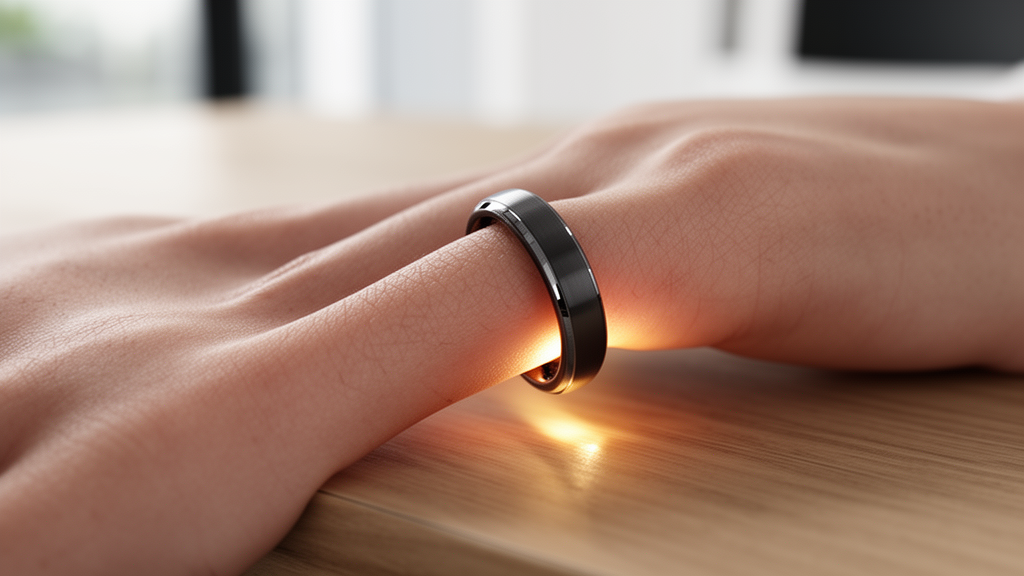
A team of engineers at the University of Southern California has developed a wearable, AI-powered smart ring that monitors stress in real time by measuring subsurface sweat gland dynamics with light. Described in a peer-reviewed study published in Science Advances under the title “All-optical sensing of dermal activity enables an AI-powered wearable ring for continuous stress monitoring,” the device introduces an optical approach that outperforms conventional electrode-based sensors in tracking physiological stress responses.
Stress affects millions of individuals across the globe and is linked to widespread health challenges ranging from depression and anxiety to cardiovascular disease. Despite its severe impact on human health, scientists and medical researchers have long struggled to measure stress continuously, noninvasively, and reliably outside controlled laboratory settings.
Contemporary wearable stress monitors, including commercially available devices such as the Fitbit Sense, typically depend on electrodermal activity, or EDA. This established method evaluates stress by tracking changes in electrical skin conductance driven by sweat gland activity. However, conventional EDA systems require electrodes to maintain continuous, stable contact with the skin, frequently relying on conductive gels that dry out over time. Physical movement and shifting skin contact routinely distort these electrical measurements, severely degrading their accuracy during extended wear.
To overcome these persistent mechanical and physiological hurdles, the USC research team sought an alternative detection mechanism based entirely on light. The project was led by Yasser Khan, an assistant professor and Andrew and Erna Viterbi Early Career Chair in the USC Viterbi School of Engineering and the Ming Hsieh Department of Electrical and Computer Engineering, alongside his doctoral student Md Farhad Hassan. Khan, who also holds joint appointments in the Alfred E. Mann Department of Biomedical Engineering and heads the Khan Lab, initially launched the research as a side project two years ago.
The optical detection platform operates by tracking the body’s immediate autonomic reactions to psychological pressure. When an individual experiences stress, the sympathetic nervous system stimulates eccrine sweat glands, producing microscopic changes in sweat volume beneath the skin surface well before visible perspiration forms. Inspired by photoplethysmography (PPG)—the optical technique smartwatches use to evaluate blood flow—the researchers hypothesized that specific wavelengths of light could similarly register subsurface sweat gland dynamics.
The researchers coined the term “optodermal activity,” or ODA, to describe this light-based sensing framework. The ring integrates two near-infrared light-emitting diodes: one emitting at 960 nanometers, a wavelength sensitive to fluctuations in water content linked to sweat, and a second emitting at 1,250 nanometers to serve as an optical reference. By comparing the differential reflection of these two wavelengths within skin tissue, the ring precisely tracks subsurface sweat activity without requiring conductive gels or skin-contact electrodes.
To translate this optical principle into a functional wearable, the team engineered a compact, flexible electronic architecture capable of multimodal biometric sensing. In addition to measuring optodermal activity, the ring’s optical assembly simultaneously collects photoplethysmography data, capturing vital cardiovascular metrics such as heart rate and heart rate variability. The hardware also integrates an onboard accelerometer and a temperature sensor, supplying essential physical context to separate psychological stress from movement artifacts and ambient heat.
In controlled experimental stress tests, signals gathered by the optodermal ring demonstrated an average 86 percent agreement over time with readings from a commercial, gel-based EDA system, confirming its ability to mirror established physiological benchmarks. During short-term trials distinguishing stress from relaxation, the optical ring achieved an accuracy rate exceeding 90 percent, whereas conventional EDA attained less than 78 percent accuracy.
When the evaluation was expanded to distinguish among four distinct physiological states—psychological stress, relaxed rest, physical movement, and heat-induced sweating—the optical ring achieved 100 percent accuracy in the study’s test protocol, compared with 75 percent for the electrode-based EDA sensor. The ring’s motion-resistant dual-modality sensing and contextual data streams enabled it to isolate stress-induced autonomic responses from physical exertion and thermal sweating.
The performance divergence between the two modalities widened substantially during long-term monitoring. After 12 hours of continuous wear, the conductive gel in the conventional EDA sensor dried, destabilizing its contact and causing its classification accuracy between stress and relaxation to plummet to 57 percent. In contrast, the optodermal ring operated without gel or conductive degradation, maintaining an accuracy of approximately 80 percent across the same extended observation window.
Data processing is managed locally on the ring through embedded Edge AI architecture. By executing machine learning models directly on the wearable rather than streaming raw biometric signals to external cloud servers, the device classifies physiological states with minimal latency while safeguarding sensitive personal data directly on the user’s finger.
Continuous optical tracking offers substantial implications for personal wellness and clinical healthcare. Co-author Adam Frank, an assistant professor of Clinical Psychiatry and the Behavioral Sciences at the Keck School of Medicine of USC, noted that continuous stress monitoring with a wearable ring could significantly advance precision psychiatry by capturing granular daily stress fluctuations rather than relying on sporadic clinic check-ins or subjective self-reporting.
Looking ahead, Khan plans to validate the technology through a yearlong study involving 40 participants in an office setting, collaborating with Burçin Becerik-Gerber, chair of the Sonny Astani Department of Civil and Environmental Engineering, and co-investigator Gale Lucas from the USC Institute for Creative Technologies. The team is also working to mitigate signal interference from heavy surface perspiration and expanding testing across broader cognitive and psychosocial stressors. Meanwhile, the underlying technology is undergoing patent review under a pending application filed by USC, with commercial licensing managed through USC’s Stevens Center for Innovation.
Khan highlighted the fundamental simplicity behind the team’s optical sensing framework, explaining that their primary objective was to observe subtle sweat activity beneath the skin using light. Although photoplethysmography has long served as an established mechanism in commercial smartwatches to track cardiovascular blood flow optically, applying dedicated wavelengths of light to evaluate autonomic sweat responses represents a major technological shift. By demonstrating that stress can be directly quantified through optical reflection rather than electrical skin conductance, the USC researchers established optodermal activity as a practical alternative to conventional electrodermal sensing. This shift addresses the core limitation of existing wearable systems, which have historically struggled to maintain uninterrupted, dependable physiological tracking during routine daily wear.
The physical implementation of the optodermal ring relies on the differential absorption and reflectance properties of two distinct near-infrared wavelengths. By directing light at 960 nanometers into the tissue, the system specifically tracks fluctuations in water volume within the eccrine sweat glands, while the secondary 1,250-nanometer emitter provides an unaffected reference baseline. Because both optodermal activity and photoplethysmography are acquired through this unified optical array, the device synchronously gathers sweat gland dynamics alongside cardiovascular parameters, including heart rate and heart rate variability. When combined with localized temperature readings and continuous accelerometer data, this integrated multi-sensor architecture enables the wearable to systematically isolate genuine sympathetic nervous system arousal from thermal sweating or physical body motion.
The integration of on-device machine learning represents a critical engineering breakthrough in transforming the multi-sensor assembly into an autonomous wearable platform. Rather than transmitting uncompressed physiological signals across wireless connections to external computing servers or cloud infrastructure, the ring processes all sensory streams locally through embedded Edge AI. This localized classification minimizes processing latency, providing immediate real-time determination of physiological states while preventing sensitive personal biometric data from leaving the physical hardware. The ability to perform high-accuracy classification directly on the finger ensures that the continuous monitoring framework remains robust, motion-resistant, and operationally viable without constant dependence on external processing pipelines.
Continuous tracking throughout daily routines offers valuable investigative possibilities that extend well beyond personal wellness measurements. Unlike periodic clinical consultations or subjective self-evaluation questionnaires, uninterrupted wearable monitoring captures how physiological stress naturally fluctuates across full days, uncovering subtle behavioral patterns that would otherwise escape clinical notice. Over extended periods, these continuous observational data can help investigators assess how persistent stress impacts mental focus, cognitive performance, and general personal well-being. Furthermore, understanding these daily physiological dynamics enables researchers to explore how physical and institutional environments can be modified to foster healthier, less stressful, and more productive working conditions.
From a clinical standpoint, co-author Adam Frank noted that continuous stress monitoring facilitated by a compact wearable ring holds significant promise for advancing the practice of precision psychiatry. To transition the prototype into broader practical validation, Khan and his research team have structured an extensive, yearlong workplace investigation. Conducted in collaboration with Burçin Becerik-Gerber of the Sonny Astani Department of Civil and Environmental Engineering and Gale Lucas of the USC Institute for Creative Technologies, the forthcoming study will observe 40 human participants within an active office environment to evaluate the sensor’s real-world operational durability.
In parallel with upcoming field investigations, the researchers are refining the physical platform to overcome specific environmental constraints, notably working to minimize signal distortion caused by excessive accumulation of surface perspiration. The engineering team also intends to broaden their testing protocols across a diverse spectrum of cognitive and psychosocial stressors. Ultimately, Khan envisions advancing unobtrusive wearable devices that uncover deeper connections linking brain function, physiological responses, and human behavior. Commercial development of the underlying technology is supported through the USC Stevens Center for Innovation, with intellectual property formally documented in a pending United States provisional patent application titled “Optodermal Wearable Device for Contactless Stress Monitoring” under serial number 63/928,394, filed by the university in December 2025.
Subject of Research: AI-powered wearable ring for continuous optical stress monitoring
Article Title: USC engineers develop AI-powered ring that detects stress with light
Article References: USC engineers develop AI-powered ring that detects stress with light. Original publication (Bibliographic details unavailable.)
Image Credits: AI Generated
DOI: Not provided
Keywords: optodermal activity, wearable technology, stress monitoring, near-infrared sensing, eccrine sweat glands, photoplethysmography, edge AI, electrodermal activity, smart ring, cardiovascular monitoring, heart rate variability, precision psychiatry, University of Southern California, Science Advances, on-device processing, sympathetic nervous system, biometric sensing
News Source: Denise Maddox. (November 19, 2026). AI-Powered Wearable Ring Tracks Stress by Measuring Subsurface Sweat With Light. Scienmag.