In an experimental study published in Advanced Materials, researchers at the Center for Multidimensional Carbon Materials within the Institute for Basic Science demonstrated that direct electrical current can be applied to solid metals to guide the transport of carbon atoms and induce graphite formation at designated locations. By applying direct current across bars of cobalt and nickel, the research team mobilized carbon atoms dissolved within the solid metal host and prompted them to precipitate into organized graphite deposits away from the initial carbon source. Beyond controlling where the material formed, the electrically biased transport mechanism selectively concentrated lighter carbon isotopes and produced measurable variations in the finished graphite’s thermal conductivity.
The experimental approach repurposes electromigration, a physical phenomenon that has historically posed a persistent obstacle to the reliability of microelectronic devices. In conventional electronic circuitry, high current densities gradually displace atoms inside small metallic interconnects, creating voids and unwanted elemental accumulations that eventually lead to circuit failure. While industrial engineering efforts have focused on suppressing this movement to protect microcircuits, the IBS research team explored whether the same electromigration force could serve as a constructive synthesis tool, directing the flow of atoms through a solid lattice under continuous electrical control rather than allowing random, uncontrolled migration.
To investigate directional carbon movement, the researchers took advantage of the behavior of carbon in cobalt and nickel at elevated temperatures, where carbon atoms dissolve into small interstitial spaces between metal atoms in the crystalline lattice. Applying direct current provided an electrical bias that favored carbon movement toward one side of the metal bar. As the dissolved carbon traveled away from the source, it entered cooler regions of the bar where its solubility dropped sharply, causing the excess carbon to accumulate and precipitate out of the metal matrix as solid graphite.
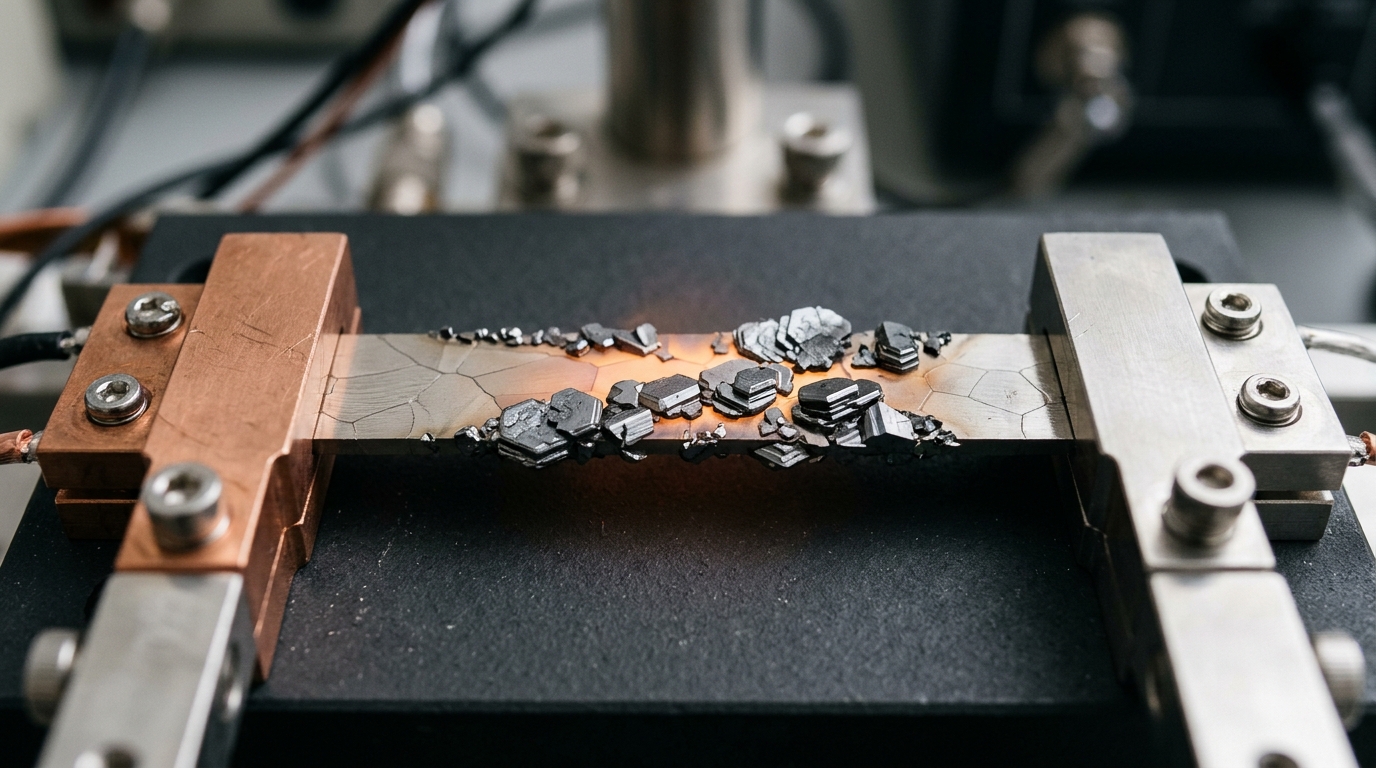
The team established an experimental setup utilizing symmetric Joule heating around a carbon source positioned at the center of cobalt and nickel bars. Direct current was applied continuously for 50 hours, prompting carbon atoms to migrate predominantly toward the negative electrode, or cathode. The directed transport caused graphite deposits to precipitate approximately 8 to 10 millimeters away from the original central source location. Corresponding author and Senior Research Fellow Seong Won Kyung noted that the experimental architecture was essential for isolating the effect, explaining that because the metal bar was heated symmetrically around the carbon source, thermal diffusion alone would have distributed carbon toward both ends equally, whereas preferential accumulation at the cathode verified that the electric current directed the atomic transport.
To confirm that continuous directional current was specifically responsible for moving the atoms over macroscopic distances, the researchers conducted comparative control experiments using alternating current under equivalent heating conditions. While direct current generated substantial deposits on the cathode side, alternating current produced only thin carbon accumulations confined close to the initial central source. Cross-sectional examinations revealed that the thickest graphite layers obtained under direct current were approximately 300 to 450 times thicker than those formed under alternating current. First author Alisher Sultangaziyev observed that because alternating current continually reverses direction while thermal conditions remain elevated, the absence of thick graphite deposits far from the source supported the necessity of sustained directional transport.
Diagnostic measurements confirmed that carbon accumulated within the bulk metal itself before precipitating, validating that transport proceeded through the internal interstitial sites of the solid crystalline lattice. Following this confirmation, the researchers evaluated whether the electrical bias exerted a differential effect on carbon’s two stable isotopes, carbon-12 and carbon-13. Although both isotopes possess identical chemical properties and proton counts, their single-neutron difference in mass influences atomic migration velocity through crystalline networks. The team prepared six starting carbon sources exhibiting varied isotopic proportions, ranging from natural isotopic abundance up to approximately 88 atomic percent carbon-13.
Across all six starting compositions and both cobalt and nickel host metals, the resulting graphite exhibited a consistent enrichment of the lighter carbon-12 isotope. The team analyzed the recovered material using complementary diagnostic methods, specifically Raman spectroscopy and time-of-flight secondary ion mass spectrometry. Co-author Dr. Yongqiang Meng confirmed that both analytical techniques independently documented the selective accumulation of carbon-12. In one nickel test utilizing a starting source of 47.4 atomic percent carbon-13, the deposited graphite contained 38.4 atomic percent carbon-13 according to Raman measurements, marking a 9.0-percentage-point increase in the carbon-12 fraction. Across the experimental series, the ratio of carbon-12 to carbon-13 in the collected graphite exceeded the starting ratios by approximately 29 percent to 62 percent.
To clarify the atomic-scale origin of this isotopic fractionation, the researchers performed atomistic calculations combined with migration simulations through the metallic lattice. The theoretical models indicated that the applied electrical bias alters the energy barriers encountered by migrating carbon atoms traveling parallel or antiparallel to the field. According to calculations, lighter carbon-12 atoms hop between interstitial lattice positions approximately 4 percent faster than carbon-13 atoms. As explained by Dr. Kim Yongchul, although this kinetic hopping disparity is minor for individual atomic steps, repeated movements over extended transport paths accumulate into a distinct shift in isotopic composition by the time atoms reach the deposition boundary.
While the computational simulations reproduced the direction of isotopic enrichment and closely matched experimental values for carbon with natural isotope abundance, the model underestimated the magnitude of enrichment observed in starting materials with high carbon-13 concentrations. This discrepancy indicates that differential hopping rates during lattice migration do not fully account for the observed separation, suggesting that additional, unaccounted processes occurring during carbon collection and phase precipitation influence final isotope ratios. Additional research will be required to resolve how transport dynamics interface with phase nucleation and growth at the precipitation front.
The study also verified that altering the isotopic composition directly altered the physical performance of the harvested graphite. In graphite, heat propagates efficiently along the basal planes of its layered crystalline structure via phonons, which are collective atomic lattice vibrations. When carbon-12 and carbon-13 isotopes coexist, the mass disparity scatters these vibrational waves and impairs thermal conductance. Using frequency-domain thermoreflectance, the authors measured the thermal conductivity of graphite recovered from nickel bars. Material derived from natural carbon abundance exhibited an in-plane thermal conductivity of approximately 2,003 watts per meter per kelvin, which dropped by about 13 percent to approximately 1,750 watts per meter per kelvin at intermediate isotopic mixtures before partially recovering to approximately 1,814 watts per meter per kelvin at the highest carbon-13 concentration.
In contrast, thermal conductivity measured perpendicular to the graphite planes demonstrated minimal sensitivity to isotopic variation. Professor Liyuan Zhang noted that the reduction in conductivity at intermediate compositions aligns with phonon scattering across mixed atomic masses, particularly along the layered planes. To verify that structural imperfections did not cause these variations, Dr. Lee Sun Hwa evaluated the samples via Raman spectroscopy and X-ray diffraction, which revealed consistent structural quality across all isotope ratios without systematic defect patterns. Looking ahead, CMCM Director Rodney S. Ruoff emphasized that electromigration could potentially be extended beyond carbon to control other mobile interstitial species, including hydrogen, nitrogen, or boron across diverse conductive hosts, offering a new experimental platform for basic solid-state materials science.
The experimental confirmation that direct electric current can direct atomic transport through solid metals marks a conceptual shift in how electromigration is viewed within materials science. Rather than treating atomic displacement purely as an engineering defect that causes microcircuit connections to degrade over time, the findings demonstrate that electromigration can be purposefully applied as an electrical control mechanism to synthesize structured carbon materials at targeted positions. By coupling directional electrical bias with controlled thermal gradients across cobalt and nickel bars, the researchers achieved spatially defined graphite precipitation while simultaneously altering the isotopic ratios of the resulting crystalline lattices.
The underlying transport dynamics and isotope fractionation observed during the experiments also introduce new questions regarding solid-state diffusion and phase transformation kinetics. While computational modeling confirmed that lower migration energy barriers enable lighter carbon-12 atoms to hop through metal interstitial sites faster than carbon-13 atoms, the underestimation of isotope enrichment at higher carbon-13 concentrations indicates that lattice migration rates alone cannot explain the complete separation effect. Additional physical phenomena occurring as carbon atoms accumulate, nucleate, and precipitate out of the metal host may exert a stronger influence on final isotopic proportions than current diffusion models predict.
Looking beyond carbon synthesis, the research team highlighted that similar electrically biased transport strategies could be explored using other mobile interstitial elements, including hydrogen, nitrogen, or boron, within various metallic or conducting host structures. Future experimental efforts will need to identify compatible combinations of mobile species and host matrices, while clarifying how atomic transport interacts with phase growth under sustained electrical fields. Investigating these coupled processes may broaden basic scientific understanding of atomic mobility in solid crystalline hosts and expand experimental approaches for tuning isotopic composition and thermal performance in synthesized solids.
Subject of Research: Current-directed carbon transport and isotope enrichment in solid metals
Article Title: From broken circuits to growing graphite: A new role for electromigration
Article References: From broken circuits to growing graphite: A new role for electromigration. Original publication (Bibliographic details unavailable.)
Image Credits: AI Generated
DOI: Not provided
Keywords: electromigration, carbon transport, graphite growth, carbon isotopes, carbon-12 enrichment, carbon-13, thermal conductivity, cobalt, nickel, interstitial migration, Joule heating, Raman spectroscopy, time-of-flight secondary ion mass spectrometry, frequency-domain thermoreflectance, X-ray diffraction, phonon scattering, Center for Multidimensional Carbon Materials, Institute for Basic Science
News Source: Bethany Barker. (November 19, 2026). Direct Electric Current Guides Carbon Through Solid Metals to Grow Graphite. Scienmag.