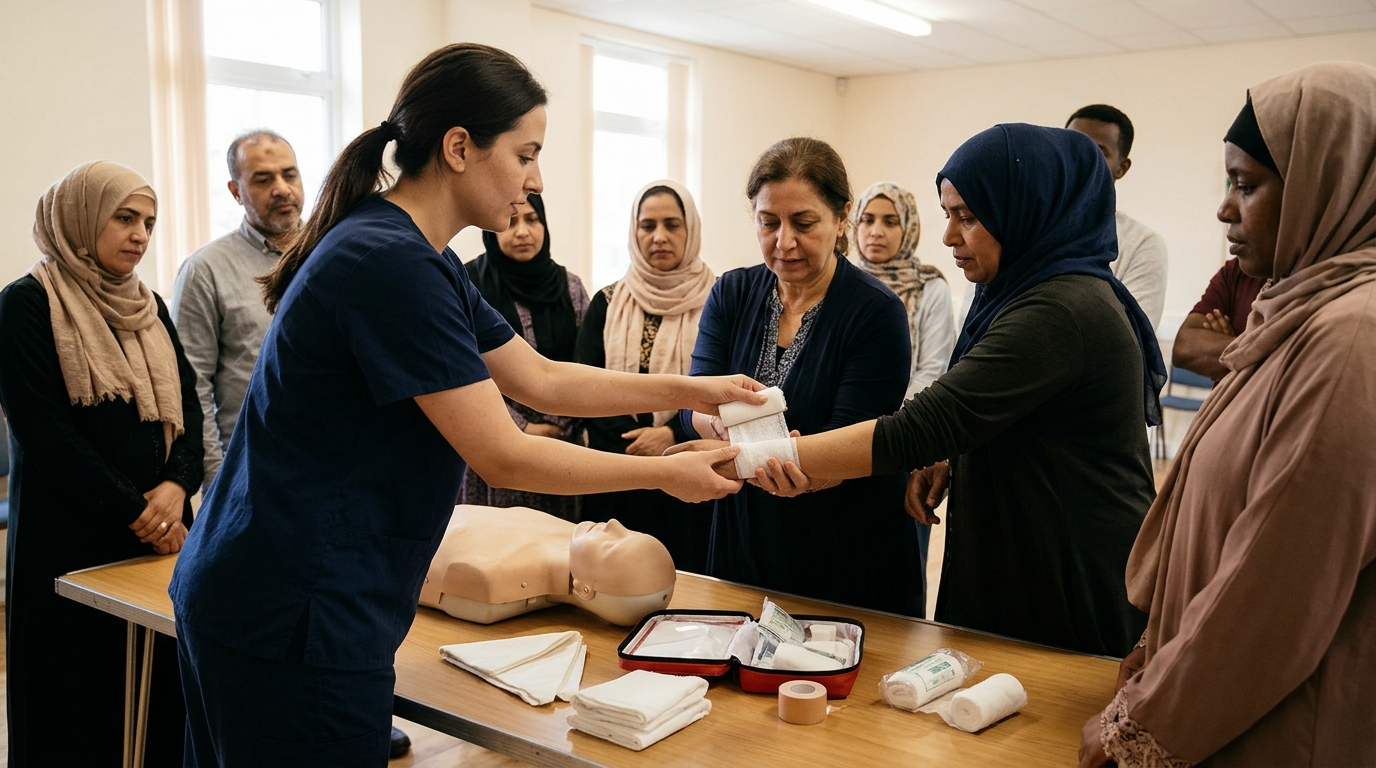
A cross-sectional investigation among pilgrims in Madinah during Hajj has demonstrated that prior first-aid instruction is strongly associated with higher emergency medical knowledge, even after controlling for key sociodemographic factors. Published in Frontiers in Public Health, the study evaluated participants across ten emergency domains and identified substantial knowledge deficits in fundamental life-saving procedures, particularly cardiopulmonary resuscitation awareness and local emergency number recognition. While participants who had previously completed formal first-aid instruction achieved an average knowledge score of 84.19 percent, untrained respondents achieved an average of only 43.62 percent, highlighting a profound divergence in basic preparatory understanding. Furthermore, multivariable statistical modeling confirmed that previous training remained associated with an adjusted advantage of more than thirty percentage points on the standardized knowledge assessment. Given the extreme crowd densities and logistical obstacles inherent to mass religious gatherings, the researchers emphasized that improving baseline pilgrim knowledge represents an important early layer of prehospital response.
The Hajj pilgrimage to Makkah in Saudi Arabia constitutes one of the largest recurrent religious mass gatherings worldwide, routinely drawing millions of worshippers from diverse global backgrounds. Performing the physically demanding rituals entails prolonged walking, intense pedestrian congestion, and severe environmental heat, exposing pilgrims to substantial health threats including acute cardiovascular conditions, severe heatstroke, musculoskeletal trauma, and communicable respiratory infections. In such compressed operational settings, municipal emergency medical services encounter formidable physical obstacles to rapid ambulance dispatch, meaning professional medical personnel may experience delays in reaching the scene of an acute crisis. Published clinical literature from previous pilgrimages has documented poor survival outcomes following out-of-hospital cardiac arrest when basic resuscitation is delayed. Under these circumstances, surrounding pilgrims frequently serve as immediate lay responders whose ability to recognize acute medical deterioration, contact emergency authorities, and initiate safe preliminary assistance before specialized healthcare providers arrive is critical to preserving human life.
To evaluate baseline competency and identify specific educational deficits among attendees, an analytical cross-sectional survey was carried out between May 26 and July 6, 2025, across prominent gathering locations in Madinah. The research team implemented a bilingual electronic questionnaire presented simultaneously in Arabic and English, allowing adult pilgrims aged eighteen or older to participate voluntarily by scanning an on-site quick-response code on their mobile smartphones. The protocol received ethical clearance from the Institutional Review Board of King Salman bin Abdulaziz Medical City, and all participants provided electronic informed consent. Before data collection commenced, investigators calculated a target sample size of 384 participants based on an anticipated population of two million pilgrims, a ninety-five percent confidence level, and a five percent margin of error. Although the final analytic sample comprised 286 respondents—yielding an achieved precision of approximately plus or minus 5.8 percent—the sample excluded a preliminary fifteen-participant pilot study deployed to confirm electronic functionality and question clarity.
The demographic profile of the 286 participating pilgrims reflected substantial representation across diverse age brackets and educational backgrounds, alongside notable gender and pilgrimage experience distributions. Female respondents accounted for 71.7 percent of the cohort, comprising 205 individuals, while male respondents represented 28.3 percent with 81 individuals. Approximately three-quarters of the sample, or 76.2 percent, reported performing Hajj for the first time, whereas 23.8 percent had prior pilgrimage experience. The age distribution was led by individuals aged 50 to 60 years at 25.9 percent, followed by young adults aged 18 to 30 years at 24.1 percent, those aged 40 to 50 years at 19.2 percent, and those aged 30 to 40 years at 16.4 percent, with participants aged 60 and older comprising 14.3 percent. Regarding educational attainment, 39.9 percent held university degrees, 29.0 percent completed secondary schooling, 12.6 percent had primary education, 8.0 percent held postgraduate degrees, and 10.5 percent reported no formal schooling. Crucially, only 30.1 percent reported prior first-aid training.
The primary assessment instrument incorporated ten dichotomous knowledge questions spanning essential prehospital care topics, including scene safety, incorrect intervention risks, bleeding control, heat illness, burns, heart attacks, unconscious patients, fractures, emergency telephone numbers, and cardiopulmonary resuscitation awareness. Correct responses were assigned one point while incorrect or “I do not know” answers received zero points, generating a cumulative score ranging from zero to ten that was converted into an overall percentage. The ten-item scale demonstrated acceptable internal consistency with a Kuder-Richardson Formula 20 coefficient of 0.82 across the sample. Overall, the mean knowledge score achieved across all 286 participants was 5.60 out of 10, or 56.01 percent, with a standard deviation of 2.89. Performance varied widely across specific subject areas: participants demonstrated relatively high awareness regarding scene safety, where 86.7 percent answered correctly, and the potential harm caused by incorrect first aid, where 83.2 percent responded accurately. In addition, 62.6 percent correctly addressed heat-related emergencies and 62.2 percent properly answered minor-burn management.
In stark contrast to general safety awareness, severe knowledge deficits emerged in critical life-support domains requiring prompt, technical intervention. The lowest proportion of correct answers was recorded for cardiopulmonary resuscitation awareness, where only 39.5 percent of respondents answered correctly, alongside 31.5 percent incorrect answers and 29.0 percent indicating they did not know. Similarly, only 39.9 percent correctly identified the official national emergency dispatch contact number, with 35.7 percent answering incorrectly and 24.5 percent admitting lack of knowledge. Proper protocol for handling an unconscious individual was understood by only 40.6 percent, while 39.9 percent endorsed moving the person immediately and 19.6 percent remained unsure. Fracture management knowledge was also constrained, achieving just 42.7 percent accuracy, with 30.8 percent stating they did not know the correct approach. Even for common clinical crises, knowledge was modest: exactly 51.4 percent answered correctly regarding bleeding control and heart attack symptoms, with 26.2 percent and 18.9 percent selecting “I do not know” for heart attacks and bleeding, respectively.
Bivariate comparisons demonstrated striking gaps between subgroups, which were subsequently interrogated using multivariable linear regression featuring HC3 robust standard errors across 285 complete cases. In unadjusted comparisons, respondents who had previously completed first-aid training achieved a mean score of 84.19 percent compared to only 43.62 percent among untrained respondents, representing a raw mean difference of 40.57 percentage points. In the adjusted regression model, which explained 59.1 percent of total variance (R-squared = 0.591; adjusted R-squared = 0.574), previous training remained an independent, robust predictor, conferring a 30.03-percentage-point advantage (95% confidence interval, 24.33 to 35.72; p < 0.001). To evaluate model stability given the bounded nature of percentage scores, the researchers executed a fractional-logit sensitivity analysis with robust covariance, which similarly yielded strong positive associations between prior instruction and higher knowledge odds (odds ratio = 4.52, 95% confidence interval, 3.39 to 6.03; p < 0.001).
Beyond formal first-aid instruction, the multivariable regression model identified several additional demographic and experiential factors independently associated with higher first-aid knowledge scores. Education emerged as a powerful determinant: relative to respondents reporting no formal education, holding a postgraduate degree was associated with a 40.29-percentage-point increase, university education with a 41.19-percentage-point increase, secondary education with a 28.65-percentage-point increase, and primary schooling with a 16.93-percentage-point increase, all reaching statistical significance. Repeat pilgrimage experience was also positively associated with knowledge, contributing an adjusted increase of 7.66 percentage points over first-time attendees (95% confidence interval, 2.25 to 13.07; p = 0.006). Female gender exhibited a modest positive association, showing an adjusted advantage of 6.23 percentage points over male participants (p = 0.022). While unadjusted analyses indicated that younger cohorts scored significantly higher than older adults, age group differences became statistically non-significant in the multivariable model, indicating that crude age-related disparities were largely confounded by differences in formal education and other baseline characteristics.
The investigation also evaluated seven unique self-reported preparedness behaviors and gathered qualitative perspectives from all 286 participants through open-ended inquiries. Regarding individual preparedness habits, carrying a basic first-aid kit was the least practiced behavior, with 59.4 percent stating they never carried one, 21.0 percent carrying one sometimes, and only 19.6 percent always carrying a kit. Conversely, 80.4 percent reported always notifying authorities during an emergency, 76.6 percent reported maintaining hygiene when assisting, and 64.7 percent claimed awareness of their nearest medical facility. In open-ended narratives regarding frequent emergencies witnessed during pilgrimage rituals, participants most commonly cited heat-related illnesses (39.5 percent), acute cardiovascular or metabolic conditions (26.6 percent), and episodes of fainting, dizziness, or loss of consciousness (18.9 percent). When asked how first-aid preparedness should be reinforced, 47.9 percent recommended practical training courses, 15.0 percent suggested digital educational materials, and 7.7 percent proposed mandatory pre-travel training. Furthermore, 81.8 percent of all participants explicitly expressed personal willingness to attend future short first-aid courses.
Despite the compelling statistical associations, the study authors outlined several essential methodological constraints that caution against drawing overextended or causal conclusions from the survey data. Because the research employed a cross-sectional design and voluntary convenience sampling in Madinah, observed correlations cannot establish that training caused superior knowledge, nor can the findings be uncritically generalized to all global pilgrims. The reliance on an electronic bilingual questionnaire presented only in Arabic and English excluded pilgrims unable to comprehend either language and may have introduced selection bias toward more digitally literate individuals. Additionally, the final sample of 286 fell below the calculated 384-participant threshold, and response rates could not be tracked because approaching counts and non-completions were unrecorded. Crucially, the authors emphasized that written multiple-choice knowledge scores and self-reported behavioral answers do not demonstrate observed psychomotor competence, clinical proficiency, or retention in real-world crises. Consequently, they concluded that future prospective studies must objectively evaluate hands-on instructional interventions, standardized practical performance metrics, and longitudinal skill retention before mandating large-scale training programs.
Subject of Research: First-aid knowledge and emergency preparedness among Hajj pilgrims in Saudi Arabia
Article Title: Previous first-aid training and self-reported preparedness among hajj pilgrims: a bilingual cross-sectional survey in Madinah, Saudi Arabia
Article References: Alahmadi, H. A., Albashir, M. H., Badawy, A. I., Mohammedsaeed, W., Mohamed, A. F., Serebal, A. A. A., Mohamed, E. H. E., Al-Za’areer, M. S., Asma, M. H., Yousif, A. I. A., Abdalhamid, R. S., Elhaj, H. A. A., & Alkhaibari, M. O. S. (2026). Previous first-aid training and self-reported preparedness among hajj pilgrims: a bilingual cross-sectional survey in Madinah, Saudi Arabia. Frontiers in Public Health, 14, Article 1989163. https://doi.org/10.3389/fpubh.2026.1989163
Image Credits: AI Generated
DOI: 10.3389/fpubh.2026.1989163
Keywords: Hajj, first-aid training, emergency preparedness, mass gatherings, cardiopulmonary resuscitation, Madinah, Saudi Arabia, public health education, heat-related illness, bystander intervention, health literacy, cross-sectional survey, emergency medical services, bleeding control, fracture management, prehospital care
News Source: Ophelia Keating. (November 19, 2026). First-Aid Training Linked to Higher Emergency Knowledge Among Hajj Pilgrims. Scienmag.