Artificial intelligence research in orthopedics has expanded rapidly, yet a substantial divide persists between technical algorithm development and routine clinical translation, according to a narrative review published in Knee Surgery & Related Research. The authors evaluate the current state of orthopedic computational tools, observing that the academic literature has experienced exponential publication growth while bedside implementation remains constrained. Although technical demonstrations across radiological detection, surgical risk calculation, and narrative documentation continue to proliferate, clinical adoption is frequently hindered by algorithmic opacity, performance degradation across unfamiliar healthcare environments, and poor compatibility with daily surgical and outpatient workflows. Consequently, the review contends that progress within the specialty must transition from developing increasingly complex models toward establishing rigorous evaluation frameworks, prioritizing independent external validation, probability calibration, and implementation science over retrospective benchmark performance.
The underlying data ecosystem supporting orthopedic artificial intelligence is founded upon three converging operational pillars routinely generated during surgical and clinical care. The first pillar comprises structured clinical information archived within electronic medical records and administrative databases, capturing patient demographics, comorbidities, laboratory indices, prescribed medications, and procedural coding. These standardized tabular inputs serve as the principal foundation for machine learning algorithms designed to stratify longitudinal outcomes and perioperative risks, including postarthroplasty blood transfusion requirements and thirty-day hospital readmissions. The second pillar relies on high-resolution imaging data housed in Picture Archiving and Communication Systems, where plain radiographs, computed tomography scans, and magnetic resonance imaging studies are archived as Digital Imaging and Communications in Medicine files. The third pillar involves textual documentation, such as operative reports, clinic letters, and discharge summaries, which modern natural language processing models process to extract structured variables.
Orthopedic computational research organizes these heterogeneous data streams across three distinct modeling paradigms, each tailored to specific data structures and operational constraints. Classical machine learning methods, including regularized logistic regression, decision trees, random forests, and gradient-boosted machines such as extreme gradient boosting, learn predictive patterns from tabular electronic medical record variables. Conversely, deep learning models based on multilayer neural networks and convolutional neural networks dominate image-centric tasks, processing raw pixel matrices to detect fractures, grade osteoarthritis severity, and measure anatomical alignment. Large language models and transformer architectures represent the third paradigm, designed to handle linguistic corpora, summarize longitudinal clinical documentation, and support supervised communication.
Among these paradigms, perioperative outcome prediction represents one of the domains nearest to clinical implementation when models are deployed as calibrated calculators rather than autonomous decision-makers. In an illustrative investigation evaluated within the review, Jo and colleagues engineered a machine learning model to estimate blood transfusion risk following arthroplasty using Korean national health insurance records paired with single-center electronic medical records. Their model achieved an internal area under the receiver operating characteristic curve of 0.842 and maintained an external area under the curve of 0.880 across an independent cohort, outperforming conventional risk assessment methods. Similarly, Gould and colleagues examined Australian arthroplasty registry and administrative databases to predict thirty-day readmission, demonstrating that even when discriminative performance is modest, well-calibrated probabilistic estimates provide actionable utility for post-discharge planning when interpreted alongside clinician judgment.
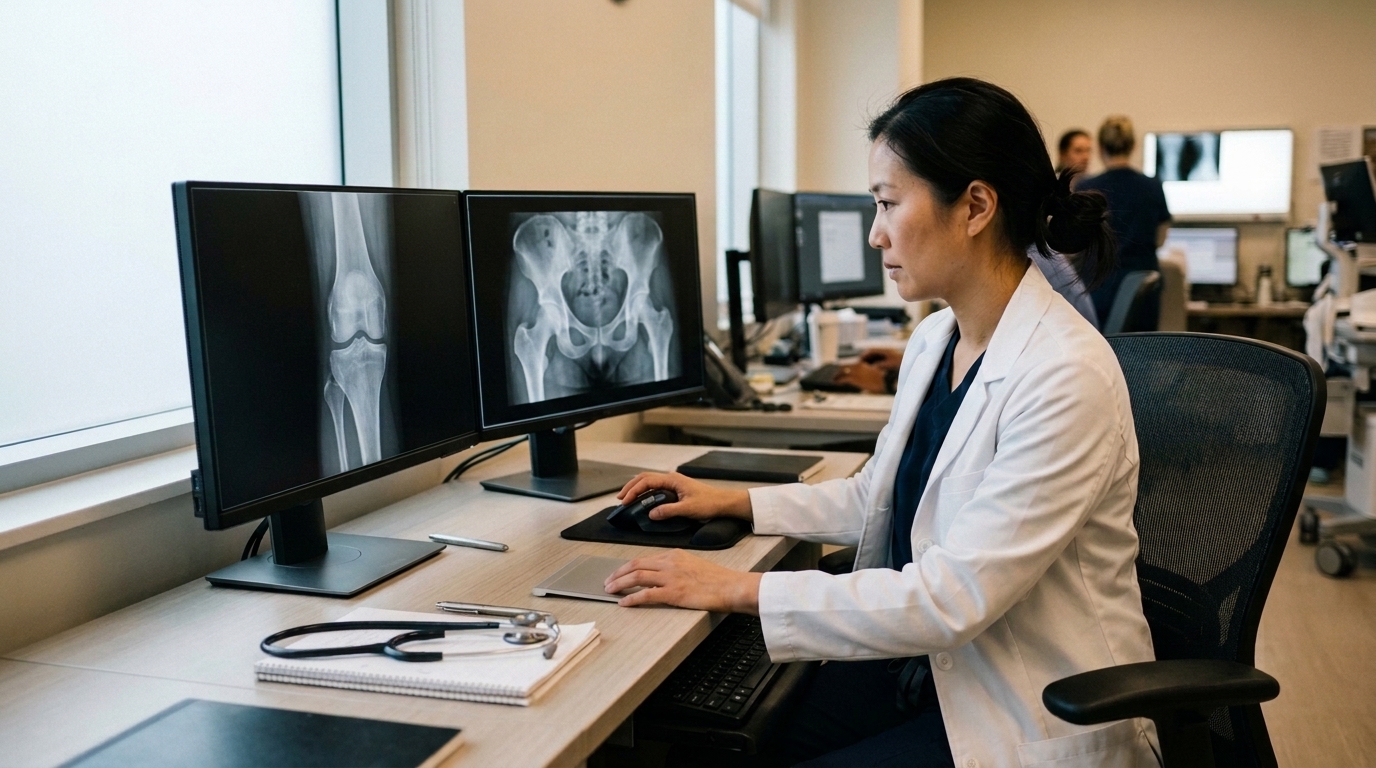
Musculoskeletal image analysis stands as a second highly mature domain, driven by the vast availability of archived Picture Archiving and Communication Systems data and the perceptual capabilities of convolutional neural networks. Automated radiographic evaluation has also been targeted toward osteoarthritis phenotyping, specifically addressing inter-reader variability in Kellgren–Lawrence grading. Researchers such as Ko and colleagues developed decision logic that maps standardized Osteoarthritis Research Society International features, including joint-space narrowing and medial or lateral osteophyte scores, directly to composite Kellgren–Lawrence grades. Furthermore, deep learning pipelines have been externally validated for complex anatomical measurements, such as posterior tibial slope and coronal plane alignment of the knee, illustrating how automated anatomical phenotyping can scale across national populations.
In contrast to structured predictive algorithms and convolutional imaging networks, large language models remain at an earlier experimental stage within orthopedic surgery. Modern clinical natural language processing builds upon foundational bidirectional transformer pretraining, enabling conversational systems to conduct structured history-taking and facilitate diagnostic discussions under experimental conditions. However, evaluations focused specifically on orthopedic knowledge reveal that while general-purpose models can achieve moderate accuracy on board-style examination questions, they continue to produce inconsistent, confident errors and demonstrate marked sensitivity to prompting variations. In addition, real-world deployment faces significant safety risks, including algorithmic hallucinations, data privacy concerns, and vulnerabilities to prompt-injection manipulations. These technical limitations dictate that language models currently function best as supervised copilots for low-risk administrative workflows, documentation drafting, and narrative data extraction rather than independent diagnostic engines.
A critical barrier confronting orthopedic artificial intelligence is domain shift, wherein models trained on single-institution datasets suffer performance degradation when deployed across external clinical environments. Variations in patient demographics, local surgical case-mix, administrative coding practices, and imaging acquisition hardware routinely compromise generalizability. The authors stress that internal validation techniques, such as cross-validation or random patient-level splits, are insufficient to justify clinical deployment. External validation across independent healthcare institutions, distinct time periods, and heterogeneous scanner vendors represents an indispensable prerequisite. Furthermore, model evaluations must look beyond standard discriminative metrics like sensitivity, specificity, and area under the receiver operating characteristic curve to incorporate probability calibration assessments. Proper scoring metrics, such as the Brier score, and calibration plots verify whether a calculated numerical risk correspond accurately to real-world event frequencies, preventing clinical mismanagement caused by miscalibrated risk estimation.
Addressing the pervasive opacity of deep learning architectures requires integrating explainability frameworks and transparent uncertainty quantification into clinical decision-support systems. Because surgical procedures, joint reconstructions, and implant selections are inherently difficult to reverse, clinicians require intelligible rationales behind algorithmic recommendations. In image analysis, techniques such as gradient-weighted class activation mapping provide visual saliency, while stepwise chain-of-thought rationales trace intermediate radiographic cues—such as joint-space narrowing and osteophyte formation—prior to assigning final disease classifications. Alongside explainability, decision-curve analysis allows researchers to assess the net clinical benefit of acting upon model predictions across diverse clinical threshold probabilities. Establishing transparent operational boundaries ensures that attending surgeons and surgical trainees recognize when an algorithm is extrapolating beyond its intended distribution or failing to provide reliable predictions.
The successful translation of orthopedic algorithms is fundamentally tied to workflow integration, user-centered design, and implementation science. Accurate predictive models frequently fail to achieve clinical adoption when they introduce excessive cognitive friction, disrupt established documentation habits, or lack interoperability with existing electronic health records and imaging systems. To mitigate these disruptions, clinical translation should adopt staged rollout pathways, commencing with silent-mode deployments where algorithms run in the background to benchmark local performance, quantify calibration, and detect data drift without interfering with direct patient care. Moreover, investigators must monitor process-oriented metrics, such as documentation time, interface edit burden, inter-provider handoff quality, and reliance patterns, ensuring that automated decision support does not inadvertently induce clinician fatigue or dangerous automation bias.
Long-term clinical reliability ultimately depends on establishing comprehensive life-cycle governance, ethical oversight, and multimodal data convergence. Emerging healthcare frameworks, such as the CONSORT-AI reporting standards and DECIDE-AI guidelines, outline stringent requirements for documenting human-AI interaction, pre-specifying clinical endpoints, and maintaining version control across software updates. Rigorous subgroup audits are essential to detect and correct algorithmic biases that could exacerbate disparities in musculoskeletal care delivery. Looking toward future developments, the integration of structured electronic medical records, imaging phenotypes, and continuous intraoperative biosignals into multimodal digital twin architectures holds promise for modeling patient-specific surgical trajectories. Realizing these advanced capabilities, however, requires that the orthopedic specialty prioritize algorithmic transparency, prospective real-world net benefit, and ongoing clinical accountability over raw computational novelty.
Subject of Research: Clinical translation, validation standards, and workflow integration challenges of artificial intelligence in orthopedic surgery
Article Title: Artificial intelligence in orthopedics: current applications, challenges, and future directions
Article References: Kim, S. Y., Choi, B. S., Han, H.-S., & Ro, D. H. (2026). Artificial intelligence in orthopedics: current applications, challenges, and future directions. Knee Surgery & Related Research, 38(1), Article 14. https://doi.org/10.1186/s43019-026-00317-5
Image Credits: AI Generated
DOI: 10.1186/s43019-026-00317-5
Keywords: artificial intelligence, orthopedic surgery, machine learning, deep learning, large language models, external validation, model calibration, clinical translation, radiographic imaging, Kellgren-Lawrence grading, fracture detection, perioperative risk, decision support, electronic medical records, PACS, implementation science, digital twin, clinical governance, arthroplasty, net benefit
News Source: Blake Davidson. (November 19, 2026). Orthopedic Artificial Intelligence Shifts Focus Toward External Validation and Workflow Integration. Scienmag.